Quick answer: No-Face represents loneliness and appetite shaped by the bathhouse’s greed; Chihiro helps him become calm by refusing to feed that cycle.
Who is No-Face?
No-Face is a lonely spirit who follows Chihiro into the bathhouse and becomes one of Spirited Away’s most discussed characters. He is not a conventional villain. He is more like an empty mirror: the people around him teach him what to want, how to behave, and what kind of power gets attention.
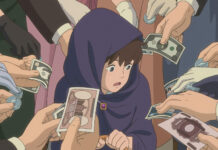
When Chihiro first lets him in, he is quiet and almost shy. Inside the bathhouse, however, he discovers that gold can make workers praise him, feed him, and obey him. His appetite grows because the environment rewards appetite. That is the key to understanding him.
What No-Face represents
No-Face represents loneliness shaped by consumer desire. He has no stable voice of his own, so he absorbs the voices and habits around him. In the bathhouse, those habits are greed, performance, and hunger. The more the workers flatter him, the more monstrous he becomes. For searchers comparing different interpretations, the safest approach is to separate what the film states directly from what it invites emotionally. Studio Ghibli rarely reduces its best moments to one locked answer; the films reward attention to behavior, setting, silence, and change over lore charts.
This is why No-Face’s rampage feels both frightening and sad. He eats because eating is the language the bathhouse understands. He offers gold because gold is what makes people look at him. Underneath the horror is a spirit who does not know how to be with others without buying them.
Why Chihiro is different
Chihiro does not treat No-Face as a customer, a monster to exploit, or a source of money. She is cautious, but she also sees his loneliness. She accepts useful help from him early on, yet refuses the gold when it matters. That refusal breaks the bathhouse pattern.
Her kindness is not naive. She gives him the bitter medicine from the river spirit, gets him out of the bathhouse, and lets him accompany her by train. In other words, she does not reward his worst behavior, but she also does not decide he is beyond saving.
Is No-Face evil?
No-Face is dangerous, but the movie does not frame him as evil in a fixed way. He is impressionable, lonely, and capable of harm when his emptiness meets greed. Chihiro’s response shows the film’s moral balance: compassion matters, but boundaries matter too. Do not feed the monster; help the lonely person leave the room that keeps making him monstrous.
Keep exploring: Start with the Studio Ghibli movies in order guide, then browse movie guides, character guides, endings explained, and rankings.
Image note: featured imagery uses official Studio Ghibli stills made available through ghibli.jp for common-sense fan/press use.
How this guide fits into a bigger Ghibli watch path
This topic also works best when it is not treated in isolation. Studio Ghibli stories often repeat ideas through different moods: a child crossing into a strange world, a home becoming safer through care, a natural place asking to be remembered, or a character learning that courage can be quiet. Reading one film alongside another helps the patterns become clearer without forcing every movie into the same timeline.
If you are new to the studio, use this guide as a doorway rather than a final answer. Watch the relevant film once for feeling, then return to specific scenes for details: how characters speak, what they refuse, when music drops away, what food or work represents, and how the landscape changes around them. Those details usually explain more than a literal lore summary.
What to notice on a rewatch
On a rewatch, pay attention to the small choices that reveal character. Ghibli often lets growth appear through posture, silence, chores, meals, travel, and the way someone treats a weaker or stranger being. A character may not announce that they have changed; the film shows it through what they are finally able to see, say, or give up.
It is also worth noticing how little the films rely on simple villains. Even frightening figures usually reflect a pressure in the world around them: greed, loneliness, war, vanity, fear, or forgetfulness. That moral complexity is one reason these stories keep attracting adult viewers as well as children.
FAQ for searchers
Is there one official interpretation?
Usually no. Studio Ghibli films give viewers strong emotional direction, but they often avoid reducing symbols to a single dictionary meaning. The best interpretation should fit the story, the character arc, and the feeling of the ending.
Is this a good entry point for new fans?
Yes. Explainer and character guides are useful for first-time viewers because they clarify what to watch for without requiring a full franchise background. Most Ghibli films stand alone, so curiosity is more important than chronology.
Why No-Face changes around different people
The most useful way to understand No-Face is to watch how quickly he absorbs the behaviour around him. Outside the bathhouse, he is quiet, hesitant, and almost blank. He notices Chihiro because she shows him basic kindness without trying to profit from him. Inside the bathhouse, he enters a workplace built around appetite, status, tips, and performance. Once the staff decide he is valuable because he can produce gold, No-Face mirrors that value system back at them in exaggerated form.
That is why the character can feel both frightening and sad. No-Face is not only tempting the bathhouse workers. He is also being taught what attention costs in that world. The more people shout, flatter, feed, and crowd around him, the less stable he becomes. His hunger grows because nobody is relating to him as a person or spirit. They are relating to him as a source of reward.
What Chihiro understands that the bathhouse misses
Chihiro’s strength is not that she has a secret explanation for No-Face. It is that she refuses to play the same game as everyone else. She accepts his presence at first, but she does not worship his gold. Later, when he becomes dangerous, she does not solve the problem by flattering him harder. She gives him medicine, creates distance, and leads him out of the bathhouse environment that has made him worse.
This is one reason No-Face remains such a memorable Ghibli character. The film does not reduce him to “greed” as a single moral label. He represents loneliness, imitation, appetite, and the way a corrupt room can shape a vulnerable person. Chihiro helps because she responds with boundaries as well as kindness. She is compassionate, but she is not impressed by the false economy around him.
Is No-Face evil?
No-Face is dangerous, but calling him evil misses the point. His worst behaviour happens when he is overstimulated, overfed, and rewarded for becoming monstrous. Once he leaves the bathhouse, he becomes quiet again. By the time he reaches Zeniba’s cottage, he can sit, help, and belong without needing to dominate the room.
That ending matters because it suggests No-Face needs the right place, not simply punishment. The bathhouse amplifies his emptiness. Zeniba’s home gives him routine, craft, and calm. Chihiro’s journey shows the difference between attention that consumes and attention that steadies. No-Face is the clearest symbol of that difference.
How No-Face connects to Spirited Away’s bigger themes
No-Face fits into a film full of names, labour, food, memory, and transformation. Chihiro survives by remembering who she is, doing real work, and learning whom to trust. No-Face struggles because he has no stable identity of his own. He borrows signals from the strongest environment around him, which makes the bathhouse especially dangerous for him.
Viewed that way, No-Face is not a side monster. He is one of the film’s clearest mirrors for Chihiro. She is also in danger of being renamed, absorbed, and trained to accept the bathhouse’s rules. The difference is that she keeps hold of enough of herself to leave. No-Face has to be led out before he can become calm enough to choose a better pattern.
FAQ: No-Face in Spirited Away
Why does No-Face follow Chihiro?
No-Face follows Chihiro because she is the first person who notices him without treating him as a tool. Her kindness gives him a point of attachment, even though he does not know how to express it safely at first.
Why does No-Face eat people?
Inside the bathhouse, eating becomes part of No-Face’s distorted attempt to gain attention, power, and connection. The more he is fed and praised for gold, the more monstrous the behaviour becomes.
Why is No-Face calmer at Zeniba’s house?
Zeniba’s cottage is quiet, practical, and non-competitive. No one crowds him for gold there, so he no longer has to perform the monstrous role the bathhouse encouraged.