Howl’s Moving Castle quick facts
- Original Japanese release: 20 November 2004
- Director and screenwriter: Hayao Miyazaki
- Based on: the novel by Diana Wynne Jones
- Running time: about 119 minutes
- Best for: romantic-fantasy viewers, older children and adults who enjoy stories driven by emotion, character and visual invention
Spoiler-free answer: Howl’s Moving Castle begins when quiet hat-maker Sophie is cursed into the body of an old woman. She leaves home, joins the household inside the wizard Howl’s walking castle and becomes entangled in a war that Howl is trying to resist. The plot behaves like a dream, but its emotional argument is clear: care, honesty and a chosen home can interrupt fear and self-destruction.
Storyline: what happens in Howl’s Moving Castle?
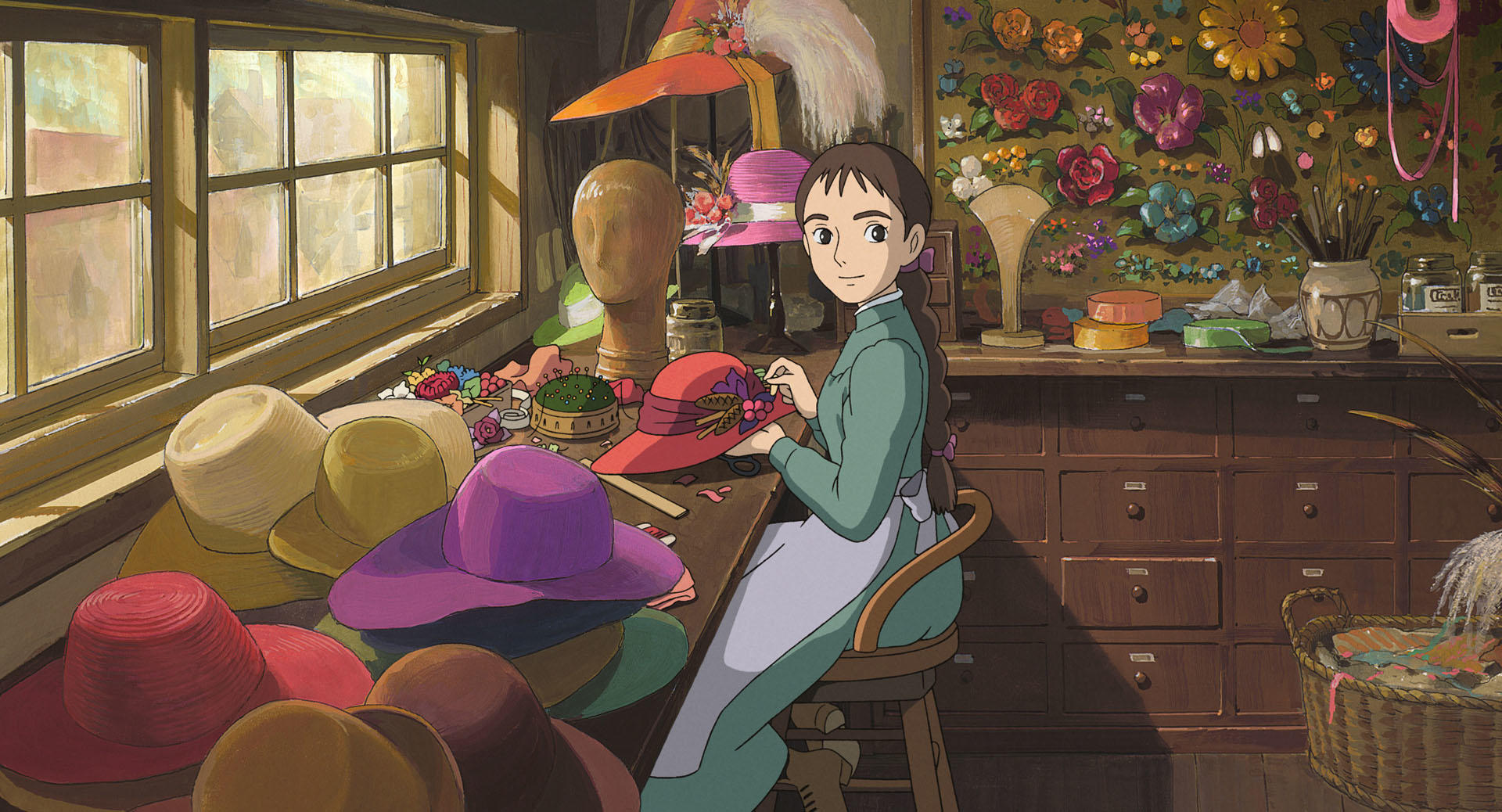
Sophie believes her life will remain small and dutiful until a glamorous wizard rescues her from threatening soldiers. The meeting draws the attention of the Witch of the Waste, who curses Sophie so that her body appears elderly. Unable to explain the spell, Sophie leaves her hat shop and crosses the hills, where a living scarecrow leads her to Howl’s impossible castle.
Inside she meets the fire demon Calcifer, the young apprentice Markl and Howl himself. Calcifer powers the castle and is bound to Howl by a contract that neither can freely explain. Sophie appoints herself cleaner and gradually turns a chaotic refuge into a home. Her age shifts with her confidence and emotional state, making the curse a visible expression of how she sees herself.
Outside, two kingdoms are at war. The royal sorcerer Madame Suliman wants Howl to serve the state, while Howl uses disguises and magical doors to avoid becoming its weapon. Each transformation into a giant bird makes returning to human form harder. Sophie must eventually connect the curse placed on her, Calcifer’s contract and a moment in Howl’s past. The resolution is less about defeating one villain than choosing to stop running from love, responsibility and vulnerability.
Main characters
Sophie Hatter
Sophie’s apparent old age frees her to speak with a confidence she previously denied herself. She is not valuable because Howl finds her beautiful; she becomes able to recognise her own value and create a household around mutual care.
Howl
Howl is talented, vain, compassionate and frightened. His resistance to war is sincere, but so is his habit of avoiding consequences. The film lets courage mean coming home as well as flying into battle.
Calcifer
Calcifer is comic relief, domestic engine and a person bound by a bargain. His connection with Howl makes the castle’s warmth inseparable from a hidden cost.
Markl, the Witch and Turnip Head
Markl shows how quickly a collection of outsiders can become family. The Witch of the Waste changes from threat to dependent member of that family, while Turnip Head’s patient help complicates the apparent enemy lines of the war.
Themes and meaning
Transformation externalises emotion. Sophie’s age, Howl’s bird form, Calcifer’s flame and the moving castle all change according to relationships and choices. Identity is flexible but not meaningless: characters become healthier when they stop performing the version of themselves that fear created.
The film is also openly anti-war. Uniforms, propaganda and magical power blur national differences until the conflict appears self-perpetuating. Miyazaki shifts the novel’s focus to make war central, but he does not turn Howl into a conventional action hero. Howl’s magic is most dangerous when institutions treat it as a resource.
Home is the counterargument. The castle begins as a defence mechanism full of clutter and false doors. Sophie’s labour turns it into a shared place, and the final version works because the people inside have chosen one another rather than because its machinery is impressive.
Age and content guidance
The movie contains wartime bombing, burning buildings, soldiers threatening Sophie, magical monsters, characters in peril and several transformations that may look frightening. Howl appears wounded and covered in dark feathers or slime. The violence is not graphic, but the war can feel more serious than the cosy castle imagery suggests.
Older primary-school children and teenagers often enjoy it, especially if they are comfortable with fantasy that does not explain every rule. Younger viewers may follow the romance and creatures while missing the political plot. Families wanting a calmer first film may start with Totoro or Kiki. For a scene-by-scene check before family viewing, use our Howl’s Moving Castle parent guide.
Production and adaptation
The film is adapted from Diana Wynne Jones’s 1986 novel. Miyazaki retains Sophie, Howl, Calcifer and the central magical contract while substantially reshaping the war, setting and character relationships. Studio Ghibli released the film in Japan in 2004, with music by Joe Hisaishi. It was later nominated for the Academy Award for Best Animated Feature.
The Japanese and English-language versions have different vocal performances but tell the same story. Neither is the single correct way to watch; subtitles preserve the original performance track, while the licensed dub can make the dense visual storytelling easier for some viewers.
Where to watch legally
Streaming homes differ by country and can change. Check our current legal streaming guide and confirm the film in your local service catalogue. Licensed Blu-ray and digital purchase or rental options may also be available. We do not name one permanent service on this page because regional rights are not permanent facts.
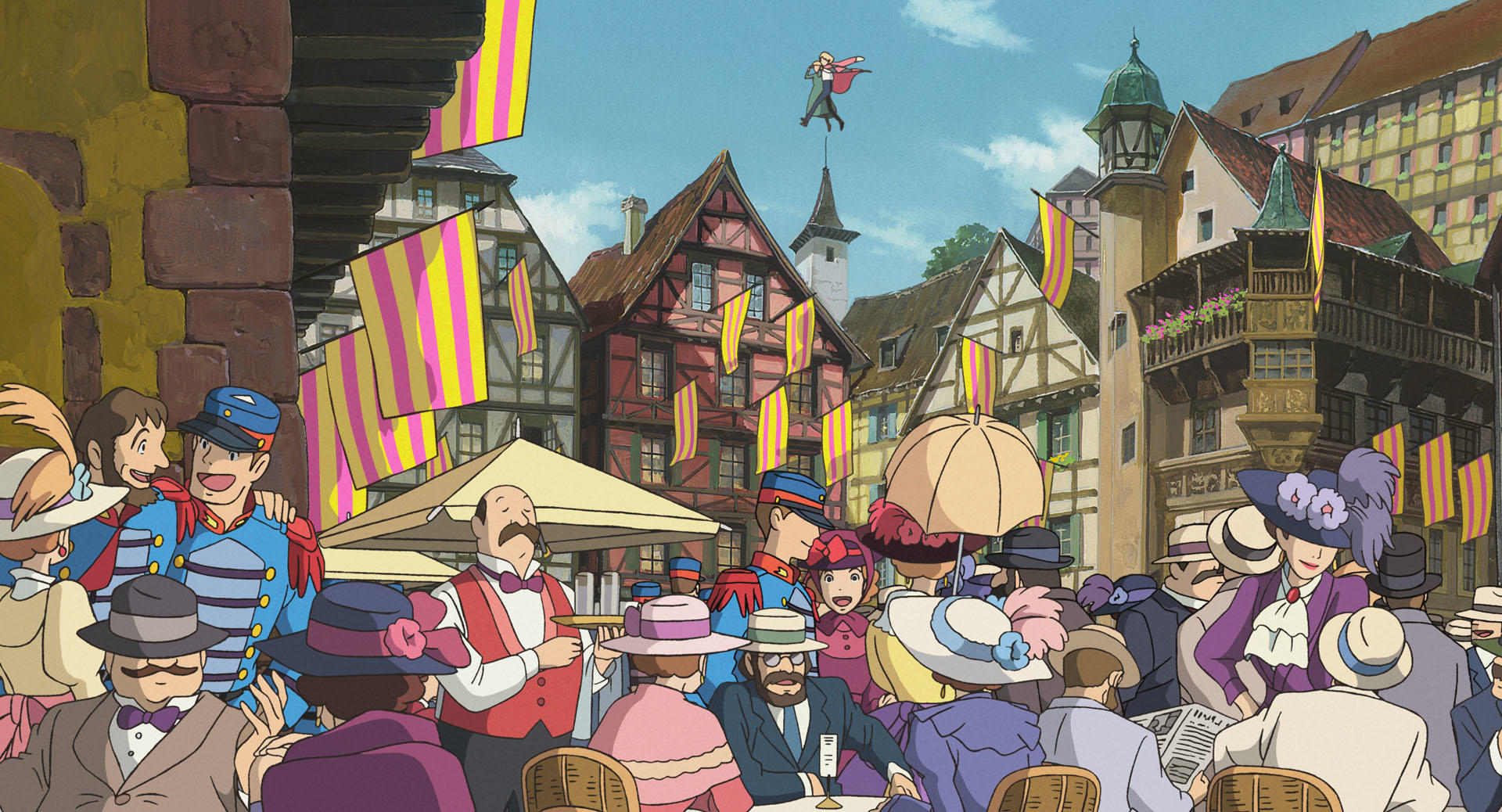
Official image gallery
Related films
Try Spirited Away for another world of contracts and changing identities, Kiki’s Delivery Service for a quieter story of confidence, or Princess Mononoke for Miyazaki’s more severe view of violence and responsibility.
Frequently asked questions
Why does Sophie keep changing age?
Her appearance tracks the curse but also her confidence, fear and self-image. The film treats the spell emotionally rather than as a fixed set of mechanical rules.
Why is Howl turning into a bird?
He transforms to interfere with the war, but every use of that power risks making the violent form permanent.
Is Howl’s Moving Castle confusing?
Some political details are intentionally compressed. Following Sophie’s relationships, Calcifer’s contract and Howl’s fear gives the story a clearer emotional route.
Is the film the same as the book?
No. It is a substantial adaptation. The novel offers different explanations and priorities, while Miyazaki makes war a central concern.
Official film stills are credited to Studio Ghibli and used under its common-sense image-use notice.