Quick answer: the ending of Ponyo is not about defeating a villain. It is about restoring balance after Ponyo chooses to become human, Sosuke proves that his love for her is steady and unconditional, and the ocean accepts that the world can settle again. The film leaves some magic unexplained on purpose, but the emotional meaning is clear: trust, care and acceptance bring the storm back into harmony.
What happens at the end of Ponyo?
Near the end of Ponyo, the world is still flooded after Ponyo’s magic has pulled the sea and moon out of balance. Sosuke and Ponyo travel through the transformed landscape to find Lisa, while the adults and elderly residents have been moved into a strange, peaceful underwater space. It looks frightening at first, but the mood is not horror. It is more like a temporary dream-world where the ocean has paused normal life until the important choice is made.
Granmamare, Ponyo’s mother, explains the condition of the spell. If Sosuke can accept Ponyo as she is, whether she is fish, human or something in between, Ponyo can become human. If he cannot, Ponyo will turn into sea foam. Sosuke does not treat this as a difficult bargain. He says he loves Ponyo in every form. That simple answer completes the emotional test, and Ponyo’s transformation becomes possible.
The storm calms, the sea returns, the people are safe, and Ponyo kisses Sosuke before becoming fully human. The ending is deliberately gentle rather than mechanical. Hayao Miyazaki is less interested in explaining every rule of the spell than in showing a child’s promise as something pure enough to settle a cosmic problem.
Why does Sosuke’s promise matter?
Sosuke’s promise matters because Ponyo is built around unconditional acceptance. He does not love Ponyo because she becomes a normal girl. He loved her as a fish, recognised her as Ponyo when she changed, and stayed loyal when the world around them became impossible. For an adult viewer, that may sound too simple. For the logic of the film, that simplicity is the point.
Many Studio Ghibli stories use children to show a kind of attention that adults have lost. Sosuke notices, protects and trusts. He does not reduce Ponyo to a problem, a danger or a possession. That is why his answer satisfies Granmamare. It proves that Ponyo’s human life would not be based on control. It would be based on being seen and accepted.
Is Fujimoto the villain?
Fujimoto can seem like the villain because he tries to take Ponyo back to the sea and keeps warning that humans are dangerous. But he is better understood as an anxious, wounded parent. He knows the ocean’s magic, he understands the imbalance Ponyo has created, and he is terrified that his daughter will be hurt by the human world.
The film does not make him completely wrong. Humans are messy, careless and often disrespectful toward nature. The opening scenes show polluted water and waste in the sea. Fujimoto’s anger comes from a real environmental concern. What changes is not that he discovers humans are perfect. It is that he sees Ponyo’s choice and Sosuke’s care as real. By the ending, he has to let go.
What does the flood mean?
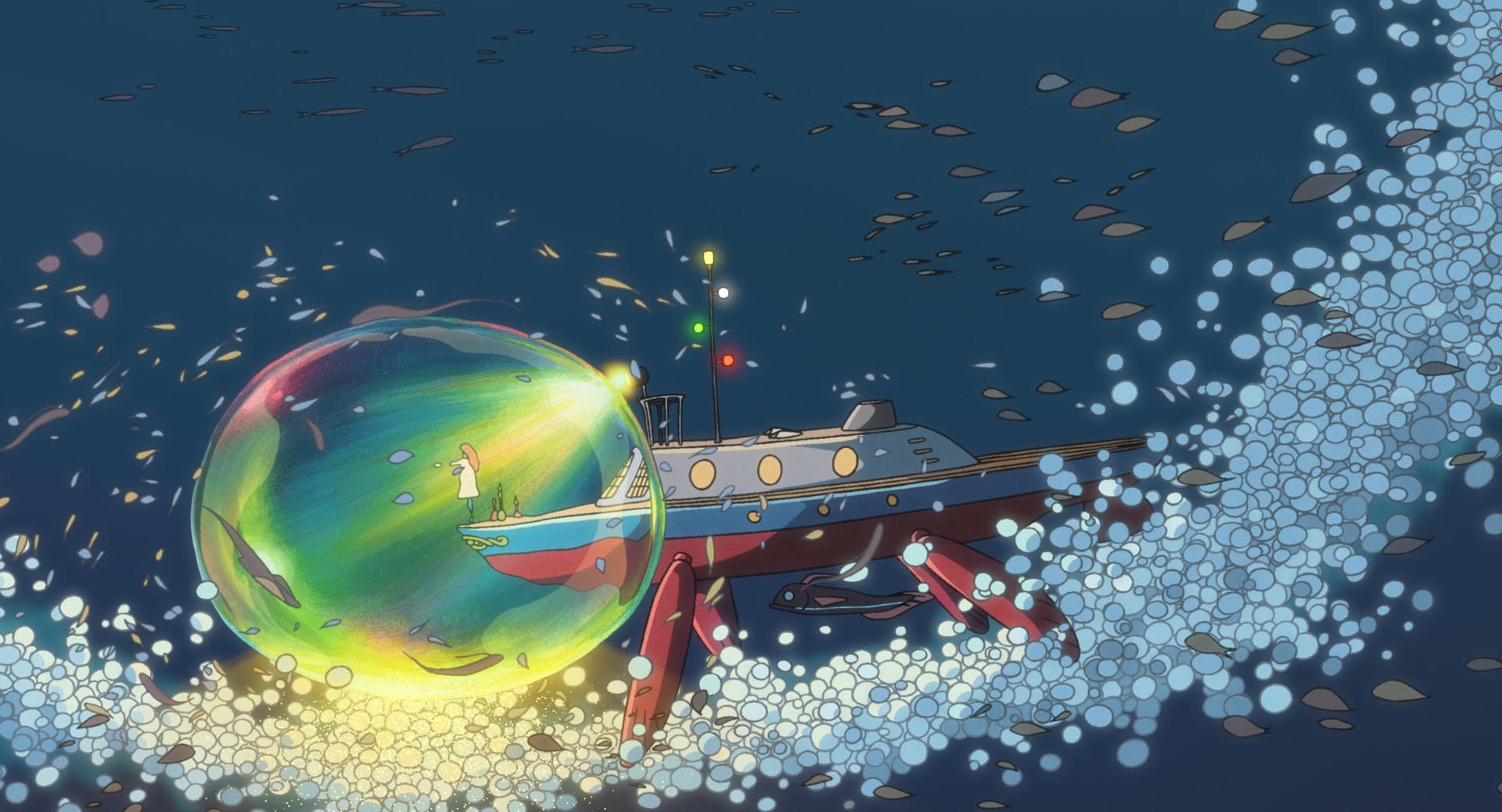
The flood works on several levels. In plot terms, it is the consequence of Ponyo using powerful magic she does not fully understand. In visual terms, it lets Miyazaki turn an ordinary coastal town into a prehistoric ocean full of ancient fish, glowing water and dreamlike movement. Symbolically, it shows nature overwhelming human routines when balance is disturbed.
This is why the ending does not feel like a standard disaster movie. The flood is dangerous, but it is also beautiful and strangely cleansing. People move through it with a sense of wonder. Children see magic where adults might only see emergency. The water makes the town unfamiliar so the characters can return to it with a changed relationship to the natural world.
Why does Ponyo become human?
Ponyo becomes human because that is what she chooses, and because her choice is accepted by the people who matter most in the story. She wants food, warmth, names, family and the ordinary physical life she sees with Sosuke. Her desire is childlike but not shallow. Becoming human means becoming vulnerable. It means losing some of the wild freedom of the sea in exchange for belonging.
That tradeoff gives the ending its bittersweet edge. Ponyo gets what she wants, but the film does not pretend that transformation costs nothing. Her parents must release her. The ocean must settle. Sosuke must keep caring for her in the ordinary world, not just during a magical adventure.
Is the ending sad?
The ending of Ponyo is mostly happy, especially compared with sadder Ghibli films such as the more mature Studio Ghibli watches. There is tension around the sea-foam condition, and Fujimoto’s goodbye carries sadness, but the film lands on reassurance. Ponyo lives, Sosuke keeps his promise, Lisa is safe, and the town survives.
The sadness is quieter: Ponyo’s childhood changes, Fujimoto has to stop holding on, and the magical ocean world retreats again. That mix of joy and loss is one reason the film stays memorable even though it is one of Ghibli’s gentlest family movies.
What is the main meaning of Ponyo?
The main meaning of Ponyo is that love and trust can restore balance, but only when they respect freedom. Sosuke does not save Ponyo by owning her. Granmamare does not protect Ponyo by trapping her. Fujimoto has to learn that fear is not the same as care. Ponyo herself must choose the life she wants.
The environmental layer matters too. The film keeps connecting personal love with the sea, weather and living creatures. When relationships are out of balance, the world becomes unstable. When the characters accept one another honestly, the world calms. It is a fairytale idea, but Miyazaki gives it enough emotional truth to work.
How this ending fits into Studio Ghibli
Ponyo is one of the best Ghibli films for viewers who want wonder before complexity. If you are deciding where it belongs in a first watch, pair this guide with our parent guide to whether Ponyo is scary for kids and the best Studio Ghibli movies for kids. For broader viewing order context, start with the beginner-friendly Studio Ghibli watch order.
As an ending, Ponyo is not trying to close every magical loophole. It is trying to leave you with a feeling: the sea is alive, childhood promises matter, and love is strongest when it says, “I know what you are, and I choose you anyway.”
FAQ
Does Ponyo die at the end?
No. Ponyo does not die. The sea-foam warning creates tension, but Sosuke accepts Ponyo fully and she becomes human.
Why does the moon get so close in Ponyo?
The moon’s closeness shows that Ponyo’s magic has disturbed the natural balance. It is a fairytale image rather than a scientific event.
Is Ponyo’s ending confusing for kids?
Most children understand the emotional version: Ponyo wants to be human, Sosuke loves her, and the storm ends. Adults are more likely to worry about the rules.
Image source note: the still used in this guide comes from Studio Ghibli’s official Ponyo works page, where official images are provided with the common-sense use notice.