Quick answer: most Studio Ghibli movies are not officially connected in one shared timeline. My Neighbor Totoro, Spirited Away, Howl’s Moving Castle, Princess Mononoke, and Castle in the Sky are best understood as separate stories with their own worlds. The fun comes from recurring ideas, visual echoes, similar spirits, flying machines, environmental themes, and fan theories rather than a Marvel-style connected universe.
Are Studio Ghibli movies in the same universe?
There is no official Studio Ghibli master timeline that places every movie into one continuous universe. The studio’s films are usually made as standalone works, often adapted from different books, manga, or original ideas. That means you do not need to watch them in a strict story order, and you do not need to understand one film to enjoy another.
That said, viewers are not imagining things when they notice connections. Ghibli films share creative fingerprints: flight, food, handmade homes, forests, old gods, lonely children, industrial machines, war, environmental damage, and small acts of kindness. These patterns can make the films feel emotionally connected even when they are not literally set in the same world.
The difference between canon connections and Ghibli echoes
A canon connection is something the filmmakers clearly establish inside the story or through official statements. A Ghibli echo is a repeated image, theme, or type of character that feels familiar across films. Most so-called Ghibli connections are echoes. They are still worth noticing, but they should not be treated as confirmed lore unless the film itself supports them.
For example, flight appears in Castle in the Sky, Kiki’s Delivery Service, Porco Rosso, Howl’s Moving Castle, and The Wind Rises. That does not mean all those aircraft and flying characters belong to one timeline. It means Hayao Miyazaki and the studio return to flight as a symbol of freedom, danger, imagination, craft, and escape.
Why fans think Totoro, Spirited Away, and other films connect
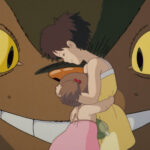
Fan theories often start because Ghibli spirits feel like they could belong to the same invisible world. Totoro, the soot sprites, river spirits, kodama, No-Face, and the Forest Spirit all suggest that ordinary places may contain older presences humans do not fully understand. That shared feeling is powerful, especially because Ghibli rarely over-explains its magic.
The strongest connection is tonal rather than factual. My Neighbor Totoro asks children to notice the countryside with patience and wonder. Spirited Away shows a spirit world shaped by work, greed, manners, and memory. Princess Mononoke makes the conflict between humans and nature violent and political. They can feel like different doors into a similar spiritual imagination, but the films do not tell us they share the same map.
Castle in the Sky and the recurring Ghibli machine world
Castle in the Sky is one of the best films to watch if you are interested in Ghibli’s repeated world-building habits. It combines ancient technology, military greed, flying ships, robot guardians, lost civilizations, and a warning about power without wisdom. Those ingredients reappear in different forms across the studio’s work.
The robot soldiers in Castle in the Sky are not proof of a shared universe, but they do show how Ghibli often treats machines with mixed feelings. Machines can be beautiful, useful, and carefully made. They can also become tools of domination. That tension returns in Howl’s Moving Castle, The Wind Rises, and even the industrial setting of Princess Mononoke.
Do any Studio Ghibli films have direct sequels?
Studio Ghibli is not built around sequels in the way many animation studios are. The closest sequel-like examples are special cases, spin-offs, or related works rather than a simple chain of numbered movie follow-ups. For a new viewer, the practical answer is simple: treat each main Ghibli feature as its own complete story.
This is one reason the studio remains easy to enter. You can start with Totoro, Kiki, Spirited Away, or Howl without worrying about missing ten films of backstory. If you want a gentle route through the catalogue, use our Studio Ghibli movies in order guide as a viewing path rather than a continuity chart.
Common fan theories, with a reality check
The shared spirit-world theory: fans imagine that Totoro, No-Face, soot sprites, kodama, and other beings could all exist in one hidden spiritual ecosystem. It is a lovely reading, but it is not officially required by the films. The safer interpretation is that Ghibli often uses spirits to show respect for places, rituals, memory, and nature.
The flying-machine timeline theory: because so many Ghibli films love aircraft, some viewers connect Porco Rosso, Castle in the Sky, Howl’s Moving Castle, and The Wind Rises. The films share design obsessions and anti-war concerns, but their worlds do not neatly line up.
The environmental mythology theory: Nausicaä, Princess Mononoke, Pom Poko, and Ponyo all explore human pressure on nature. This is one of the strongest thematic links in the catalogue, but again it works better as a recurring worldview than as a literal shared chronology.
Best connected-feeling Ghibli watch order
If you want the films to feel connected without pretending there is official continuity, try a themed mini-marathon. For spirits and childhood wonder, watch My Neighbor Totoro, Spirited Away, and Ponyo. For machines, flight, and war, watch Castle in the Sky, Porco Rosso, Howl’s Moving Castle, and The Wind Rises. For nature and conflict, watch Nausicaä of the Valley of the Wind, Princess Mononoke, and Pom Poko.
This approach gives you the pleasure of patterns without forcing the films into a continuity they were not designed to support. It also helps new viewers understand why Ghibli feels so coherent as a studio, even when the stories move between cosy realism, fairy tale, war memory, environmental fable, and surreal spirit worlds.
FAQ
Do I need to watch Studio Ghibli movies in order?
No. Most Ghibli movies are standalone. A curated watch order can help with tone and accessibility, but it is not needed for plot continuity.
Are Totoro and Spirited Away connected?
They are not officially connected as one story. They do share a sense that children can encounter hidden spiritual worlds when adults are distracted, absent, or unable to see clearly.
Is there a Studio Ghibli cinematic universe?
Not in the modern franchise sense. Studio Ghibli has recurring themes, visual motifs, and creative concerns, but not a single official cinematic universe linking all films.
Image note: this article uses an official Studio Ghibli still made available on ghibli.jp with the studio’s common-sense usage notice. This site is an independent fan guide and is not affiliated with Studio Ghibli.