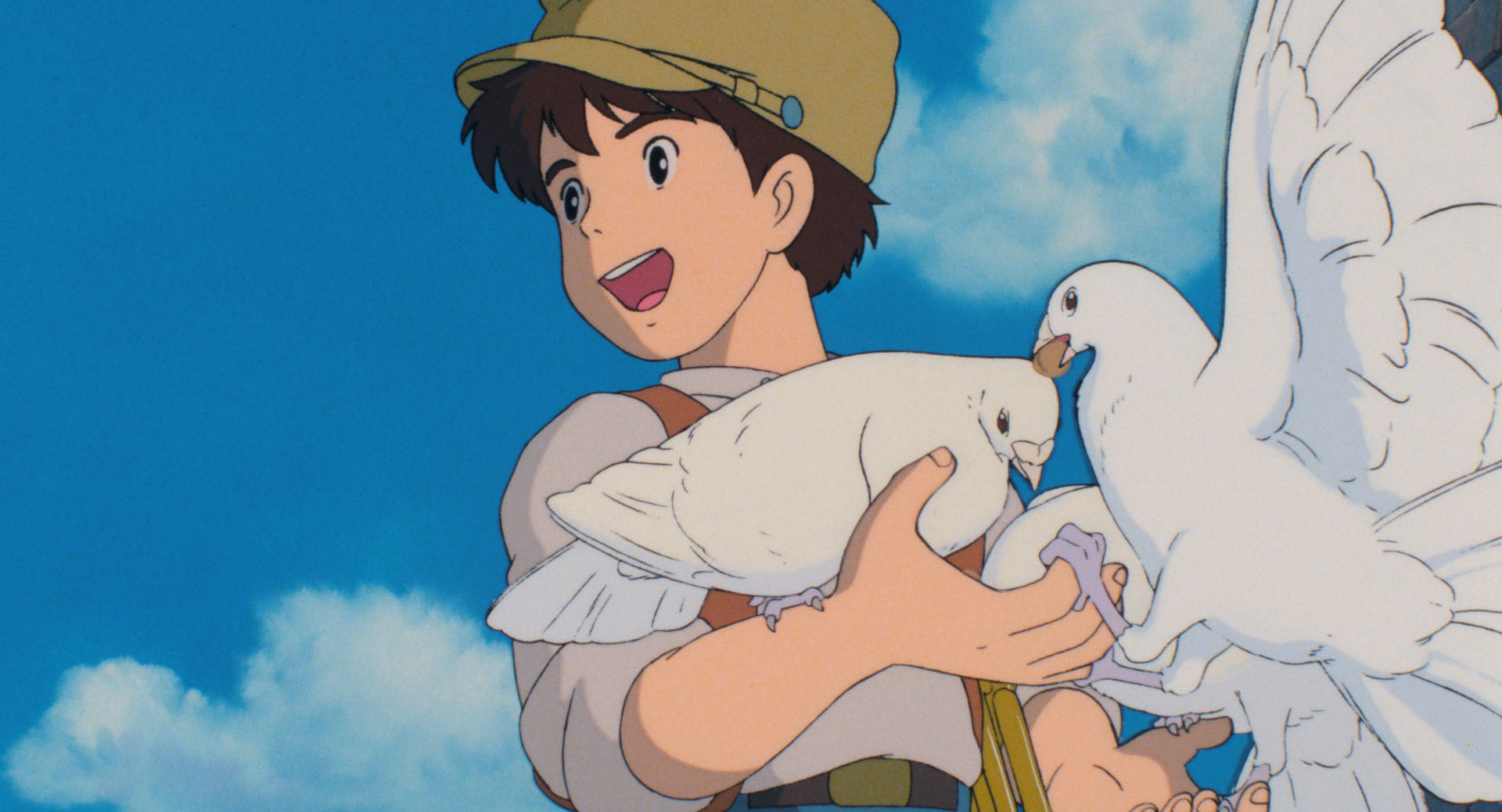
Quick answer: Castle in the Sky is exciting rather than frightening for many children aged about 7 to 9 and up, but sensitive younger viewers may find its gunfire, military pursuit, falls from height, explosions and scenes of children in danger intense. There is no graphic gore, sexual content or horror focus. The film is adventurous and ultimately hopeful, yet it is more action-heavy than My Neighbor Totoro, Ponyo or Kiki’s Delivery Service.
The best age depends less on whether a child understands the story and more on how they react to sustained peril. Sheeta and Pazu are chased, captured, shot at and separated, while a powerful weapon causes large-scale destruction. Confident family-film viewers may be comfortable from around 7. Children who dislike guns, loud explosions, threatening adults or characters nearly falling may be better waiting until 9 or 10.

Castle in the Sky parent guide at a glance
| Concern | What parents should know |
| Violence | Frequent adventure violence, gunfire, fist fights, explosions and military attacks, without graphic injury detail. |
| Scary moments | Children are kidnapped, threatened and placed in danger; robots can appear intimidating before their gentler purpose becomes clear. |
| Emotional intensity | Separation, grief for a damaged world, and adults exploiting children and nature. |
| Language and romance | No major language concern and only gentle, age-appropriate affection between the young leads. |
| Best fit | Children who enjoy adventurous fantasy and can handle sustained chase scenes and peril. |
How scary is Castle in the Sky?
Castle in the Sky is not a horror film. Its tension comes from adventure danger: pursuit, capture, weapons, heights and the fear that Laputa’s power will be used by the wrong people. The tone regularly returns to wonder, humour and friendship, so frightening moments do not dominate every scene.
What may surprise parents is how long the danger lasts. This is not a gentle film with one brief villain scene. The military and Muska continue to pursue Sheeta and Pazu through much of the story. The children are resourceful, but adults repeatedly put them in situations where they could be badly hurt. A child who is relaxed about cartoon peril may find that thrilling. A child who worries when young heroes are separated from safe adults may find it stressful.
Violence, weapons and explosions
The film contains pistols, rifles, military machinery, explosions and aerial attacks. Characters fire weapons during chases, pirates and soldiers fight, and vehicles crash or break apart. Pazu is injured during the action, although the film does not dwell on blood or wounds. Much of the violence has the fast rhythm of a classic adventure serial, but the threat is real within the story.
Laputa also contains destructive technology on a much larger scale. A demonstration of its power is one of the film’s darkest sequences because it shows how an apparently beautiful place can become a weapon. Younger viewers may focus on the spectacle. Older children are more likely to understand the moral fear behind it: knowledge without care can be used to dominate others.
Kidnapping, threats and children in danger
Sheeta is pursued because adults want access to her family history and the crystal she carries. She is captured, questioned and pressured. Pazu also faces danger while trying to help her. Muska is controlled rather than visibly monstrous, but his calm willingness to threaten children can make him more unsettling than a loud fantasy villain.
There are several moments involving heights, including falls or near-falls from aircraft and the floating city. The heroes usually have a means of escape, and the magical crystal changes how some falls play out, but children who are especially frightened by heights may still tense up. It can help to tell a nervous viewer in advance that the film keeps returning to Pazu and Sheeta working together rather than leaving them helpless.
Are the robots frightening?
The Laputian robots are large, silent and extremely powerful. Their design can look eerie when they first move, and one robot’s response to violence becomes destructive. That sequence includes fire, military panic and a sense that the situation has escaped human control.
The film later presents the robots with much more tenderness. They care for gardens, animals and the remains of Laputa. This change is important to the story: the robots are not simply monsters. Their behaviour reflects whether they are protecting life or being pulled into human conflict. Children who initially find them scary often come to see them as sad, gentle guardians.
Sad or emotionally difficult themes
The film includes loneliness, loss and the remains of a civilisation that has disappeared. Sheeta carries the burden of a family connection she does not fully understand. Pazu wants to honour his father, whose discovery was dismissed by others. Laputa itself is beautiful but abandoned, which gives the final act a melancholy feeling beneath the adventure.
These themes are not presented in a bleak way. Friendship, courage and respect for nature give the story a hopeful centre. Still, children who are sensitive to abandoned places, separated families or the destruction of animals and environments may want reassurance and a short conversation after the film.
Is there anything else parents should know?
There is no explicit sexual content. Pazu and Sheeta develop a warm bond built on trust, teamwork and mutual protection rather than mature romance. The pirates initially seem threatening, but they become comic and supportive companions. Some of their interest in Sheeta can feel old-fashioned in tone, though the film does not turn it into sexualised content.
Classification labels vary by country and release, so parents should check the rating shown by their local cinema, disc or streaming service. A rating is a useful starting point, but it cannot account for a particular child’s sensitivity to weapons, loud sound, kidnapping or heights.
What age is Castle in the Sky best for?
For many families, age 7 to 9 is a sensible starting range. A child around 7 who already enjoys action-led animated adventures may handle it well with an adult. A sensitive child of the same age may prefer to wait. By 9 or 10, most viewers can follow both the adventure and the film’s ideas about power, greed, nature and responsibility.
For a first Studio Ghibli film, Castle in the Sky works best for children who actively want adventure. If your child prefers calm stories, begin with My Neighbor Totoro, Ponyo or Kiki’s Delivery Service. If they enjoy fantasy battles and chases, Castle in the Sky is a strong next step before the darker violence of Princess Mononoke.
How to watch it with a sensitive child
- Explain the tone: say that it is an adventure with chases, guns and explosions, but also humour, friendship and a hopeful ending.
- Watch together: an adult nearby can make kidnapping or separation scenes feel less overwhelming.
- Lower the volume if needed: sound can make explosions and machinery feel more intense than the images alone.
- Pause after the robot sequence: this is a useful moment to explain that the robots are protectors, not simple villains.
- Choose a calm time: it is a feature-length adventure, so a tired child may find the sustained action harder to process.
Final verdict for parents
Castle in the Sky is a rewarding family adventure for children who can manage non-graphic violence and repeated peril. Its danger has purpose: the film uses exciting action to explore why power should not be separated from compassion. Pazu and Sheeta solve problems through loyalty and courage, not because adults remove every obstacle for them.
Choose it for a child who likes airships, pirates, robots, ruins and brave young heroes. Wait if guns, kidnapping, explosions or falls from height tend to linger in their mind. For more context, read the full Castle in the Sky guide, compare the broader Studio Ghibli movies for kids guide, or see the parent guide to Howl’s Moving Castle.
FAQ
Is Castle in the Sky too violent for young children?
It has frequent fantasy-adventure violence, including guns, explosions, fights and children in peril, but no graphic gore. Whether it is too much depends on the child’s response to sustained action rather than one isolated scary scene.
Is Castle in the Sky darker than Totoro or Ponyo?
Yes. It has more weapons, threatening adults, military conflict and prolonged danger than My Neighbor Totoro or Ponyo. It is still hopeful and often funny, but it is a more intense family watch.
Does Castle in the Sky have a happy ending?
The ending is hopeful for the main characters, although it is bittersweet about Laputa and the misuse of its technology. Children are not left with a purely tragic conclusion.
What should children understand before watching?
They do not need historical knowledge. It is enough to understand that several groups want Sheeta’s crystal for different reasons, and that Pazu is trying to protect her while discovering whether his father’s story about Laputa was true.
Image credit: Official stills from the Castle in the Sky page on ghibli.jp, used under Studio Ghibli’s common-sense image-use notice. This article is an independent fan guide and is not affiliated with Studio Ghibli.