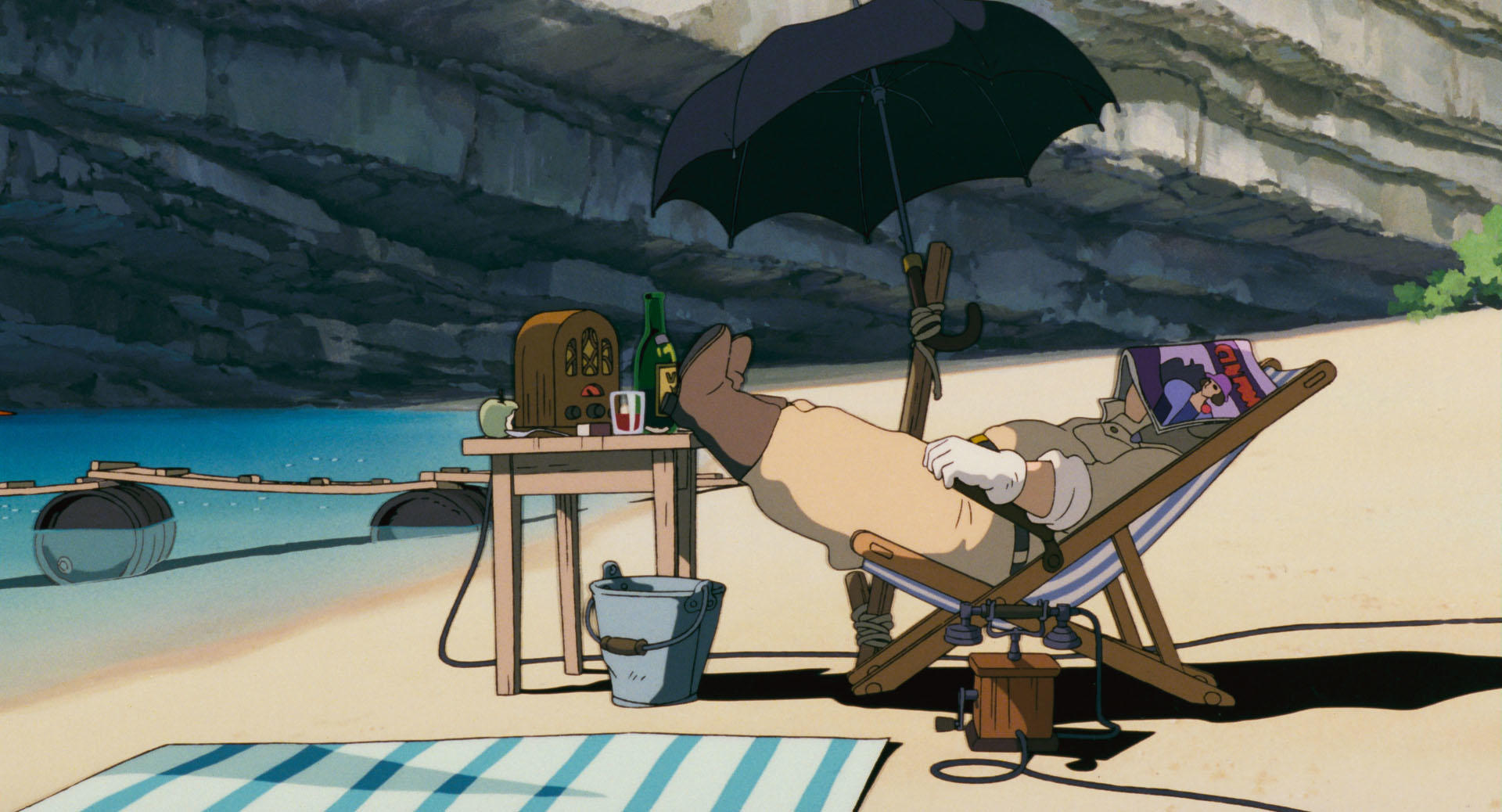
Quick answer: Porco Rosso is suitable for many children aged about 8 to 10 and up, especially those who enjoy planes and adventure. It has aerial gunfights, fist fights, pirates, kidnapping played for comedy, smoking and alcohol, but very little graphic injury. Its harder material is thematic rather than frightening: war memories, fascism, sexism, survivor guilt and an adult hero who hides behind a cynical persona.
Younger children may enjoy the flying and comedy without following the historical context, but the film is less immediately child-centred than My Neighbor Totoro, Ponyo or Kiki’s Delivery Service. It is often a better family watch once children can handle cartoon gunfire and are patient with a story about regret, work and adult relationships.

Porco Rosso parent guide at a glance
| Concern | What parents should know |
| Violence | Aerial dogfights, machine-gun fire, damaged aircraft and an extended comic fist fight. Injuries are not shown graphically. |
| Scary moments | Pilots are shot at over the sea, pirates seize a group of schoolgirls, and a wartime memory has a haunting tone. |
| Language and romance | Romantic rivalry, flirting and old-fashioned comments about women, but no sexual content. |
| Smoking and alcohol | Adults smoke cigarettes and drink wine or spirits as part of the period setting. |
| Best fit | Older primary-age children and teenagers who like aviation, history, comedy or thoughtful adventure. |
How violent is Porco Rosso?
The action centres on seaplane pilots and air pirates in the Adriatic. Aircraft exchange machine-gun fire, bullets strike planes, engines fail and pilots make emergency landings. The danger is real within the story, but the presentation is closer to a romantic adventure serial than a realistic war film. There is no lingering blood, gore or detailed depiction of wounds.
The climactic duel eventually becomes a long fist fight. Porco and Curtis punch each other repeatedly until both are swollen and exhausted. The sequence is deliberately ridiculous as well as physical, with spectators treating it like a sporting event. Children who imitate fighting may need a reminder that the comedy comes from two proud adults behaving foolishly, not from the film presenting punches as harmless.
Are the air pirates frightening?
The Mamma Aiuto gang are armed criminals, but they are broad comic villains rather than cruel monsters. Early in the film they kidnap a group of schoolgirls. That premise can sound alarming, yet the girls are energetic, unafraid and so difficult to manage that the pirates quickly lose control of the situation. The children are returned safely, and the scene avoids realistic abuse or sustained terror.
Even so, a child who is very sensitive to kidnapping or guns may not find the joke reassuring. It helps to explain beforehand that the pirates are inept and that the captured children are not harmed. The film repeatedly undercuts their menace by showing their panic, vanity and reluctant respect for Porco.
War memories and the film’s saddest scene
The most emotionally intense passage is Porco’s memory of flying during the First World War. After a battle, he sees a strange stream of aircraft and fallen pilots rising into the sky. His friend Berlini is among them, while Porco survives. The scene is calm and beautiful rather than graphic, but its meaning is death, loss and survivor guilt.
Younger viewers may simply read it as a dreamlike flight. Older children are more likely to understand why Porco is emotionally distant and why he feels uncomfortable being treated as a hero. Parents can frame the scene as a memory from a pilot who wishes his friends had come home too. The film does not give a neat explanation for every supernatural detail, and that ambiguity is part of its melancholy tone.
Why does Porco look like a pig?
Porco’s transformation is never reduced to a simple spell with a clear rule. He calls himself a pig and often behaves as though the form reflects his shame, isolation and disappointment with humanity. The story suggests that his appearance is connected to how he sees himself, but it leaves room for interpretation.
This is unlikely to frighten most children. He is recognisably the same person throughout and other characters mostly accept his appearance. The more useful family conversation is about why somebody might use sarcasm, solitude or a tough image to avoid grief and closeness. The film offers hope that care and trust can reach him without pretending that one romantic gesture fixes everything.
Smoking, drinking and adult behaviour
Porco and other adults smoke frequently, and alcohol appears in hotel, restaurant and social scenes. These details fit the story’s interwar European setting, but they are visible enough for parents to know about. The film does not pause to warn viewers about either habit, nor does it build its plot around intoxication.
There is also gambling and money talk around pilots, pirates and repairs. Porco works as a bounty hunter, negotiates fees and owes money after rebuilding his plane. This gives the world an adult texture. It can be interesting for older children because flying is shown not only as fantasy but also as skilled, expensive work involving mechanics, engineering and risk.
Sexism, flirting and romance
The setting contains old-fashioned attitudes toward women. Some men doubt Fio’s ability to engineer an aircraft because she is a young woman. Porco can be patronising, and Curtis boasts about fame, marriage and his future in a way that makes romance sound like another competition. The film challenges much of this behaviour by making Fio the clearest, most capable problem-solver in the workshop and at the final confrontation.
Gina’s feelings for Porco are more mature and understated. Fio also cares for him, but the film does not include explicit sexual content. There is flirting, talk of marriage and a kiss with fairy-tale significance. Families may want to discuss the gap between admiring someone and treating them as a prize, especially because the men’s rivalry repeatedly turns women into part of their contest.
Historical and political themes
Porco Rosso takes place in the period when fascism was rising in Italy. Porco’s famous refusal to align himself with fascists is brief and witty, but younger children may not understand the reference. Secret police and government pressure appear around the edges of the story, and Porco faces danger because he will not cooperate with the regime.
No history lesson is required before watching. For an older child, a simple explanation is enough: the government is becoming authoritarian, and Porco values personal freedom even though he is cynical about people. Teenagers and adults will find more in this layer, including the contrast between glamorous flying adventures and the political systems that turn pilots and machines toward war.
What age is Porco Rosso best for?
Age 8 to 10 is a practical starting range for many families. A confident eight-year-old who enjoys aircraft and comic action may have no problem with it. A child who dislikes guns, fist fights or stories focused on adults may prefer to wait. By ten or eleven, viewers are more likely to appreciate Fio’s engineering, Porco’s grief and the historical background alongside the adventure.
For a first Studio Ghibli film, younger viewers will usually connect more quickly with My Neighbor Totoro, Ponyo or Kiki’s Delivery Service. Porco Rosso makes a strong next step for a child ready for more adult themes without the graphic intensity of the darkest Ghibli films.
How to watch Porco Rosso as a family
- Set expectations: describe it as a funny flying adventure with guns, pirates and a sad wartime memory.
- Explain the period lightly: children only need to know that the story takes place between major wars as an authoritarian government is gaining power.
- Notice Fio’s work: her design skill and confidence give families a useful way to discuss competence and sexist assumptions.
- Talk about Porco’s mask: ask whether his pig form reflects a magical curse, his self-image, or both.
- Do not force the ending: the film leaves parts of Porco and Gina’s future deliberately uncertain.
Final verdict for parents
Porco Rosso is a good family choice for children who can handle non-graphic aerial combat and enjoy stories that do not explain every feeling. Its guns and punches are visible, but the lasting material is about grief, dignity, freedom and learning to trust other people again. It is thoughtful without becoming bleak and funny without pretending war has no cost.
Choose it for plane enthusiasts, budding engineers and older children ready for a Studio Ghibli film led mostly by adults. Wait if kidnapping, gunfire, smoking or sustained fist fighting are current concerns. For the full plot and themes, visit the Porco Rosso movie guide. You can also compare the broader parent-friendly starter guide or read the Castle in the Sky parent guide.
FAQ
Does Porco Rosso show anyone dying?
No death is shown graphically. A dreamlike wartime memory strongly implies that many pilots died, including Porco’s friend, but the scene uses distant aircraft and symbolic imagery rather than bodies or wounds.
Is Porco Rosso scary for a seven-year-old?
Some seven-year-olds will enjoy it, especially if they are comfortable with action cartoons. Others may find the machine-gun fire, kidnapping premise and fist fight too intense, or may simply lose interest in the adult-focused story.
Does Porco Rosso have bad language or sexual content?
There is no explicit sexual content. The film includes flirting, romantic rivalry, old-fashioned sexist remarks and some rough dialogue, but its main parent concerns are violence, smoking, alcohol and mature themes.
Is Porco Rosso darker than Castle in the Sky?
It is less relentlessly perilous for child characters, but more adult and historically melancholy. Castle in the Sky has more sustained chase danger; Porco Rosso asks more of viewers emotionally and politically.
Image credit: Official stills from the Porco Rosso page on ghibli.jp, used under Studio Ghibli’s common-sense image-use notice. This article is an independent fan guide and is not affiliated with Studio Ghibli.