Porco Rosso quick facts
- Original Japanese title: Kurenai no Buta (literally “Crimson Pig”)
- Japanese release: 18 July 1992
- Original concept, screenplay and director: Hayao Miyazaki
- Producer: Toshio Suzuki
- Music: Joe Hisaishi
- Theme song performer: Tokiko Kato
- Studio: Studio Ghibli
- Original Japanese distributor: Toho
- Running time: about 93 minutes
- Best for: viewers who want aviation adventure, dry comedy, romance and adult melancholy in a compact film
Spoiler-free answer: Porco Rosso follows a former Italian fighter ace who now looks like a pig and makes his living hunting seaplane pirates over the Adriatic. When an ambitious American pilot destroys his aircraft, Porco turns to a young engineer named Fio for a rebuild. The result is a funny, stylish adventure whose bright water and aerial action conceal a story about war memory, damaged ideals, masculinity and the fear of returning to ordinary human life.
Spoiler-free overview
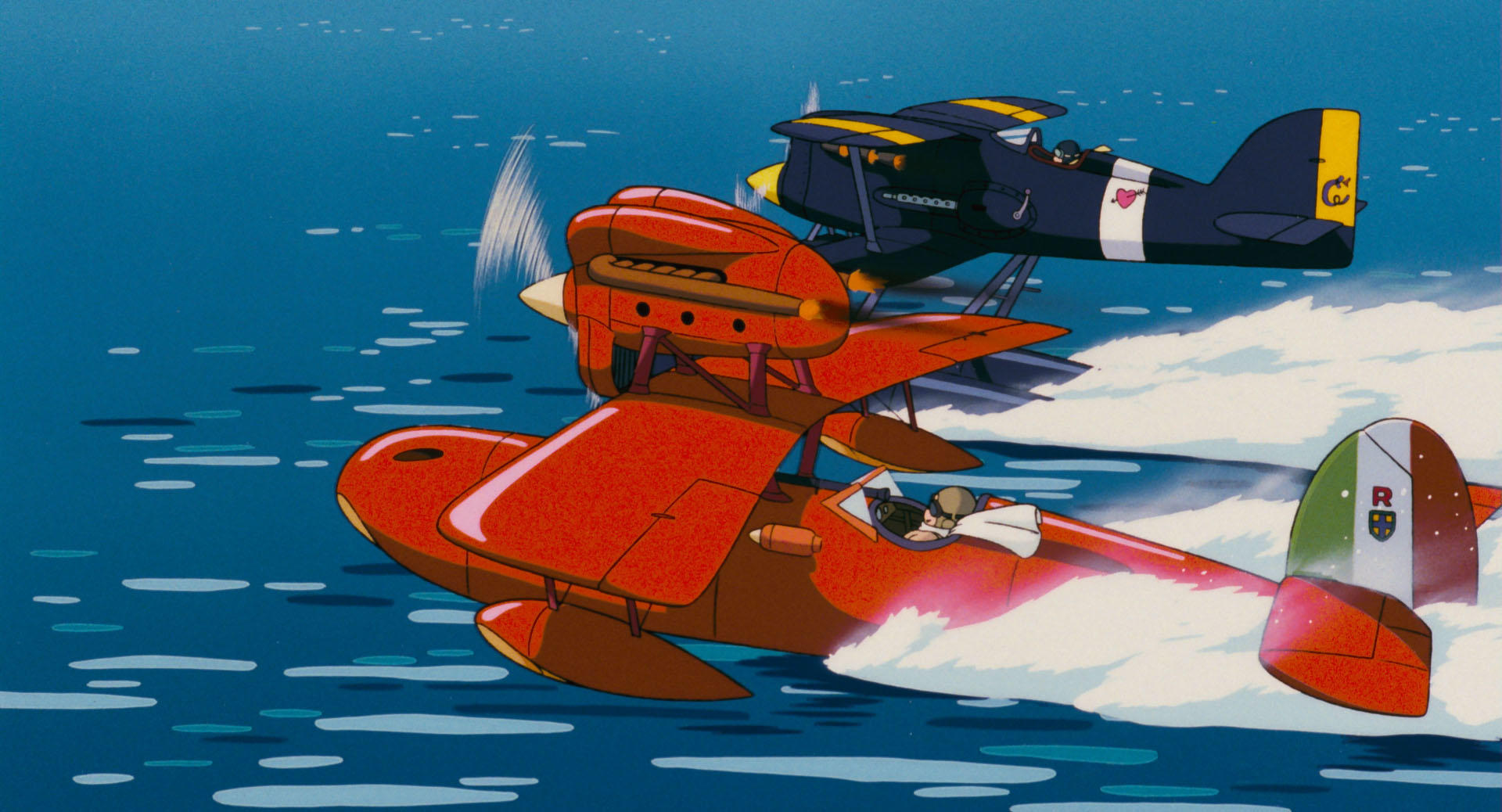
Porco Rosso is easy to enjoy as a swift adventure. It has sky pirates, comic hostages, a glamorous hotel, a rival pilot, a beautifully rebuilt seaplane and a final contest that refuses to remain dignified. The action is clear, the running time is short by modern standards, and the Adriatic setting gives almost every exterior a holiday brightness.
Yet the hero does not belong comfortably inside that cheerful world. Porco was once Marco Pagot, a human pilot who survived war while friends did not. The film never supplies a mechanical rule for his transformation into a pig. That ambiguity matters. His appearance can be read as curse, armour, self-judgement, political refusal or all four at once. He would rather make himself into a cynical legend than admit how deeply he still cares about people.
The movie is also unusual in how seriously it treats making and repairing things. Fio is not included merely to admire the experienced male pilot. She calculates, designs, negotiates and leads. The workshop women turn an apparently solitary flying story into a celebration of shared craft. If Kiki’s Delivery Service is about learning to work without losing yourself, Porco Rosso asks whether work and friendship can help an older person recover a self he deliberately abandoned.
Storyline and ending: what happens in Porco Rosso?
This section contains full spoilers. In the years between the world wars, seaplane pirates trouble ships and travellers across the Adriatic. Porco Rosso operates as a bounty hunter from a hidden island cove. Early in the film the Mamma Aiuto gang attacks a passenger vessel and kidnaps a group of schoolgirls. The pirates expect obedient hostages and instead get energetic children who climb over their aircraft. Porco intercepts them, rescues the girls and collects the reward with the weary competence of someone who has done this many times.
His social world centres on the Hotel Adriano, run by Gina, a singer and Porco’s old friend. Pilots of every allegiance respect her. Gina has lost several aviator husbands, and her affection for Porco carries years of knowledge that neither of them turns into a simple declaration. The hotel feels elegant and safe, but news of fascist power and old military connections reminds Porco that his private life cannot remain outside politics forever.
The pirates, frustrated by Porco’s victories, hire Donald Curtis, a confident American pilot with film-star and presidential ambitions. Curtis is talented as well as ridiculous. He is immediately attracted to Gina and imagines himself the leading man in every room. When he encounters Porco in the air, Porco’s engine fails at the worst moment. Curtis shoots the red seaplane down and assumes his rival is dead.
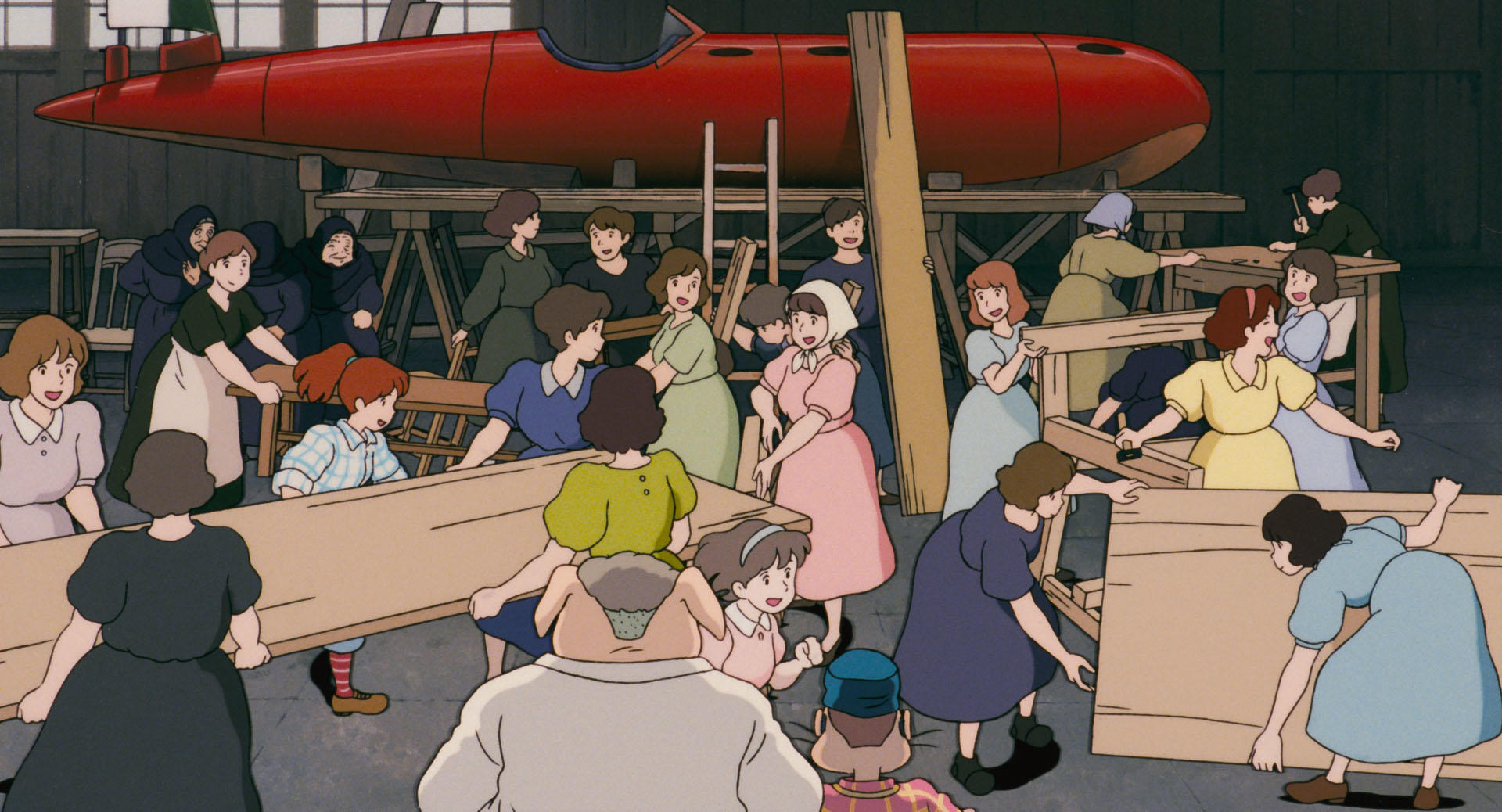
Porco survives and takes the damaged aircraft to Milan. His trusted engineer, Mr Piccolo, assigns the rebuild to his teenage granddaughter Fio. Porco objects because she is young and female, but her technical knowledge quickly answers him. Fio redesigns the aircraft while the Piccolo family’s women provide the workforce. The sequence undercuts Porco’s habits without pretending that one speech changes him. He gradually respects Fio because she does excellent work and refuses to be diminished.
While in Milan, Porco learns that the authorities are watching him. An old air-force acquaintance warns him about the danger and offers a route back into official service. Porco refuses. His famous anti-fascist line is funny because it is delivered as personal bad temper, but the decision is serious. He will not purchase safety by serving a system he despises.
Fio insists on travelling with Porco, partly because the rebuilt plane is not fully paid for and partly because she trusts her engineering. Back at the Adriatic hideout, the pirates surround them. Fio confronts the men and appeals to their professional pride as aviators. Her courage changes the terms of the encounter. Curtis challenges Porco to a duel. If Porco wins, Curtis will pay the repair bill; if Curtis wins, he intends to marry Fio. Fio accepts the wager on the condition that the contest be fair, turning herself from a supposed prize into the person who controls the negotiation.
The final dogfight exhausts both aircraft without producing a clean winner. Porco and Curtis land, then continue with a long, increasingly battered fistfight in shallow water. Their rivalry becomes absurdly physical. Gina arrives and warns that the Italian air force is approaching. She also reveals that she has been waiting to see whether Porco will visit her garden in daylight, a private wager about whether he can choose life rather than permanent retreat.
Before everyone disperses, Curtis sees Porco’s face after Fio kisses him. The film does not show the audience a definitive transformation. In Fio’s closing narration, we learn that she and Gina remain friends, that Porco continues flying, and that whether Gina’s wager succeeded is their secret. A red seaplane near the hotel suggests an answer without turning emotional change into a tidy magical cure.
Main characters
Porco Rosso / Marco Pagot
Porco is skilled, funny, vain and tired. His pig face makes his self-exile visible, but the more important barrier is emotional. He keeps relationships at the level of banter, debt or professional loyalty because those forms feel safer than hope. His journey is not about becoming cheerful. It is about allowing Fio, Gina and his fellow pilots to remind him that cynicism is not the same as freedom.
Fio Piccolo
Fio is a gifted aircraft engineer whose confidence comes from preparation rather than magic. She studies the design, takes responsibility for the rebuild and understands how to speak to pilots in the language of honour they claim to value. Her youth lets her challenge Porco’s assumptions, but the film earns her authority through visible work.
Gina
Gina runs the Hotel Adriano and commands respect without needing an aircraft or weapon. She has endured loss and sees through Porco’s performance. Her patience is not passive waiting. She sets her own wager, protects the neutral space around her hotel and refuses to chase a man who must choose to return.
Donald Curtis
Curtis is Porco’s American rival: talented, theatrical, romantic and convinced that ambition naturally makes him the hero. He is a comic mirror rather than a pure villain. Where Porco hides from public life, Curtis imagines politics and cinema as stages built for him. Their fight exposes the foolish pride beneath both poses.
Mr Piccolo and the workshop team
Piccolo recognises Fio’s talent and organises a family workforce when the men are away seeking other employment. The workshop scenes celebrate engineering as collective knowledge. Porco’s aircraft may express individual style, but many hands make flight possible.
Themes and interpretation
The pig as self-judgement and protection
The film never confirms one cause for Porco’s condition. That is more useful than a neat spell. Marco survived a war in which other pilots died, and he has withdrawn from ordinary human obligations. Looking like a pig externalises how he sees himself while allowing him to pretend the distance is inevitable. If the curse can change, it changes through connection, not through solving a rule.
Anti-fascism without heroic purity
Porco refuses fascist authority, but the film does not turn him into a spotless political hero. He is a bounty hunter, a stubborn debtor and often sexist. His decency survives in choices: rescuing people, refusing the regime, respecting Gina’s space and eventually recognising Fio’s ability. Resistance begins with refusing to surrender judgement, even when the person resisting remains flawed.
Flight as beauty marked by war
The seaplanes are drawn with obvious affection. Engines, wings and water landings have weight and rhythm. At the same time, Porco’s happiest skill was formed through combat and loss. The film can love aircraft without pretending machines exist outside history. That tension later becomes central to The Wind Rises.
Masculinity as performance
Porco, Curtis and the pirates constantly perform competence, appetite and toughness for one another. Fio and Gina see both the charm and the evasion. The final fistfight is funny because two excellent pilots reduce themselves to swollen faces and stubbornness. Real courage appears elsewhere: admitting dependence, respecting expertise, living with grief and risking affection.
Repair as a form of hope
Fio rebuilds more than a damaged aircraft. Her work creates a practical reason for Porco to trust someone, return to the sky and face a rival. Repair does not erase the machine’s history or the pilot’s losses. It makes another flight possible. That is the film’s gentlest answer to despair.
Age suitability and content guidance
Porco Rosso is adventurous rather than graphic, but it is not entirely conflict-free. There are aerial dogfights, machine-gun fire, a comic kidnapping, crashes, threats and a prolonged fistfight. Characters end up bruised and exhausted, while the kidnapped schoolgirls are lively and unharmed. The tone makes much of the danger playful, although younger or aviation-anxious viewers may still find the attacks tense.
Adults smoke and drink. There are references to war deaths, survivor guilt and fascism. Some male characters make sexist comments, and the wager involving Fio’s proposed marriage needs context even though Fio controls the challenge and is never treated as romantically interested in Curtis. Porco’s pig appearance may seem strange rather than scary. Many confident older children can enjoy the action, but teenagers and adults are more likely to understand the political and emotional undertones. Check the current classification for your country and edition because ratings vary.
Production and release context
Studio Ghibli’s official works page credits Hayao Miyazaki with the original concept, screenplay and direction; Toshio Suzuki as producer; Joe Hisaishi for music; and Tokiko Kato as theme-song performer. It gives a Japanese release date of 18 July 1992, a running time of approximately 93 minutes and Toho as distributor. The Japanese title, Kurenai no Buta, means “Crimson Pig.”
The film grew from Miyazaki’s aviation interests and a manga project commonly known in English as The Age of the Flying Boat. What could have remained a compact flying adventure expanded into a feature where machinery, European interwar atmosphere and personal disillusionment reinforce one another. That history helps explain the film’s unusual balance. It can behave like an episodic pilots’ tale while carrying political shadows that are never reduced to a lecture.
Visually, the film contrasts open Adriatic space with enclosed memories and workshops. Porco’s hidden cove offers escape, the Hotel Adriano offers community, and Milan brings craft into contact with surveillance. Joe Hisaishi’s score and Tokiko Kato’s performance deepen the old-world atmosphere, but the movie never becomes mere nostalgia. Its beauty is always shadowed by the question of what Europe is becoming.
Where to watch Porco Rosso legally
Streaming catalogues and home-video rights vary by country and change over time. Start with the site’s current legal Studio Ghibli viewing guide, then search for the title inside the service available in your region. In North America, GKIDS maintains an official Porco Rosso film page for licensed release information. Physical editions, digital rentals and subscription availability can differ elsewhere.
Related films
Choose Kiki’s Delivery Service for another story about flight, work and confidence; Castle in the Sky for a faster aviation adventure; or Only Yesterday for an adult story about the life someone has built and the one they might still choose. The Wind Rises is the most direct later companion if you want Miyazaki’s more serious examination of aircraft, beauty and historical consequence.
Frequently asked questions
Why is Porco Rosso a pig?
The film deliberately leaves the cause ambiguous. His appearance can be understood as a curse, a symbol of survivor guilt, a rejection of society or the shape of his own self-contempt. The ending suggests change without explaining it as a simple spell.
Was Porco Rosso originally human?
Yes. He was an Italian pilot named Marco Pagot. Memories and other characters establish his human identity before he became known as Porco Rosso.
Does Porco become human at the end?
Curtis appears surprised by Porco’s face after Fio kisses him, but the audience is not shown a definitive reveal. Fio’s narration preserves the answer as part of Gina’s private wager. The emotional possibility matters more than a permanent visual confirmation.
Is Porco Rosso anti-fascist?
Yes. The political context is explicit, and Porco refuses alignment with the fascist state even when it could make his life safer. The film expresses that position through character, humour and the gathering pressure around him rather than through a conventional political plot.
Is Porco Rosso suitable for children?
Many older children can enjoy its short running time, pirates and flying action. Parents should expect gunfire, crashes, comic kidnapping, smoking, drinking, a fistfight, sexist attitudes and themes of war and political repression. Younger viewers may enjoy the surface adventure while missing the adult melancholy.
Is Porco Rosso a romance?
It includes a mature, unresolved love between Porco and Gina, plus comic romantic rivalry from Curtis. Romance is important, but the film is equally about friendship, grief, craft, pride and whether Porco can rejoin human life.
Image source: official Porco Rosso stills from the Studio Ghibli works gallery, whose page includes the studio’s common-sense image-use notice.
Official film stills are credited to Studio Ghibli and used under its common-sense image-use notice.