Quick answer: Princess Mononoke is about the damage people cause when survival, industry, fear, and pride are allowed to outrank balance. It is not a simple humans versus nature story. Hayao Miyazaki makes the conflict harder, and better, by giving almost every side a reason to fight.
That is why the film still feels unusually grown-up for a fantasy adventure. Ashitaka is not trying to defeat one villain. San is not simply a forest princess who needs to be softened. Lady Eboshi is not a cartoon industrial tyrant. The forest spirits are beautiful, frightening, and not always gentle. The result is one of Studio Ghibli’s richest films, a movie about war, environmental loss, illness, community, and the difficult work of seeing clearly when everyone around you wants certainty.
What Princess Mononoke is really about
At the surface level, Princess Mononoke follows Ashitaka after he is cursed by a corrupted boar god. His journey leads him west, where he finds a violent struggle between Iron Town and the ancient forest. But the deeper story is about a broken relationship between human ambition and the living world.
The curse matters because it is not just a wound. It is hatred made visible. Ashitaka’s arm becomes stronger when rage rises in him, but that power is dangerous because it comes from the same poison destroying the boar. The film keeps asking whether strength without restraint is still heroic.
Miyazaki does not argue that humans should simply disappear from the landscape. Iron Town shelters lepers, former brothel workers, and people who have very few choices in the wider world. The town’s industry is destructive, but it also gives vulnerable people food, identity, and protection. That tension is the point.
Why Ashitaka is the centre of the film
Ashitaka’s role is easy to understate because San, Moro, Eboshi, and the Forest Spirit are so memorable. He is the film’s moral witness. His repeated goal is to “see with eyes unclouded by hate,” which sounds simple until the film shows how hard it is.
He refuses to flatten the conflict into good and evil. He sees the suffering of the forest, the dignity of Iron Town, the terror of the animals, the courage of San, and the recklessness of Eboshi. That does not make him passive. It makes him disciplined. In a world where everyone is being pulled toward revenge, Ashitaka’s restraint becomes radical.
For new viewers, this is one reason the movie can feel different from a standard adventure. Ashitaka is not trying to win the war for one faction. He is trying to stop the war from consuming everyone.
San is not just “raised by wolves”
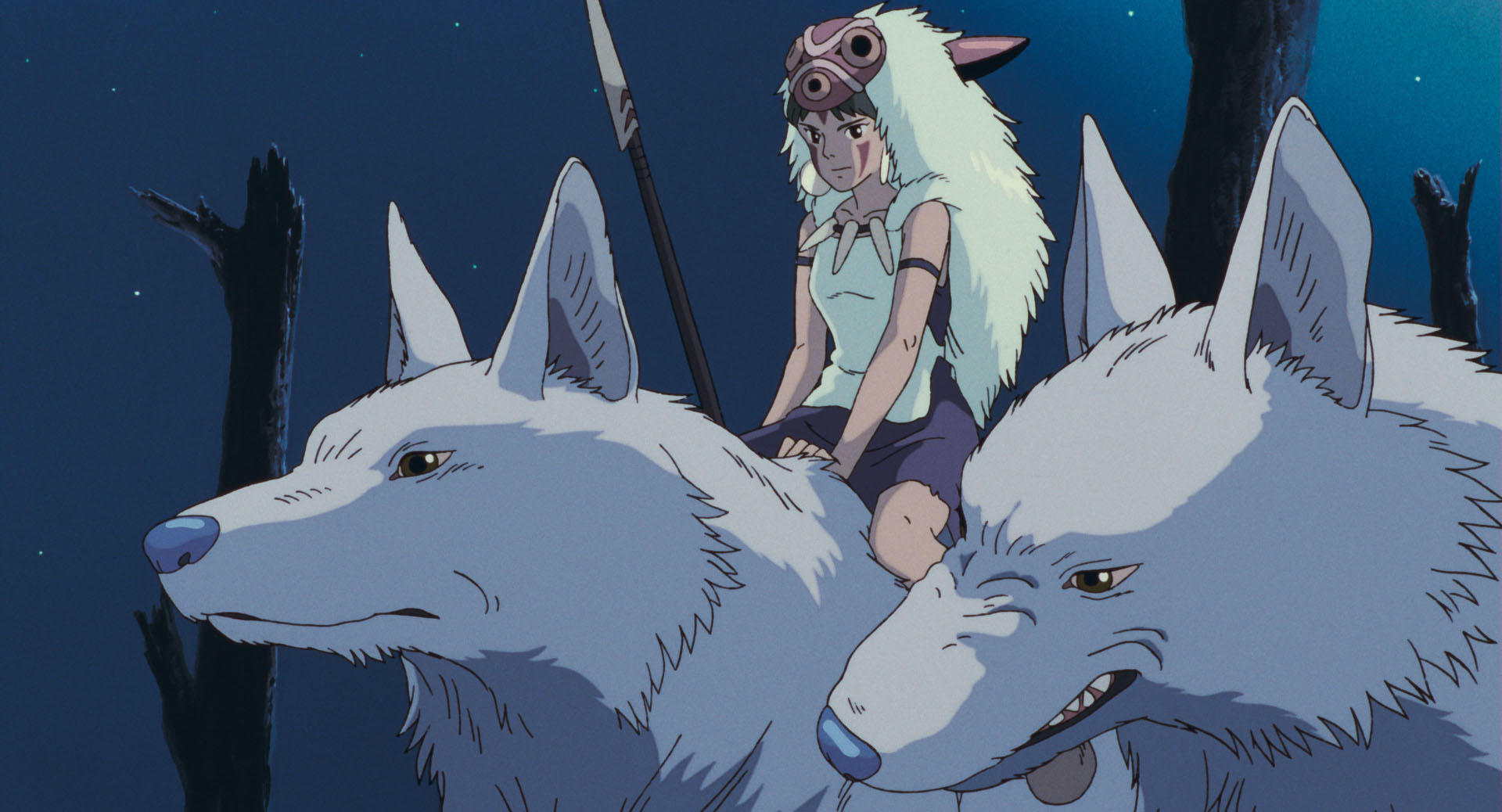
San is often described as a human girl raised by wolves, but that summary misses the emotional force of the character. She does not simply prefer the forest. She believes she belongs to it, and she sees humans as the source of betrayal, pollution, and violence.
Her anger is understandable. The forest is being cut, wounded, and hunted. The gods she loves are being driven toward despair. San’s ferocity is not a quirky personality trait. It is loyalty shaped by abandonment and war.
Her connection with Ashitaka matters because he does not ask her to stop being San. He does not “civilise” her or pull her neatly back into human society. Their bond is built on recognition, not possession. The ending respects that by refusing to force a false resolution.
Lady Eboshi is complicated on purpose
Lady Eboshi is one of Ghibli’s most interesting antagonistic figures because she does terrible harm while also doing real good. She destroys parts of the forest and helps drive the central crisis, yet she also builds a community for people discarded elsewhere.
This complexity is not there to excuse her. It is there to make the film honest. Many destructive systems are not run by people who wake up thinking they are evil. They are often run by people pursuing security, progress, profit, status, or protection for their own group. Eboshi’s compassion has borders, and the forest sits outside them.
The film’s challenge is that viewers can understand her motives without agreeing with her choices. That is one reason Princess Mononoke rewards rewatches. Every return makes the conflict feel less like a puzzle to solve and more like a wound everyone keeps reopening.
The Forest Spirit and the cost of imbalance
The Forest Spirit is not a cuddly guardian. It is life and death in one figure, calm and unknowable until humans try to seize control of it. When the characters attempt to use the sacred for political or material gain, the world itself becomes unstable.
This is where the film’s environmental message becomes mythic rather than preachy. Nature is not presented as decoration or a lifestyle preference. It is the condition that allows every other human plan to exist. When that balance is broken, no faction truly wins.
Is Princess Mononoke suitable for beginners?
Yes, but it is not the softest first Studio Ghibli movie. Compared with My Neighbor Totoro or Kiki’s Delivery Service, this is more violent, intense, and politically layered. It can be a brilliant early watch for adults and older teens who want to see the epic, serious side of Ghibli.
If you are planning a first-time Ghibli run, pair it with the broader Studio Ghibli movies in order watch guide. A lighter film before or after Princess Mononoke can make its scale and severity land even more strongly.
Why the ending works
The ending does not pretend the world has been fixed. The forest may recover, Iron Town may be rebuilt differently, and Ashitaka and San may remain connected while living apart. That ambiguity is not a weakness. It is the film’s final act of honesty.
Healing is possible, but it is not automatic. The characters have seen what hatred costs. Whether they build something better depends on what they do after the story ends. That is why Princess Mononoke feels less like a closed fairy tale and more like a warning handed to the viewer.
FAQ
Is Princess Mononoke anti-human?
No. It criticises destructive human behaviour, but it also shows human communities, care, courage, and survival. The film is anti-hatred and anti-exploitation more than anti-human.
Who is the villain in Princess Mononoke?
There is no single simple villain. Lady Eboshi causes enormous harm, but the deeper enemy is hatred, imbalance, and the belief that one group’s survival justifies destroying everything outside it.
Does San become human again?
San is already human biologically, but emotionally and spiritually she belongs with the wolf gods and the forest. The film does not force her into Iron Town or a conventional human life.
Why is Ashitaka cursed?
He is cursed after defending his village from a boar god corrupted by hatred and an iron bullet. The curse pushes him into the wider conflict and makes the film’s theme visible in his own body.
Image source note: official Studio Ghibli still via ghibli.jp, whose work pages include the common-sense use notice: ※画像は常識の範囲でご自由にお使いください。