My Neighbors the Yamadas quick facts
- Original Japanese title: Hōhokekyo Tonari no Yamada-kun
- Japanese release: 17 July 1999
- Screenplay and director: Isao Takahata
- Based on: Hisaichi Ishii’s four-panel family manga
- Producer: Toshio Suzuki
- Music and theme song: Akiko Yano
- Running time: about 104 minutes
- Format: an episodic family comedy told through linked sketches rather than one continuous adventure
- Best for: viewers who enjoy observational comedy, distinctive animation and warm stories about imperfect families
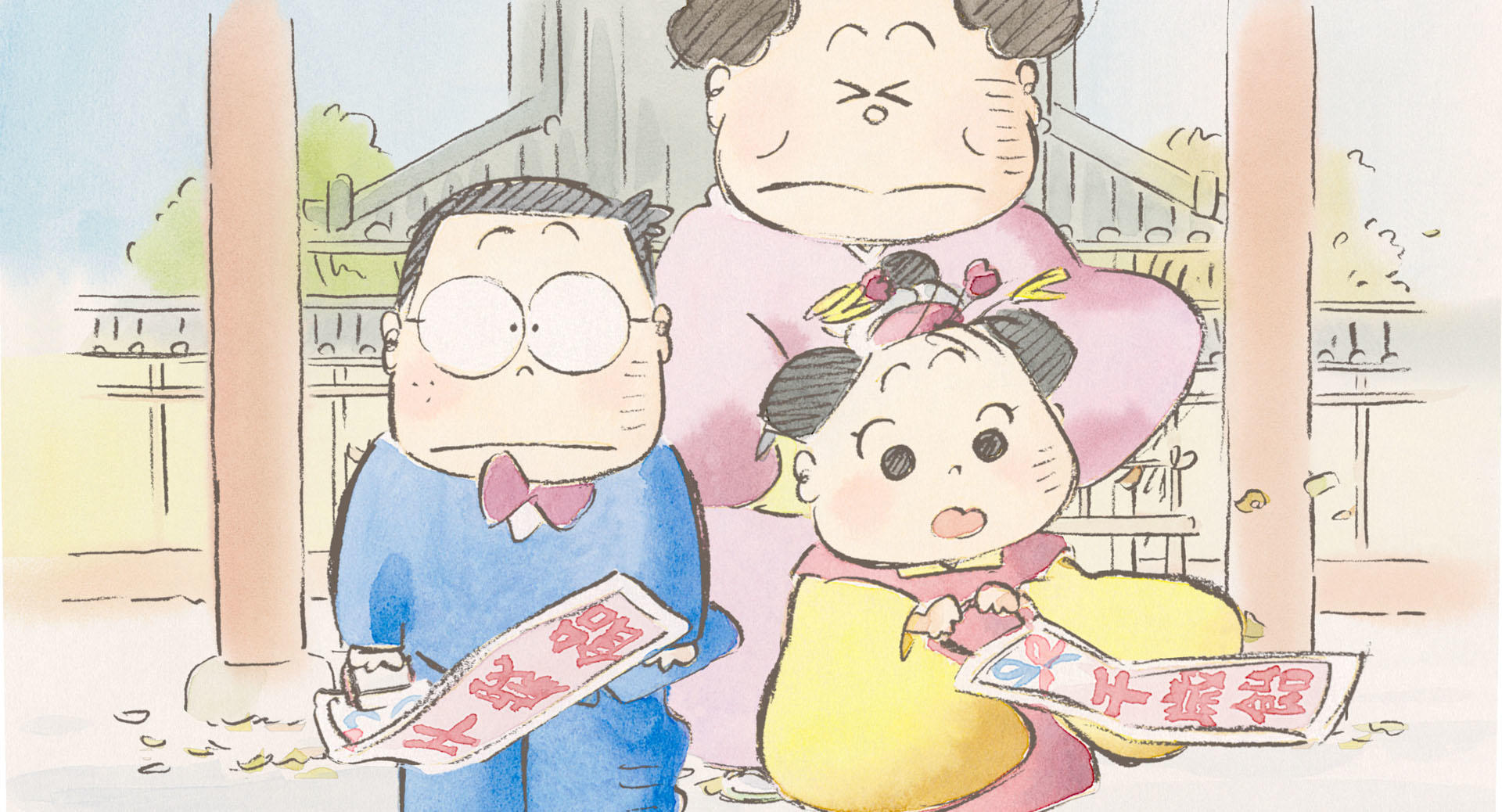
Spoiler-free answer: My Neighbors the Yamadas follows an ordinary suburban family through arguments, meals, school worries, lost belongings and fleeting moments of affection. There is no villain and no single quest. Isao Takahata builds the film from comic vignettes, using a pale watercolour look and playful fantasy sequences to show how everyday family life can feel ridiculous, exhausting and quietly precious at the same time.
Spoiler-free overview
This is one of Studio Ghibli’s most unusual films. Its people do not travel into a spirit world, pilot aircraft or fight an ancient war. They forget what they went upstairs to find. They disagree over the television. A parent tries to bond with a teenager and makes the situation more awkward. Dinner is shaped by convenience, leftovers and whoever can avoid doing extra work. The comedy comes from recognition rather than spectacle.
The central household includes Takashi and Matsuko Yamada, their teenage son Noboru, younger daughter Nonoko, Matsuko’s sharp-tongued mother Shige and the family dog Pochi. Everyone loves the others, but that love rarely arrives as a polished speech. It appears in a shared walk home through the rain, a worried search, a badly handled attempt at encouragement or the simple fact that tomorrow’s irritation will still happen around the same table.
Viewers expecting a conventional plot may initially wonder where the story is going. The better question is what the sketches accumulate. Repeated habits reveal the family’s structure: Takashi wants the dignity of a traditional father but is often ignored; Matsuko is practical, distractible and resistant to domestic perfection; Shige has survived enough to puncture everyone’s self-importance; Noboru wants independence while still needing support; Nonoko sees adult confusion with disarming clarity. By the end, the Yamadas have not transformed into better people. The film has taught us how to read the care inside their mess.
It works as a standalone entry and needs no knowledge of other Ghibli films. For another Takahata film that finds emotional meaning in ordinary life, continue with Only Yesterday. For a gentler family film with more fantasy, try My Neighbor Totoro. If you want another unconventional visual experiment, keep The Tale of the Princess Kaguya on your list.
Storyline: what happens in My Neighbors the Yamadas?
The film opens by introducing the household and imagining Takashi and Matsuko’s married life through a wedding speech. Their partnership becomes a comic voyage: they race down a cake like a bobsled team, cross rough seas and move through extravagant images of children arriving from peaches and bamboo. The sequence turns familiar advice about marriage into visual play. Family life is not presented as a smooth journey. It is a vehicle everyone must keep steering while arguing about the direction.
The film then settles into shorter episodes. In one of the largest, the family leaves a department store and only later realises that Nonoko is missing from the car. Their return is delayed by traffic and confused recollections. Nonoko, meanwhile, thinks her family is the party that has become lost. She calmly helps a smaller child before leaving with that child’s mother. The sequence is funny because every adult decision makes the search less efficient, but the fear underneath it is real. The eventual phone call confirming Nonoko is safe releases the tension without turning the incident into a moral lesson.
Other sketches examine the tiny contests inside Takashi and Matsuko’s marriage. A fight over the television remote becomes a physical duel involving angles, blocked signals and improvised tactics. Neither person gets to enjoy the programme, while Shige finds their battle more entertaining than television. Takashi makes requests when he is home, imagining that his authority should organise the household, only to discover that everyone else has their own plans. Matsuko often tries to reduce the work of cooking or cleaning, but her shortcuts are not framed as wickedness. They are part of the family’s constant negotiation over effort.
Takashi repeatedly attempts to perform fatherhood as he imagines it should look. He wants Noboru to play catch as a bonding ritual, but the teenager refuses the script. When they do play, a broken window provides more shared purpose than Takashi’s formal plan. He tries to offer guidance on schoolwork, only to become paralysed by the same open-ended choice that troubles his son. Their relationship is affectionate but indirect. Both would rather approach closeness sideways than admit they need it.
Noboru faces school pressure, embarrassment about his parents and the first stirrings of romance. His family tells him to study, yet the repetition of the command becomes so absurd that it loses all force. He wants cooler, more competent parents but also depends on the household he criticises. The film respects his adolescent frustration without pretending the adults become less embarrassing once he explains it.
Nonoko often acts as the clearest observer. Her small size and direct voice expose contradictions the adults have learned to ignore. She can be impulsive and inconvenient, but she is rarely burdened by the need to protect anyone’s pride. Shige plays a similar role from the opposite end of life. Her sayings, blunt advice and refusal to flatter Takashi prevent the household from settling into a simple hierarchy.
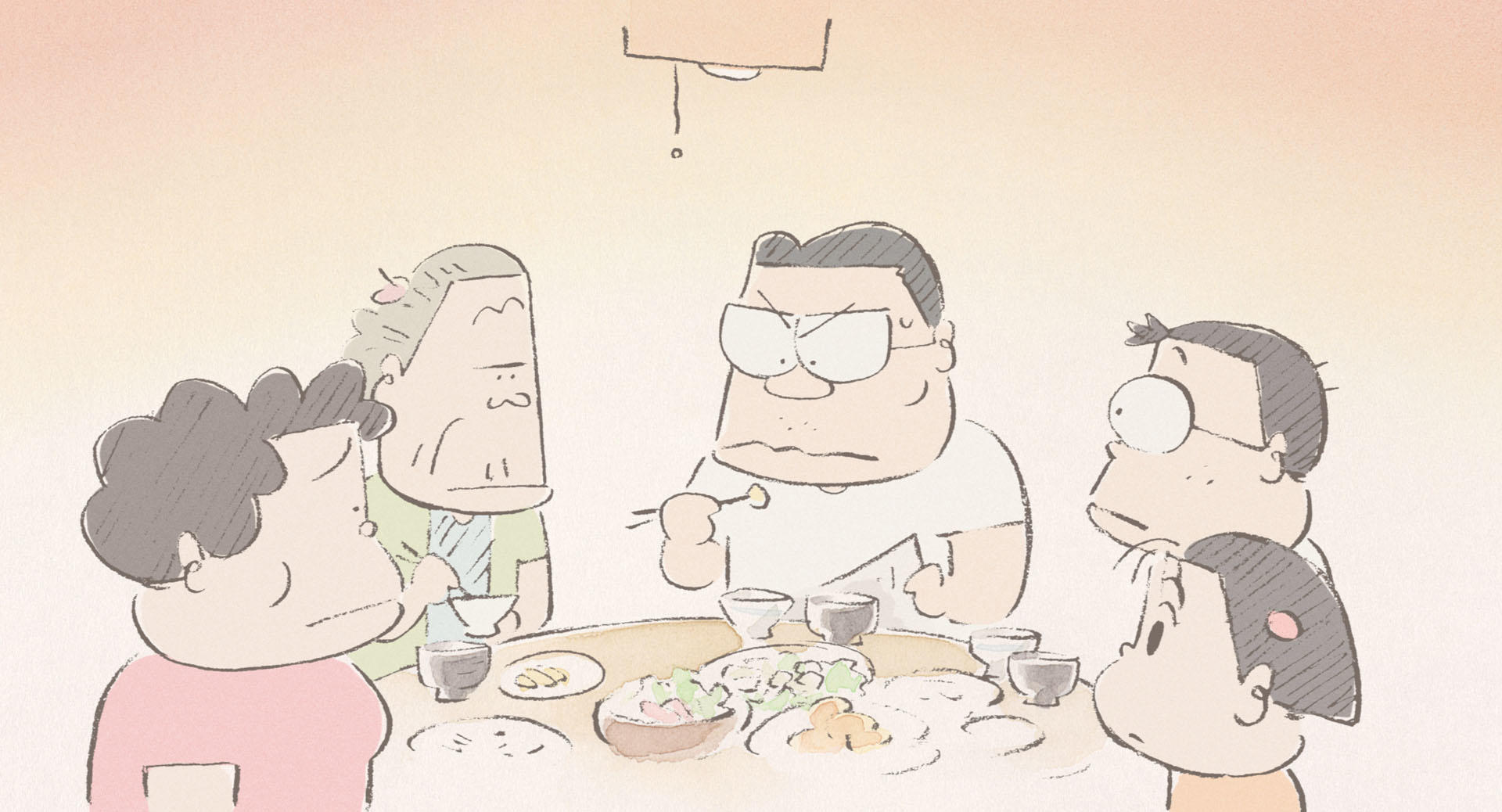
Domestic objects become recurring comic forces. Laundry and other belongings disappear beneath the family table as if swallowed by a black hole. Breakfast may turn out to be a careful arrangement of leftovers rather than a fresh expression of devotion. A meal can be selected because it requires less preparation. These jokes make the home feel lived in. Order is temporary, appetite is constant and the same people who create the mess must work out how to share it.
One of the warmest passages begins when Takashi is stranded without an umbrella and phones home. He hears the family debate who should bring it, gives up and decides to buy another, then is asked to pick up food as well. The request seems to confirm that nobody is thinking about him. Yet on the way home, he finds that the family has come to meet him. They walk together under umbrellas, affection arriving after irritation rather than instead of it.
The episodes also let reality bloom into fantasy. Ordinary worries can become heroic battles, ocean voyages or poetic seasonal images before shrinking back to the living room. That movement is the film’s substitute for a conventional climax. The Yamadas are not secretly epic heroes, but daily life feels epic from inside a family. A television argument can become a contest of champions. A wedding speech can contain storms. A walk through rain can carry the emotional weight of a reunion.
The ending does not resolve every disagreement. The family continues as it began: noisy, affectionate, avoidant and interdependent. A communal performance of “Que Sera, Sera” suits that conclusion. Whatever comes next will not be controlled perfectly. The meaningful achievement is that they face it as a household, even when each person rows in a different direction.
Main characters and family relationships
Takashi Yamada
Takashi is the father, an office worker who wants respect and traditional authority but seldom receives them in the form he expects. His grand gestures often collapse into awkwardness. The comedy never makes him worthless. His failed attempts to connect with Noboru and his hurt when the family seems indifferent reveal someone who genuinely wants to matter at home.
Matsuko Yamada
Matsuko is the mother and the household’s practical centre, although she is no domestic ideal. She forgets things, looks for shortcuts and can turn laziness into ingenuity. Her relationship with Takashi is built from friction as much as romance. They know exactly how to irritate each other, yet the film repeatedly shows that this familiarity also lets them endure difficult days together.
Shige Yamano
Shige, Matsuko’s mother, is direct, resilient and unimpressed by Takashi’s claims to authority. She supplies proverbs and hard-earned perspective, but she is not a serene stereotype of wisdom. She enjoys the family’s absurdity, contributes to arguments and has her own appetites. Her presence makes the home multigenerational rather than neatly centred on the parents.
Noboru Yamada
Noboru is a teenager caught between dependence and separation. He worries about school, social life and having embarrassing parents. His irritation is credible because the adults really do mishandle their attempts to help. At the same time, he inherits their habits and remains part of their rhythms, whether he admits it or not.
Nonoko Yamada
Nonoko is the younger daughter, confident enough to treat a department-store separation as the adults’ mistake. Her observations cut through status and ceremony. She is not simply the cute child of the family. Her stubbornness and loud presence can cause chaos, while her lack of adult self-consciousness often produces the cleanest truth in a scene.
Pochi
Pochi is the family dog, sometimes looking like another weary witness to the household. His limited role is part of the joke: even the pet appears to have a complicated relationship with Yamada family life.
Themes, meaning and interpretation
Love is often visible as persistence
The Yamadas rarely express affection perfectly. Care appears through returning, searching, buying the requested groceries, sharing food and remaining available after an argument. The film does not ask viewers to ignore the family’s selfish moments. It suggests that durable love is often made from imperfect acts repeated over time.
Family roles are performances
Takashi wants to play the wise father, Matsuko is expected to manage the home, Noboru is told to be a diligent student and Shige is invited to provide wisdom. Every role breaks down under the pressure of actual personality. The humour comes from the gap between the official script and what these people can really manage.
The ordinary deserves artistic attention
By giving meals, remote controls, umbrellas and missing socks the space normally reserved for fantasy quests, Takahata argues that domestic life is not empty material. It contains fear, rivalry, tenderness and absurdity at a scale most viewers recognise. The film’s looseness is deliberate: memory often preserves family life as sharp little scenes rather than one clean narrative.
Poetry and comedy can share a frame
Short episode titles, seasonal transitions and occasional haiku-like pauses sit beside broad physical jokes. The white space around the drawings prevents the comedy from becoming noisy all the time. It gives a small gesture room to land and lets imagination briefly carry the family out of the suburbs.
Imperfection is not the opposite of belonging
No Yamada becomes an ideal spouse, parent, child or grandparent. Their flaws are not repaired before they deserve a home. Belonging comes from being known in detail, including the maddening detail, and still remaining part of the group.
Age suitability and content guidance
My Neighbors the Yamadas is among the gentler Studio Ghibli films. It contains comic family arguments, mild rude behaviour, parental frustration and a sequence in which a young child is separated from her family in a department store. That incident may worry sensitive younger viewers, but it resolves safely. Some fantasy exaggeration includes peril or chaotic imagery without sustained threat.
The film is family-friendly in content, although its episodic pace and adult observations about marriage, work and domestic routine may appeal more to older children and adults than to very young viewers expecting a continuous adventure. Classifications vary by country and edition, so families should confirm the current local rating. In North America, GKIDS lists its home release as PG.
Production, adaptation and visual style
Isao Takahata wrote and directed the film from Hisaichi Ishii’s four-panel manga about the Yamada family. The source format matters. Instead of forcing newspaper-strip characters into a tightly plotted quest, the film preserves the rhythm of setup, reversal and punchline while using recurring relationships to create a feature-length emotional arc.
Studio Ghibli’s official page credits Toshio Suzuki as producer and Akiko Yano for the music and theme song. The film opened in Japan on 17 July 1999 and runs about 104 minutes. Its Japanese title, Hōhokekyo Tonari no Yamada-kun, includes an onomatopoeic bird call before the family name, matching the film’s playful and seasonal tone.
The visual approach was a major technical and artistic departure for the studio. Characters retain simple comic-strip outlines, colours resemble light washes and large areas of the screen remain white. Traditional drawings were brought into a digital colouring and compositing process so that the film could maintain this delicate look across a feature. The technology is not used to make the images hard or glossy. It helps preserve the feeling of drawings that might have just appeared on paper.
That apparent simplicity supports surprisingly elaborate movement. Fantasy sequences can transform a wedding cake into a mountain, a family journey into a voyage or an ordinary disagreement into spectacle. The result shows why animation style is not a ladder from simple to realistic. The right line and timing can communicate more about an embarrassed parent than a densely rendered background.
Where to watch legally
Streaming and home-video rights vary by country and can change. Use the site’s current Studio Ghibli streaming guide, then verify the title inside the licensed service available in your region. In North America, GKIDS maintains an official My Neighbors the Yamadas page and currently lists Blu-ray, DVD and on-demand options. Availability elsewhere may differ.
Official image gallery
Related films and guides
Watch Only Yesterday for Takahata’s reflective view of ordinary life and memory, Pom Poko for another of his ensemble films with sharper social stakes, or My Neighbor Totoro for a gentler family story where small experiences matter. The Studio Ghibli release timeline places the Yamadas’ visual experiment between Princess Mononoke and Spirited Away.
Frequently asked questions
Does My Neighbors the Yamadas have one continuous plot?
No. It is constructed from linked vignettes about the same family. Repeated characters, habits and relationships provide continuity, while each sketch has its own setup and payoff.
Who are the members of the Yamada family?
The central household is father Takashi, mother Matsuko, teenage son Noboru, younger daughter Nonoko, grandmother Shige and dog Pochi.
Why does the movie look so different from other Ghibli films?
It adapts the simplified language of a four-panel newspaper comic and uses pale digital colouring to create a watercolour-like appearance. The open white space and loose lines are an intentional part of its storytelling.
Is My Neighbors the Yamadas suitable for children?
It is generally gentle, with mild family conflict and a safely resolved lost-child sequence. Younger children may find the episodic structure less immediately gripping than Ghibli’s fantasy adventures, while adults may recognise more of the marriage and parenting comedy.
Is it based on a manga?
Yes. It is based on Hisaichi Ishii’s four-panel family comic, associated with the title Tonari no Yamada-kun and later Nono-chan.
Who directed My Neighbors the Yamadas?
Isao Takahata wrote the screenplay and directed it. His other Studio Ghibli features include Grave of the Fireflies, Only Yesterday, Pom Poko and The Tale of the Princess Kaguya.
Is My Neighbors the Yamadas connected to My Neighbor Totoro?
No. The similar English wording does not indicate a shared story. They are separate films with different characters, settings and directors.
Official film stills are credited to Studio Ghibli and used under its common-sense image-use notice.