The Tale of the Princess Kaguya quick facts
- Japanese title: Kaguyahime no Monogatari
- Japanese release: 23 November 2013
- Screenplay and director: Isao Takahata
- Co-screenwriter: Riko Sakaguchi
- Based on: the classical Japanese story The Tale of the Bamboo Cutter
- Producer: Yoshiaki Nishimura
- Music: Joe Hisaishi
- Running time: about 137 minutes
- Best for: older teenagers and adults who enjoy folktales, distinctive hand-drawn animation and emotionally demanding stories about freedom, family and impermanence
Spoiler-free answer: The Tale of the Princess Kaguya follows a tiny girl discovered inside a glowing bamboo shoot who grows with impossible speed. Her adoptive father interprets the wealth that appears around her as proof that she must become a noble princess. The life he builds for her is beautiful and suffocating. Isao Takahata turns an old folktale into a deeply human story about a girl treated as a blessing, a status symbol and a future bride before anyone fully listens to what she wants.
Spoiler-free overview
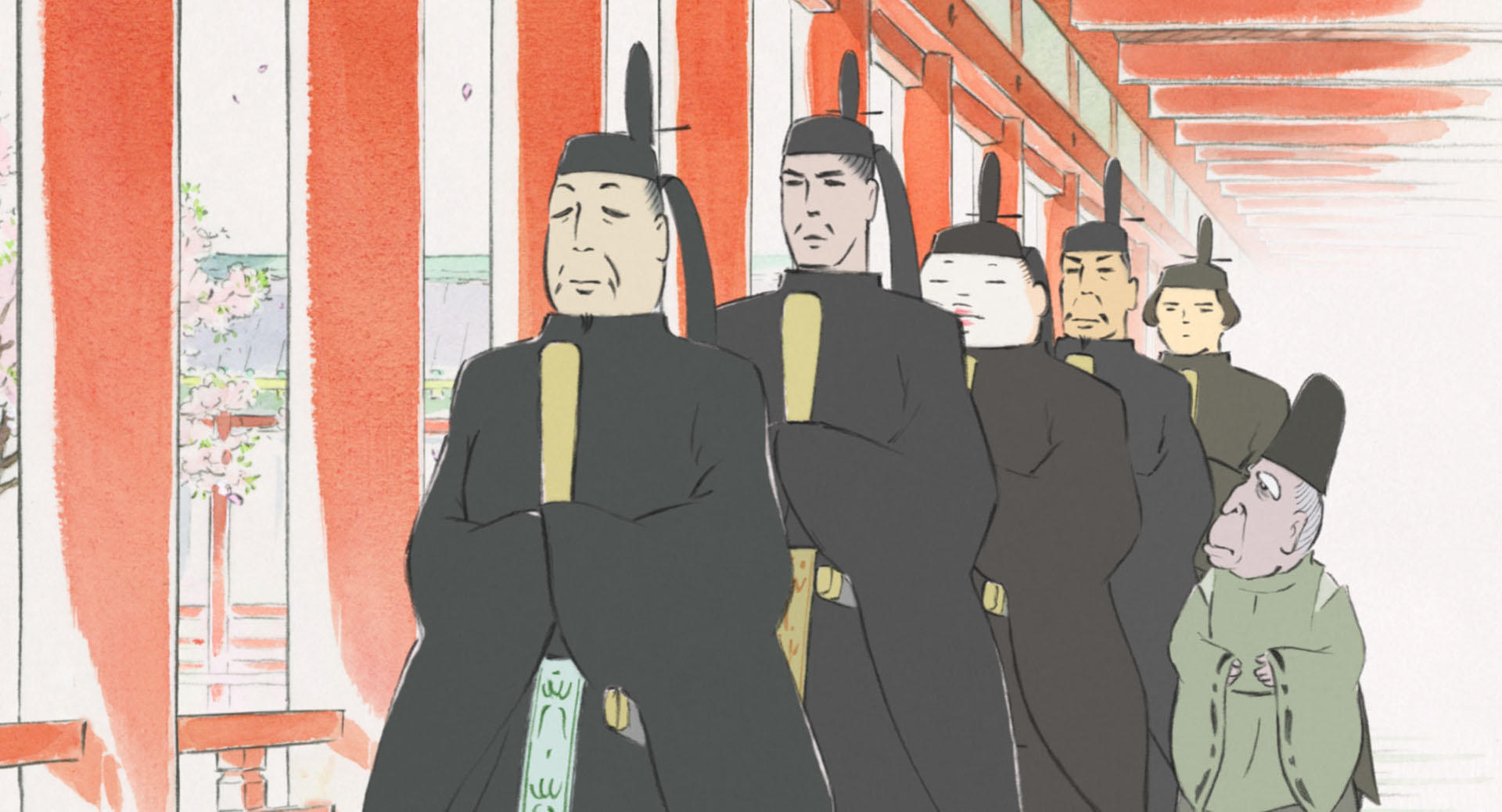
This is not a conventional fantasy adventure. The film begins with earthy comedy and the speed of childhood, then becomes more formal as Kaguya is moved from the countryside to the capital. Its visual style changes with her feelings. Calm scenes can resemble a delicate picture scroll, while fear or anger sends charcoal lines racing across the screen. The unfinished-looking space is deliberate: movement, memory and emotion matter more than polished surfaces.
Kaguya’s tragedy does not come from one simple villain. Her adoptive father loves her and sincerely believes wealth and rank will secure her happiness. Noble suitors speak the language expected of them. Palace customs present themselves as civilisation. Yet each layer of admiration narrows Kaguya’s choices. The film asks whether love still counts as care when it refuses to hear the person being loved.
New viewers should expect a patient 137-minute drama, several funny episodes and an ending of unusual emotional force. For another Isao Takahata film about memory and the life a woman might choose, read the Only Yesterday guide. For a gentler story about a young person building independence, try Kiki’s Delivery Service.
Storyline: what happens in The Tale of the Princess Kaguya?
The following section contains full story spoilers.
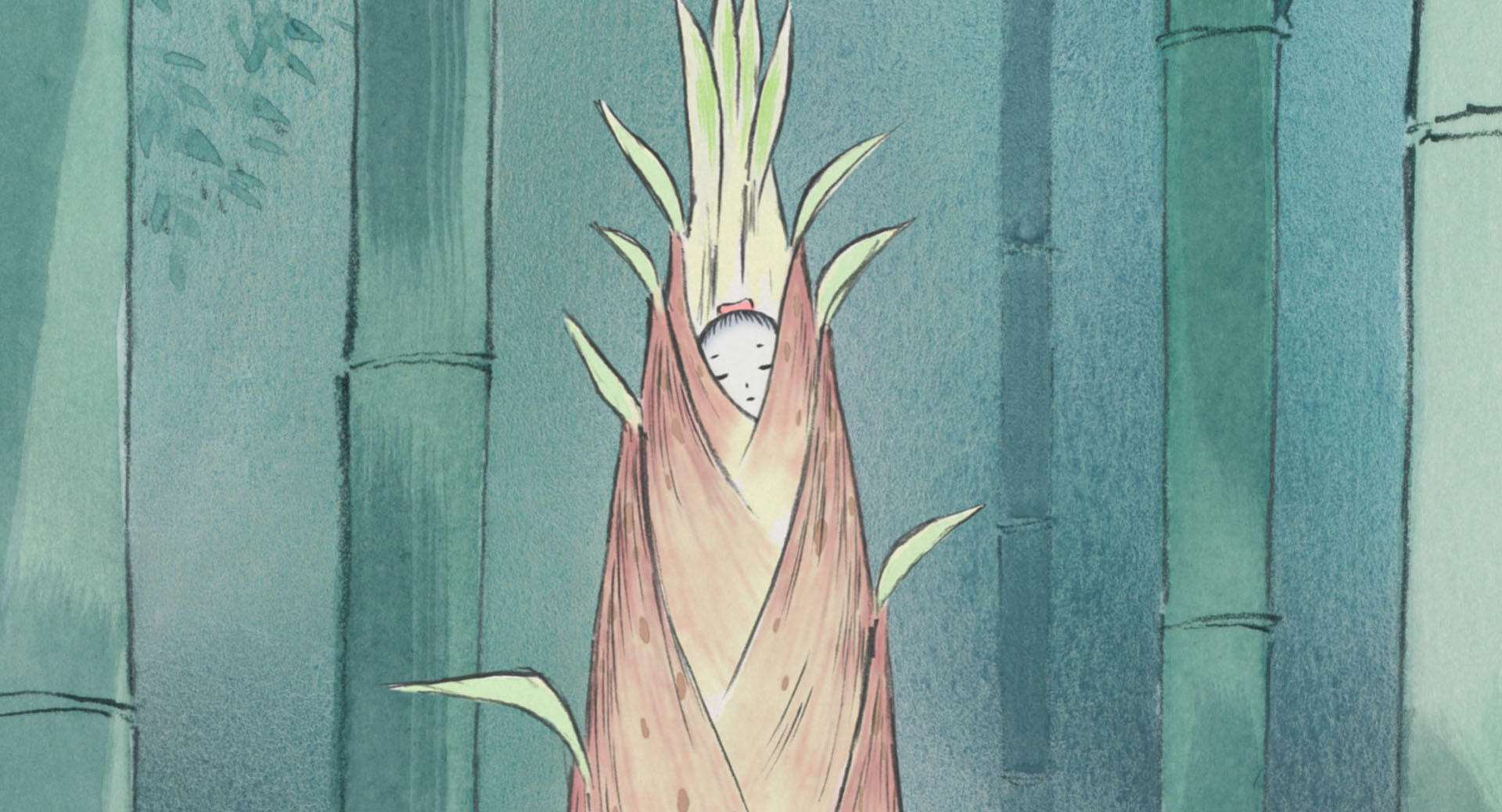
A bamboo cutter finds a tiny, radiant girl seated inside a shining bamboo stalk. He carries her home to his wife, and the couple decide to raise her. The child grows with supernatural speed, progressing from infant to active young girl in a matter of weeks. Country children nickname her “Little Bamboo” because she shoots upward so quickly. Among them is Sutemaru, an older boy who becomes her closest companion.
Her early life is physical and joyful. She runs through fields, eats melon, watches animals and joins the other children in work and play. The animation gives this countryside a sense of breath and momentum. Kaguya belongs to a seasonal world where food, mud, trees and friendship are experienced directly rather than arranged for display.
The bamboo cutter then discovers gold and fine robes inside more bamboo stalks. He decides these gifts reveal a heavenly instruction: the girl is destined to be raised as a princess in the capital. He builds a mansion and moves the family away from the hills. Kaguya loses her friends without having chosen to leave them.
At the mansion, Lady Sagami teaches Kaguya aristocratic behaviour. She must sit correctly, write calligraphy, play the koto, hide ordinary expressions and reshape her appearance. Kaguya learns quickly but resists the idea that elegance requires erasing spontaneity. When attendants remove her eyebrows and blacken her teeth according to court fashion, the process makes visible what the new life demands: her body is being prepared as evidence of somebody else’s achievement.
During a naming celebration, Kaguya overhears men discussing her beauty as though she were an exotic possession purchased by her father’s wealth. Her anger explodes into one of the film’s most famous sequences. She flees the mansion, sheds layers of clothing and runs through a landscape that dissolves into urgent black strokes. The escape carries her back toward the countryside, but winter has emptied it and Sutemaru’s family has moved on. When she awakens again in the capital, the freedom may have been dream, memory or magical flight. The emotional truth is clear even if the event is not explained mechanically.
Five noble suitors pursue Kaguya by comparing her to legendary treasures. She answers by asking each man to bring the object he named: the Buddha’s stone begging bowl, a jewelled branch from Mount Hōrai, a robe made from the fire-rat’s fur, a dragon’s jewel and a cowry shell born by a swallow. The impossible tasks expose their performances of devotion. Some return with frauds, one becomes trapped in his own deception, and another dies while chasing proof of love. Kaguya does not celebrate the outcome. The games show how courtship has made everyone, including her, part of a cruel structure.
The Emperor then becomes interested. Unlike the suitors, he assumes rank gives him access and tries to seize Kaguya during a visit. She disappears from his arms and only returns after he promises to leave. The moment is brief but decisive: even the highest social authority sees her refusal as an obstacle rather than a choice.
Kaguya’s isolation deepens. She eventually tells her adoptive parents that she came from the Moon. Before arriving on Earth, she had watched another lunar being long for this world. Her own desire to experience earthly life brought her here. In a moment of despair, she asked the Moon to take her back. Now a procession will arrive on the next full moon, and the request cannot simply be withdrawn.
The family posts guards and tries to protect her mansion. Their weapons are meaningless against the serene celestial procession. Before it arrives, Kaguya returns to the countryside and reunites with Sutemaru, now married and a father. For a short, dreamlike interval they fly together and imagine the life that might have been possible. The sequence does not turn Sutemaru into a simple romantic solution. Too much time and responsibility has passed. It expresses Kaguya’s grief for a road closed by choices made around her.
When the Moon people descend, their calm music is more frightening than an attack. Kaguya embraces her earthly parents and insists that life here was real: birds, insects, seasons, affection and pain all mattered. A celestial robe is placed around her shoulders. It removes the grief and attachment that connect her to Earth. She looks back from the procession with tears still visible, suggesting that feeling cannot be erased as neatly as the Moon promises.
The ending is tragic because Kaguya understands the value of ordinary life just as it is taken from her. Earth includes suffering, embarrassment and loss, but those experiences are inseparable from touch, freedom, memory and love. The Moon offers purity without pain, and the film reveals that condition as a terrible emptiness.
Main characters
Princess Kaguya
Kaguya is not only a symbol of beauty or impermanence. She is funny, impulsive, gifted, angry and capable of hurting others when cornered. Her rapid physical growth makes the pressure on her unusually visible, but her central struggle is recognisable: people who love an idea of her keep replacing the life she experiences from inside.
The bamboo cutter
Kaguya’s adoptive father sees himself as obeying destiny. Gold appears, so he believes status must be the correct use of it. His mistake is not lack of affection. It is confusing provision with understanding. He works tirelessly to build what society calls a successful life while ignoring the evidence that it makes his daughter miserable.
The bamboo cutter’s wife
Kaguya’s adoptive mother is warmer and more attentive to her daughter’s feelings. She recreates a small garden where Kaguya can grow plants and touch the rhythms of rural life. Yet she cannot fully stop the father’s plans. Her tenderness matters, but the film also shows the limits of sympathy without enough power to change the household’s direction.
Sutemaru
Sutemaru represents Kaguya’s remembered countryside and the possibility of a less formal life. He is not a perfect prince waiting outside the social system. By the time they reunite, he has obligations of his own. Their flight together is powerful because it belongs to longing and imagination rather than an uncomplicated escape route.
Lady Sagami
Lady Sagami teaches courtly behaviour and often provides dry comedy. She is not merely cruel. She understands the rules required for a woman to survive in aristocratic society and cannot imagine refusing the whole structure. Her lessons show how oppressive customs can be maintained by people who regard them as practical reality.
The suitors and the Emperor
The suitors promise impossible devotion but repeatedly treat Kaguya as a prize. The Emperor is more direct: his status has taught him that desire grants permission. Together they reveal a system in which a celebrated woman can be highly valued and barely recognised as an autonomous person.
Themes and interpretation
Freedom versus an ideal life
The mansion contains luxury, art and education, yet Kaguya experiences it as confinement. The film does not claim poverty is automatically liberating. It argues that a life cannot be judged good only from the outside. Comfort becomes coercive when it requires the person receiving it to disappear into a role.
Parents can love the future more than the child
The bamboo cutter wants security and honour for Kaguya. His tragedy is that he responds to imagined destiny more strongly than to her actual voice. This makes the family conflict painful rather than simple. The film asks parents and carers to notice when ambition for a child has become ambition through a child.
Beauty as a social trap
Kaguya’s beauty attracts attention, wealth and status, but it turns her into an object of exchange. Men describe her with rare treasures and then try to prove they deserve ownership. The idealisation sounds respectful while denying ordinary personhood.
Impermanence gives life value
Spring changes to winter. Childhood vanishes. People move away. Feelings lead to grief. The Moon offers release from this cycle, but the ending refuses to call detachment a complete victory. Earth matters because experiences end, not despite it.
Animation as emotional truth
The spare brushwork does more than make the film look distinctive. Lines thicken, spaces open and bodies lose stable form when Kaguya’s emotion overwhelms courtly restraint. The style can show a psychological truth without pretending every sequence is literal reportage.
Age suitability and content guidance
The film contains no graphic violence, but it is emotionally heavy and may be difficult for younger children. Kaguya is separated from the countryside life she loves, pressured to change her body and behaviour, pursued by adult men and briefly grabbed by the Emperor. A suitor dies during a dangerous attempt to retrieve a treasure. His death is not shown graphically, but the consequence and Kaguya’s guilt are serious.
The ending involves forced separation from loving parents, memory loss and intense grief. The Moon procession is visually beautiful rather than monstrous, which can make it more unsettling. Younger viewers may also find the length and courtship episodes slow. Older children interested in folklore or art may engage with it when an adult is available to discuss consent, parental expectations and the ending. Check the current classification for your country and edition rather than treating one age suggestion as universal.
Production and release context
The Tale of the Princess Kaguya was directed and co-written by Isao Takahata and released in Japan on 23 November 2013. Riko Sakaguchi co-wrote the screenplay, Yoshiaki Nishimura produced it, and Joe Hisaishi composed the score. The source story, often called The Tale of the Bamboo Cutter, dates back more than a thousand years and is among Japan’s oldest surviving prose narratives.
Takahata did not present the folktale as a polished period spectacle. The film’s pencil and watercolour-like appearance required enormous control even when the image seems spontaneous. Backgrounds can remain incomplete so a gesture or emotional shift dominates the frame. This approach separates the movie from the richly filled fantasy worlds many viewers associate with Studio Ghibli while remaining unmistakably hand-crafted.
The film was released in the same year as Hayao Miyazaki’s The Wind Rises. Together they show two very different late-career approaches to beauty, ambition and loss. Princess Kaguya was later nominated for the Academy Award for Best Animated Feature.
Where to watch legally
Streaming rights change by country. Use the site’s current legal Studio Ghibli viewing guide, then confirm the film inside the relevant service before subscribing or paying. In North America, GKIDS maintains an official film page and licensed home-video information. Digital rental, purchase and physical editions may also be available depending on region.
Official image gallery
Related films
Watch Only Yesterday for Takahata’s adult reflection on childhood and choice, Pom Poko for his crowded ecological folklore, or The Wind Rises for another 2013 Ghibli film about beauty inseparable from loss. When Marnie Was There is a gentler companion about memory, family wounds and emotional release.
Frequently asked questions
Is The Tale of the Princess Kaguya based on a true story?
No. It adapts the classical Japanese folktale The Tale of the Bamboo Cutter. The film expands the princess’s childhood, emotional life and resistance while retaining the bamboo discovery, noble suitors and return to the Moon.
Why does Kaguya return to the Moon?
She belongs to the Moon and, during despair on Earth, calls for it to take her back. The celestial procession treats the return as inevitable. Emotionally, the ending shows how fully she has come to value imperfect earthly life only when the opportunity to remain is gone.
What does the robe from the Moon do?
The celestial robe removes Kaguya’s grief and attachment to Earth. That promise is presented as frightening rather than merciful because sorrow is tied to her memories of love, seasons, family and freedom.
Is Sutemaru Kaguya’s true love?
He is her closest childhood connection and represents the life she lost. Their reunion carries romantic longing, but the film does not offer him as a simple solution. He has a family and responsibilities, and the flying sequence belongs partly to the realm of wish, memory and impossible alternatives.
Why does the animation look unfinished?
The open paper, sketch-like lines and watercolour textures are a deliberate aesthetic. Detail expands or falls away according to mood. The apparent looseness lets movement and feeling transform the image more directly than a uniformly polished surface would.
Is Princess Kaguya suitable for children?
Some older children will appreciate its folktale structure and art, but it is long, sad and concerned with coercion, unwanted attention, death and separation. It generally suits older children, teenagers and adults better than viewers expecting a light family adventure.
Official film stills are credited to Studio Ghibli and used under its common-sense image-use notice.