The Cat Returns quick facts
- Original Japanese title: Neko no Ongaeshi
- Japanese release: 20 July 2002
- Director: Hiroyuki Morita
- Screenplay: Reiko Yoshida
- Original story: Aoi Hiiragi
- Project concept: Hayao Miyazaki
- Producer: Toshio Suzuki
- Music: Yuji Nomi
- Running time: about 75 minutes
- Best for: families and viewers who want a brisk, funny fantasy with cats, fairy-tale rules and a confidence-building heroine
Spoiler-free answer: The Cat Returns follows Haru, a teenager who saves a cat from traffic and discovers that he is Prince Lune of the Cat Kingdom. The cats interpret her good deed as consent to a series of increasingly alarming rewards, including marriage to the prince. To get home, Haru must stop drifting with other people’s decisions, trust the elegant Baron and choose her own life before she becomes a cat permanently.
Spoiler-free overview
The Cat Returns is one of Studio Ghibli’s shortest and most immediately accessible feature films. It moves quickly from an ordinary school day to talking cats, formal processions, strange gifts and an unwanted royal engagement. The fantasy has the shape of a fairy tale, but the central danger is surprisingly modern: Haru keeps being carried forward because she is polite, uncertain and slow to say no.
The film is connected to Whisper of the Heart through Baron Humbert von Gikkingen and the large white cat Muta. It is not a direct sequel to Shizuku and Seiji’s story. Instead, it takes figures associated with imagination in the earlier film and gives them a literal adventure. You can watch it first without confusion, although seeing Whisper of the Heart adds another layer to Baron’s storybook charm.
Its tone is lighter than Spirited Away or Princess Mononoke. The Cat Kingdom is absurd before it is frightening, and much of the comedy comes from feline etiquette being treated as royal law. Even so, Haru faces real pressure. Her body begins to change, the king treats her wishes as irrelevant and her route home becomes a race against time. The lightness works because the film never loses sight of Haru’s need to recover her voice.
Choose this when you want a clear fantasy adventure rather than a dense mythology. For another girl negotiating a magical world with dangerous rules, continue with Spirited Away. For the Baron’s earlier appearance and a more realistic coming-of-age story, watch Whisper of the Heart. For another gentle film about building independence, try Kiki’s Delivery Service.
Storyline: what happens in The Cat Returns?
Haru begins the film feeling out of step with her own life. She oversleeps, arrives late at school and is embarrassed in front of classmates. Her crush does not seem interested, and she responds to awkward situations by letting them happen rather than directing them. On the way home with her friend Hiromi, she sees a cat carrying a small parcel step into traffic. Haru saves him with a lacrosse stick just before a truck reaches them.
The cat stands upright, thanks her and introduces himself as Prince Lune. That night, a royal procession arrives. The Cat King declares that Haru will be rewarded for saving his son. Haru is too astonished to object effectively. The promised gratitude soon becomes a nuisance: her garden fills with catnip, boxes of live mice arrive at school, and cats begin following her. When the king’s representative suggests that Haru could marry Prince Lune, her startled response is treated as an agreement.
A mysterious voice tells Haru to find the Cat Bureau. She follows a large white cat, Muta, through narrow streets to a small building where she meets Baron Humbert von Gikkingen and Toto, a raven statue who also comes to life. Baron listens carefully and offers the thing the royal cats have not: help based on what Haru actually wants. Before they can prepare, the king’s guards seize Haru and Muta and carry them into the Cat Kingdom.
The kingdom initially looks like an inviting holiday. Cats relax in sunlight, food is abundant and responsibility seems optional. That comfort is part of the trap. Haru is dressed for a banquet and notices that her ears, hands and face are becoming feline. The longer she accepts the kingdom’s version of her future, the less human she becomes. Muta is lured away by food, apparently leaving Haru without her bluntest ally.
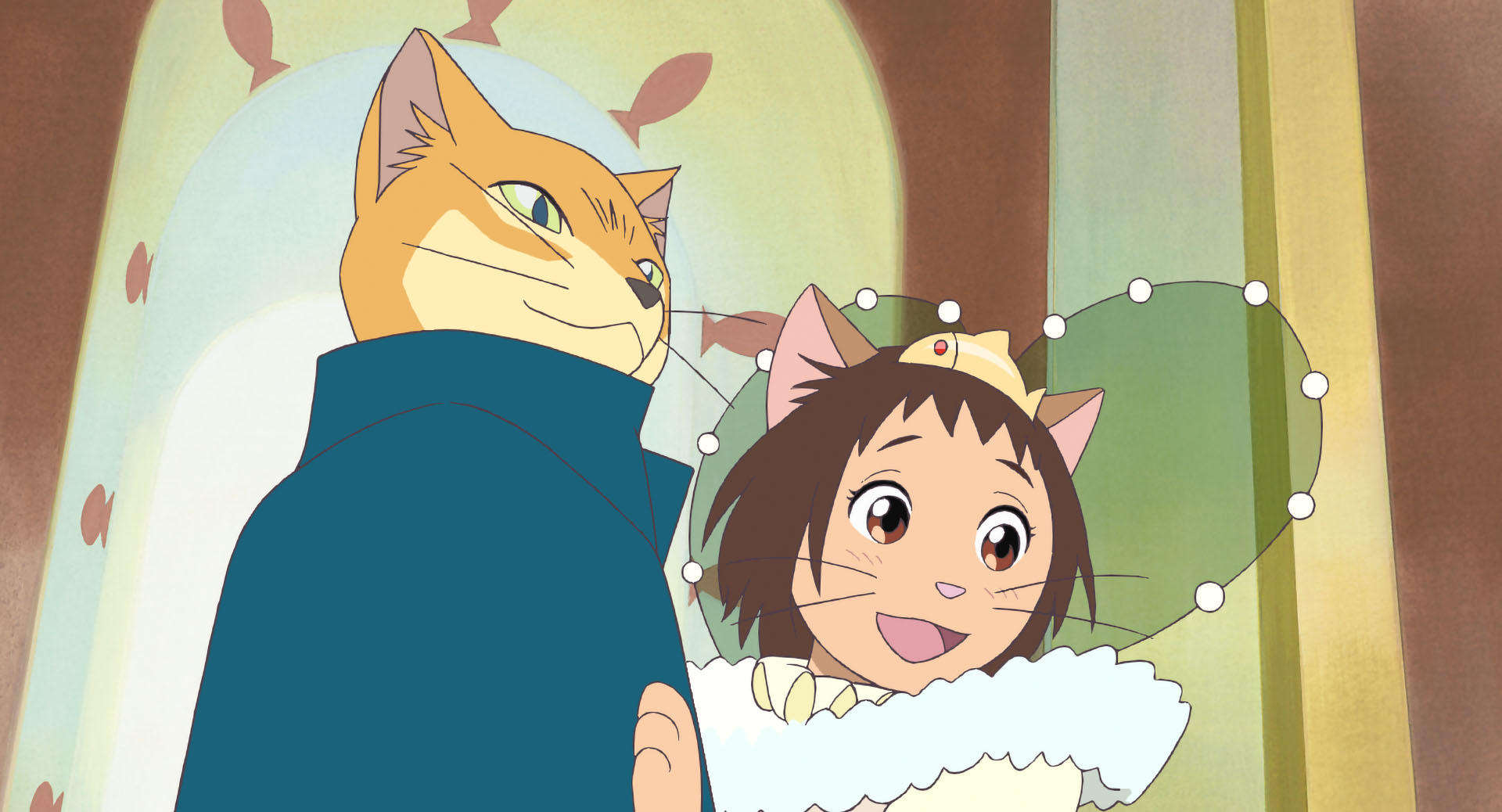
At the royal banquet, performers are punished when they fail to entertain the king. Haru is expected to smile while her marriage is discussed around her. Baron arrives in disguise and dances with her, briefly restoring her sense of control. Once exposed, he challenges the king’s plans. Muta returns too, having eaten his way through the trap, and the rescue party disrupts the celebration.
Haru, Baron and Muta flee through a maze designed to keep them from the tower that leads home. The Cat King cheats by changing the maze and demolishing walls rather than allowing a fair escape. Haru gradually stops behaving like luggage in her own rescue. She makes decisions, keeps moving and refuses to accept the king’s authority simply because it comes with ceremony.
Prince Lune returns with Yuki, a white cat who helped Haru from inside the palace. Lune rejects the proposed marriage because he loves Yuki. Haru realises that Yuki is also the kitten she once helped by giving her fish crackers when they were both younger. Her first act of kindness did not create a debt that gave cats ownership over her future. It created a connection, freely remembered and freely returned.
The Cat King still tries to impose his solution, but Haru has changed. She says what she wants and rejects the Cat Kingdom’s claim. During the final escape, the tower collapses and Haru falls through the sky toward the human world. Baron tells her to trust herself and look at who she has become. With help from Toto and a flock of birds, the group reaches safety.
Back at home, Haru wakes with a new steadiness. She gets up early, prepares breakfast and receives the news that her former crush is single without returning to her old anxious fixation. The adventure has not made her a different person overnight. It has shown her that drifting is also a choice, and that she can choose more deliberately.
Main characters
Haru Yoshioka
Haru is an ordinary teenager whose uncertainty makes the fantasy possible. Her kindness is genuine, but kindness without boundaries leaves her vulnerable to people who redefine it as obligation. Her growth is not about becoming a sword-fighting hero. It is about recognising her own preferences, speaking them clearly and trusting that her life has value even before somebody else approves it.
Baron Humbert von Gikkingen
Baron is a living cat figurine, an elegant guide whose courtesy differs sharply from the Cat King’s manners. The king uses ceremony to erase consent; Baron uses politeness to make space for Haru’s decisions. He is composed, brave and almost impossibly capable, but his most important advice is not “depend on me.” It is “believe in yourself.” Read the site’s Baron character guide for a closer look at his appearances.
Muta
Muta is large, irritable and obsessed with food. His complaints puncture Baron’s perfect storybook atmosphere, while his loyalty repeatedly proves stronger than his grumbling. The Cat Kingdom knows him by another reputation, which hints that his history is much larger than Haru first assumes.
The Cat King
The Cat King is funny because he treats whim as government policy, but he is also the story’s clearest threat. He assumes that status makes agreement unnecessary. His rewards, entertainments and marriage plans serve his own convenience. The film lets his absurdity remain amusing without pretending Haru should surrender to it.
Prince Lune and Yuki
Lune is the prince Haru saves. He is courteous and grateful, but the king acts in his name without asking him. Yuki works inside the palace and quietly helps Haru. Their relationship resolves the unwanted engagement while revealing that Haru’s earlier kindness had already travelled further than she knew.
Toto
Toto is a raven statue brought to life alongside Baron. He scouts from the air, argues with Muta and becomes crucial during the final fall. Together, Baron, Muta and Toto make the Bureau feel like a compact adventure team rather than a single magical rescuer.
Themes, meaning and interpretation
Kindness does not create consent
Haru saves Lune because a life is in danger. The Cat King converts that generous act into a chain of obligations. Gifts become demands, gratitude becomes possession and politeness is treated as permission. The film’s comedy makes the escalation entertaining, but its moral line is clear: somebody helping you does not give you the right to choose their future.
Self-trust is a practical skill
Haru does not lack a hidden destiny. She lacks confidence in ordinary decisions. The Cat Kingdom magnifies that habit until it physically transforms her. Her return begins when she names what she wants. Confidence here is not feeling fearless; it is acting from your own judgment while frightened.
Escapism can become another cage
The kingdom offers food, sunlight, servants and an escape from school embarrassment. It sounds restful because Haru feels dissatisfied with normal life. Yet comfort without agency quickly becomes confinement. The film enjoys fantasy while warning that a beautiful alternative is not freedom if somebody else controls your role inside it.
Identity changes under expectation
Haru develops cat features as the kingdom defines her as a future feline princess. The transformation turns social pressure into an image. She becomes what everyone around her assumes she will become, until she remembers herself strongly enough to resist.
Real help returns agency
Baron rescues Haru, but he never claims her decisions. Yuki gives warnings rather than commands. Muta’s loyalty leaves room for argument. Their help works because it strengthens Haru’s capacity to act. That is the opposite of the Cat King’s “rewards,” which make her smaller and more dependent.
Age suitability and content guidance
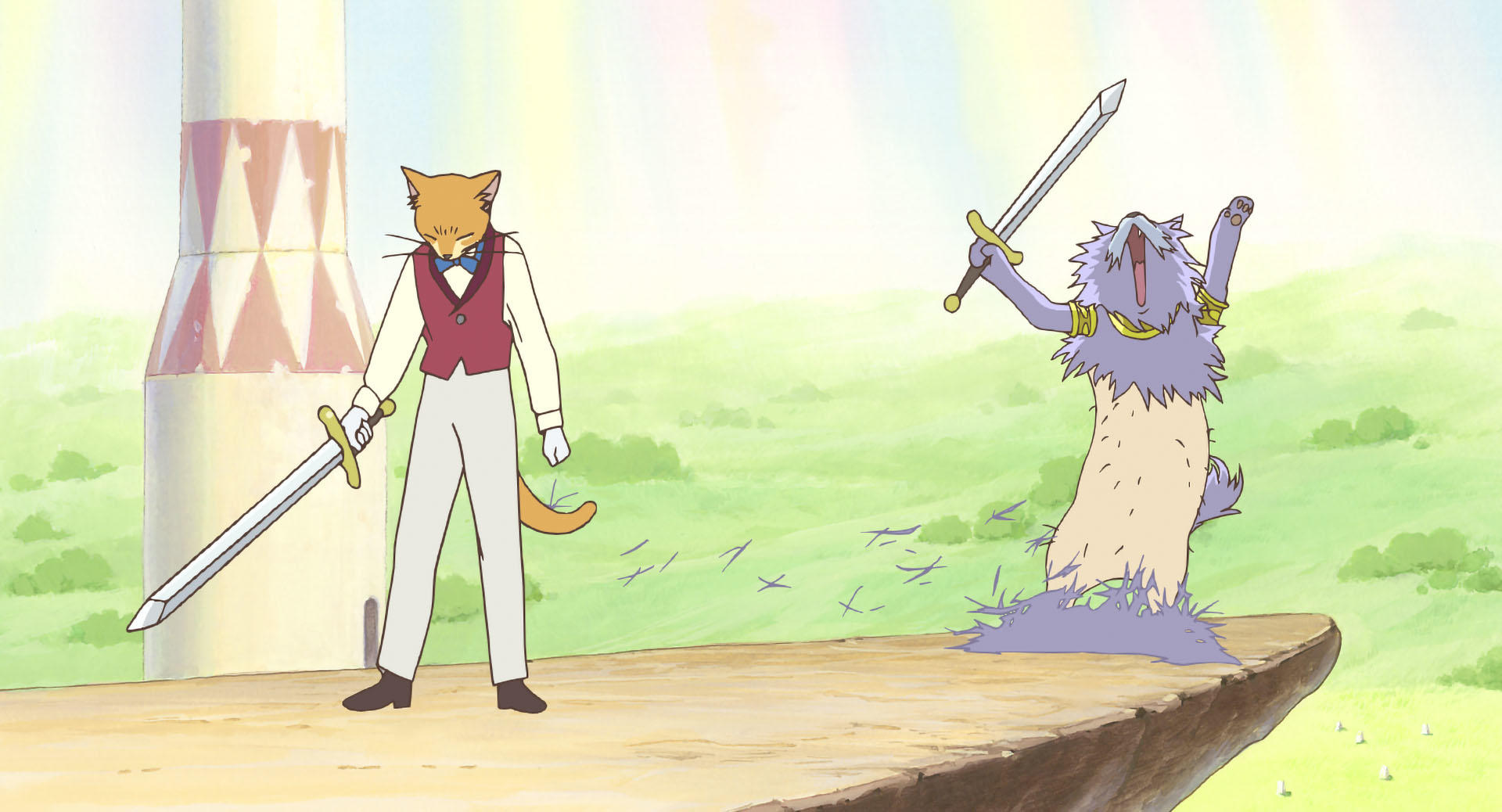
The Cat Returns is generally one of Ghibli’s more family-friendly adventures, but it is not free of peril. Haru is nearly struck by traffic while saving Lune. She is abducted, pressured into an unwanted marriage and gradually transformed into a cat. There is comic swordplay, palace guards, threats of punishment, a damaged tower and a long fall from the sky. The action is stylised and there is no graphic injury or gore.
Sensitive children may be unsettled by Haru losing control of her body or by the adults of the Cat Kingdom ignoring her refusal. Most of the tension is balanced by jokes, talking animals and a brisk runtime. Ratings vary by territory and release, so families should check the current local classification. As a practical starting point, it suits children comfortable with mild fantasy danger and a villain who is silly but persistent.
Production, release and connection to Whisper of the Heart
Studio Ghibli’s official works page lists the Japanese release date as 20 July 2002 and the running time as approximately 75 minutes. Hiroyuki Morita directed from Reiko Yoshida’s screenplay, based on an original story by Aoi Hiiragi. Hayao Miyazaki is credited with planning the project, Toshio Suzuki as production producer, Yuji Nomi for the music and Ayano Tsuji for the theme song. Toho distributed the Japanese release.
The Aoi Hiiragi connection matters because she also created the manga behind Whisper of the Heart. The Cat Returns develops the Baron and Muta into a more overt fantasy but does not continue Shizuku’s biography. It is best described as a spin-off or imaginative companion. The earlier film is about making a story; this one feels like stepping inside a related story.
Morita’s direction favours speed, clear silhouettes and broad comic reactions. The shorter runtime keeps the adventure lean. Haru’s real-world scenes establish uncertainty quickly, the royal procession shifts the rules, and the Cat Kingdom moves from temptation to escape without a long mythology lesson. That economy is part of the film’s identity rather than evidence that it is a minor version of a longer Ghibli epic.
Where to watch legally
Streaming, rental and disc rights vary by country and can change. Start with the site’s current Studio Ghibli streaming guide, then confirm the title in your local service. In North America, GKIDS maintains an official The Cat Returns page with current release information. Do not assume a listing in one country applies elsewhere.
Official image gallery
Related films and guides
Watch Whisper of the Heart for Baron and Muta in a grounded story about creativity, Spirited Away for a deeper magical world built on dangerous rules, or Kiki’s Delivery Service for another heroine learning to direct her own life. The Studio Ghibli cat guide compares Baron and Muta with Jiji, Catbus and other feline favourites.
Frequently asked questions
Is The Cat Returns a sequel to Whisper of the Heart?
Not in the usual plot-continuation sense. It is a related spin-off or imaginative companion that reuses Baron and Muta in a literal fantasy. Haru’s story does not continue Shizuku and Seiji’s life.
Why does Haru start turning into a cat?
The transformation reflects how completely the Cat Kingdom is assigning her a new identity. As Haru accepts the kingdom’s plan and forgets her own wishes, she becomes more feline. Reasserting herself helps reverse that process.
Who is the Baron?
Baron Humbert von Gikkingen is an elegant cat figurine who comes to life and runs the Cat Bureau. He first appears as an important object and imagined hero in Whisper of the Heart.
Are Muta and Moon the same cat?
The films connect the large wandering cat from Whisper of the Heart, known by names including Moon and Muta, with the grumpy companion in The Cat Returns. The spin-off gives him a much more openly fantastical role.
Is The Cat Returns scary for children?
It has mild fantasy peril, abduction, transformation, comic fighting and a major fall, but little graphic content. Children sensitive to body transformation or loss of control may need reassurance.
Who directed The Cat Returns?
Hiroyuki Morita directed it. Reiko Yoshida wrote the screenplay from Aoi Hiiragi’s original story, with Hayao Miyazaki credited for the project concept.
How long is The Cat Returns?
Studio Ghibli’s official works page lists a running time of approximately 75 minutes, making it one of the studio’s brisker feature-length adventures.
What does Neko no Ongaeshi mean?
The Japanese title refers to a cat’s repayment or return of a favour. The phrase captures the story’s comic problem: the cats repay Haru’s kindness in ways she never requested.
Official film stills are credited to Studio Ghibli and used under its common-sense image-use notice.