Whisper of the Heart quick facts
- Japanese title: Mimi o Sumaseba (耳をすませば)
- Japanese release: 15 July 1995
- Director: Yoshifumi Kondō
- Original manga: Aoi Hiiragi
- Screenplay and storyboards: Hayao Miyazaki
- Producer: Toshio Suzuki
- Music: Yuji Nomi
- Running time: about 111 minutes
- Setting: suburban Tokyo, inspired by the hills around Seiseki-Sakuragaoka
- Best for: older children, teenagers and adults who enjoy realistic coming-of-age stories, first love, music and creative self-discovery
Spoiler-free answer: Whisper of the Heart follows Shizuku Tsukishima, a book-loving junior-high student who discovers that the same name appears repeatedly on her library cards. Her curiosity leads to Seiji Amasawa, an ambitious boy learning to make violins, and to an antique shop filled with stories. Their connection pushes Shizuku to test a dream of her own. The result is a warm but unusually honest film about first love, creative work and the uncomfortable distance between admiring art and making it.
Spoiler-free overview
This is one of Studio Ghibli’s most grounded feature films. There are no literal spirits, curses or flying kingdoms in Shizuku’s everyday life. Trains, libraries, concrete apartment blocks, steep roads and family routines give the film its shape. Fantasy enters through imagination: an elegant cat statue called the Baron, an unfinished story and the possibility that an ordinary neighbourhood can contain a doorway into a larger life.
Shizuku is clever and imaginative, but she is also restless. She rewrites the lyrics of “Country Roads,” reads when she should be studying and resists the future adults expect her to plan. Seiji initially annoys her. Once she understands the seriousness of his goal, however, irritation becomes admiration and pressure. He is willing to leave home for a trial apprenticeship in violin making. Shizuku has strong feelings about stories, but no equivalent proof that she can create one.
The film’s romance works because it does not simply tell Shizuku that she is special. Seiji’s ambition becomes a challenge: if she wants a creative life, what is she prepared to practise, finish and show to another person? Their affection matters, but so do the library, the workshop, her family and the patient adult who reads her first manuscript without pretending it is already perfect.
Choose Whisper of the Heart when you want a gentle film with real emotional stakes. It pairs naturally with our Kiki’s Delivery Service guide because both films treat confidence as a relationship between talent, work and recovery. It also leads directly toward The Cat Returns, which reimagines the Baron as an active fantasy hero.
Full story and ending explained
This section contains full spoilers. During a summer in Tokyo, Shizuku notices the name Seiji Amasawa written on the checkout cards of many library books she borrows. The repeated name turns a routine habit into a mystery. She imagines someone who reads even more than she does, not realising that she has already encountered the real Seiji and found him irritating.
Shizuku is also distracted by her friend Yuko’s feelings for their classmate Sugimura. Sugimura, meanwhile, likes Shizuku. The crossed crushes create embarrassment rather than melodrama. Shizuku cannot solve everyone else’s feelings neatly, and the confusion exposes how little she understands her own response to Seiji.
One day Shizuku follows a large cat from a train through unfamiliar streets and up the hills. The cat leads her to an antique shop owned by Seiji’s grandfather, Nishi. Inside she sees the Baron, a finely dressed cat figurine whose missing companion has become part of the shop’s private history. The room, its repaired clock and the stories attached to its objects awaken Shizuku’s imagination.
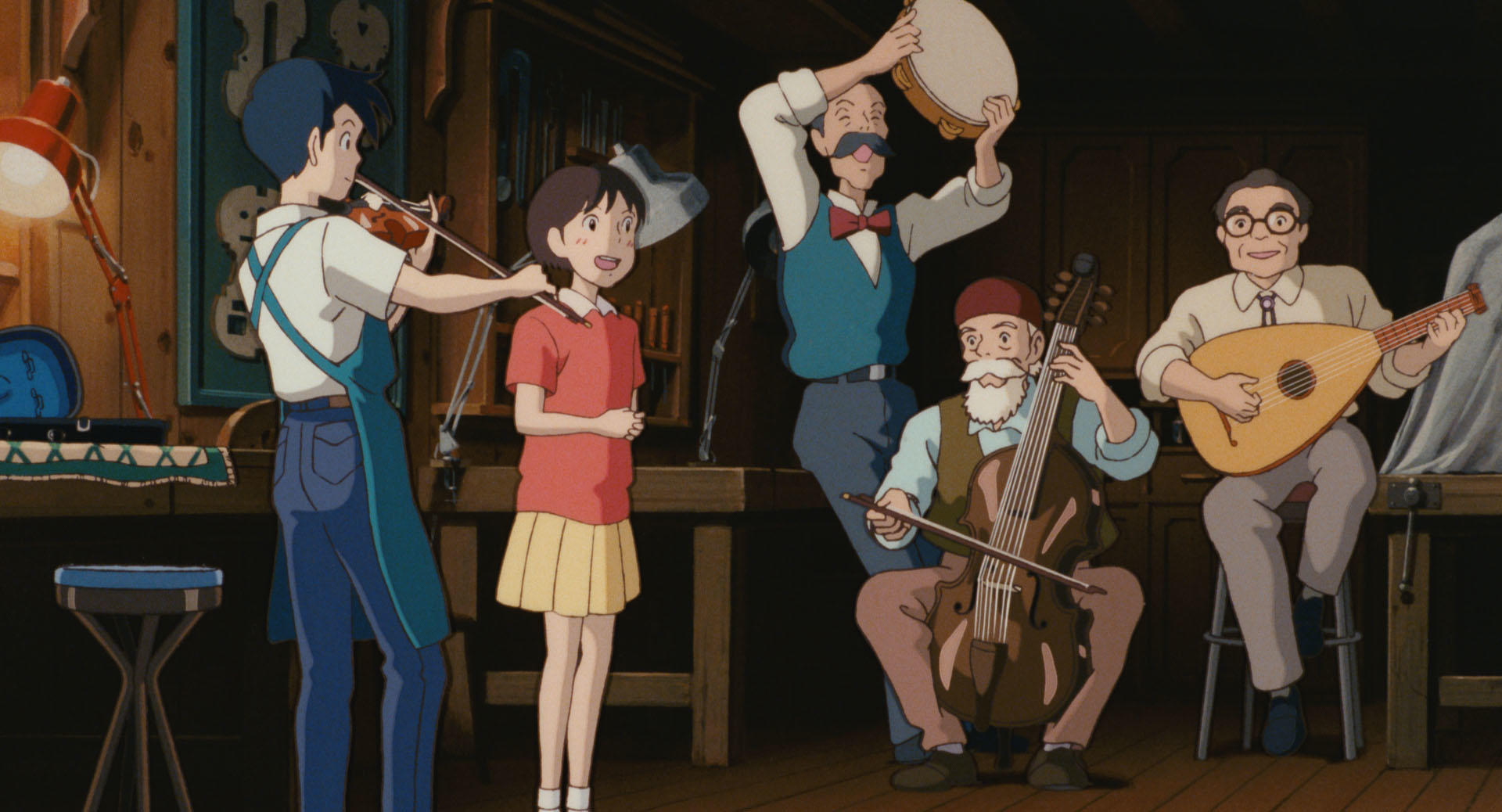
She soon learns that Seiji is Nishi’s grandson. He is studying violin making and wants to test whether he has the ability and discipline to pursue it seriously. In the workshop he plays “Country Roads” while Shizuku sings, and Nishi’s friends join in. The scene is joyful because no one performs alone: craft, music and encouragement meet in one room.
Seiji leaves for a trial period with a workshop in Cremona, Italy. Before he goes, he and Shizuku acknowledge their feelings. His departure gives Shizuku a deadline and a mirror. She decides to use the same period to write a complete story inspired by the Baron. Rather than waiting for confidence, she will find out what she can do by working.
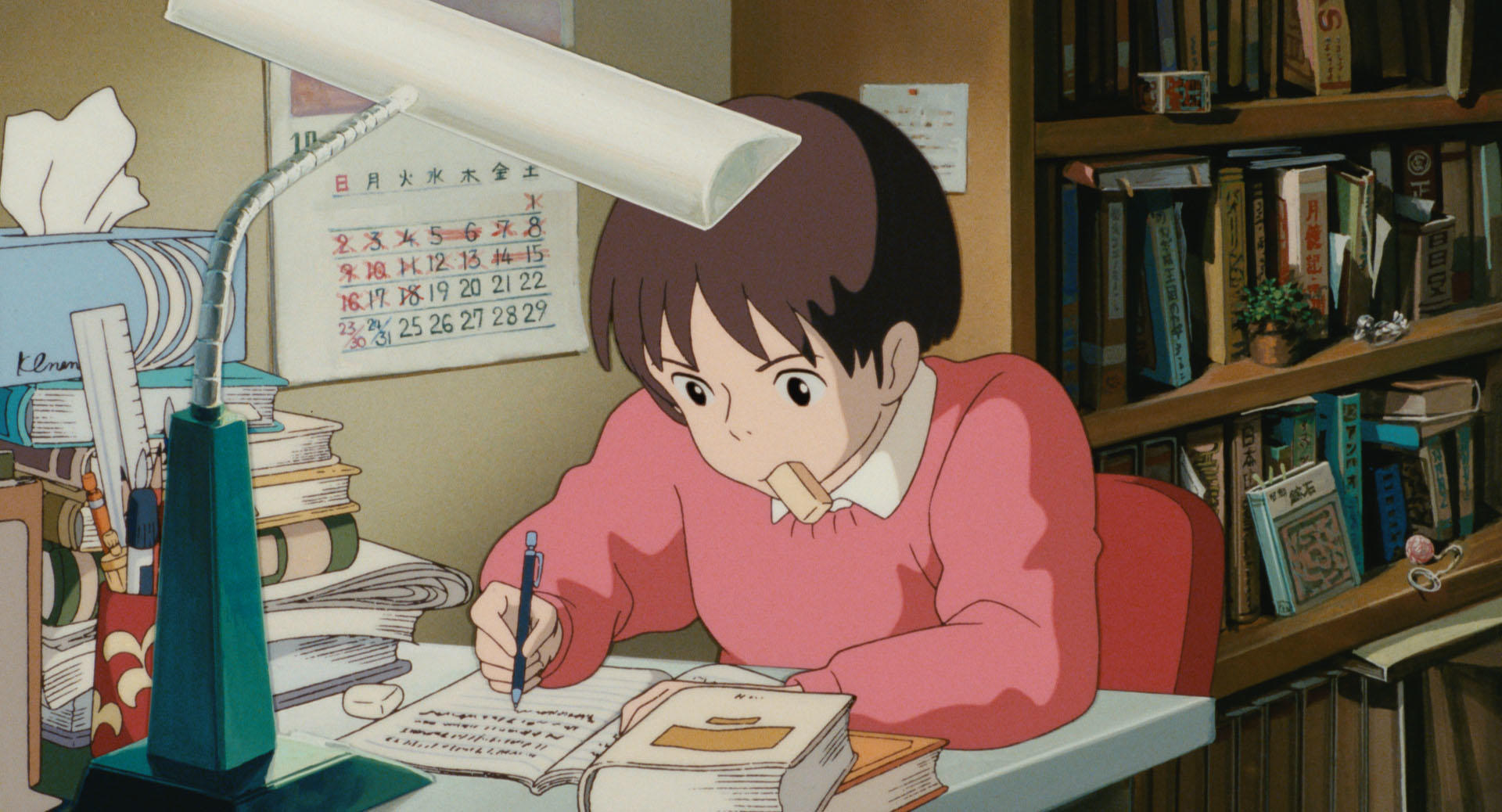
That choice unsettles her ordinary life. Shizuku reads, drafts and revises late into the night. Her schoolwork suffers, she becomes exhausted and her family worries. Her older sister pushes her to focus on exams, while her parents take a more measured approach: if Shizuku is deliberately testing something important, she must also accept the consequences of that decision.
The fantasy passages from Shizuku’s story show the Baron guiding a girl through a mineral-bright landscape. These scenes are not a separate supernatural plot. They let viewers enter the exhilaration and uncertainty of writing, where images feel vivid before the author knows how to shape them. Shizuku is creating a world while learning that a vivid idea does not automatically become a finished story.
When she finally gives the manuscript to Nishi, his opinion matters more than praise from a romantic partner. He reads it carefully and tells her that it is rough, direct and valuable, comparing her talent to an unpolished stone that still needs work. Shizuku cries, partly from relief and partly because finishing has shown her how much she does not yet know. The film refuses both cruel rejection and empty reassurance. Her first story is an achievement because she completed it and learned from it, not because it proves instant mastery.
After the test, Shizuku returns to studying with a clearer sense of proportion. She has not abandoned writing. She now understands that her dream requires patience, education and repeated practice. Seiji returns early and takes her by bicycle to a viewpoint above the waking city. Shizuku helps push the bicycle up the steep final climb, a small visual answer to the question of what their relationship should be: neither person simply carries the other.
At sunrise Seiji proposes that they marry someday, and Shizuku accepts. The moment is intentionally youthful, earnest and awkward. It is not a practical wedding plan so much as a declaration that they can imagine a future in which both ambitions matter. The ending is hopeful because Shizuku has acquired direction, not because every decision has been settled.
Main characters
Shizuku Tsukishima
Shizuku is curious, verbal and stubborn. She consumes books easily, but the film distinguishes taste from craft. Her central growth is the move from imagining herself as a writer to making a flawed piece of writing and allowing someone to read it. She does not become less dreamy; she becomes more responsible for the dream.
Seiji Amasawa
Seiji can appear smug when Shizuku first meets him, but his seriousness changes her view. His violin-making goal gives the story an outward measure of commitment. Importantly, he is also uncertain. The trip to Cremona is a test, not proof that he is already a master, and his fear of falling behind Shizuku mirrors her fear of falling behind him.
Shiro Nishi
Nishi, Seiji’s grandfather, owns the antique shop and provides the film’s model of generous mentorship. He takes Shizuku’s imagination seriously without flattering her. His response to the manuscript gives her both kindness and an honest standard. The history of the Baron also shows how objects can preserve longing and unfinished stories.
Yuko Harada and Sugimura
Yuko and Sugimura make the school world feel socially real. Their tangled affections create pain, but nobody is turned into a villain. Sugimura’s confession forces Shizuku to recognise that friendship does not guarantee romantic reciprocity and helps clarify where her own feelings are moving.
Moon and the Baron
The wandering cat, called Moon by one household and Muta elsewhere, is a guide without needing magical powers. Following him changes Shizuku’s route through the city. The Baron is a statue inside the realistic story and a living companion inside her imagination. Both suggest that creativity begins by noticing an invitation hidden in ordinary life.
Themes and interpretation
Creative ambition needs imperfect work
The film’s clearest idea is that wanting to create is not the same as creating. Shizuku’s manuscript is uneven, but finishing it transforms fantasy into evidence. She can now improve something real. That makes the film especially useful for writers, artists and students who mistake the discomfort of being a beginner for proof they should stop. Our Ghibli guide for artists and creative burnout develops this connection alongside Kiki and Jiro.
First love can sharpen identity
Seiji does not rescue Shizuku or provide her dream. His seriousness makes her ask what she wants. Shizuku’s effort also challenges him. The romance is most convincing when it creates mutual movement rather than dependence. Even the bicycle climb turns partnership into physical action.
Books connect strangers across time
The library-card mystery makes reading social. Shizuku’s private reading life contains traces of another person, and that discovery changes how she sees the city. The old checkout system becomes a quiet record of two lives crossing before either reader knows the other.
Ordinary places can hold imaginative depth
The film treats suburbs as worthy of wonder. A commuter train, a concrete stairway, a workshop and a hilltop view can become emotionally enormous when a character pays attention. Fantasy is not an escape from the neighbourhood. It grows from the stories, craft and relationships already there.
Mentorship should combine belief with standards
Nishi does not tell Shizuku that effort alone makes the manuscript excellent. He reads with care, names its roughness and protects the courage required to show it. His metaphor of the unpolished stone gives her a future based on practice rather than a fixed label such as talented or untalented.
Age suitability and content guidance
Whisper of the Heart is one of Studio Ghibli’s gentler films. It has no fantasy violence, frightening monsters or major character death. The tension comes from school pressure, family disagreements, unreturned crushes, creative exhaustion and the emotional intensity of first love. Younger children may find its 111-minute realistic story slower than Totoro or Ponyo, while teenagers may recognise its worries immediately.
Shizuku loses sleep and lets her grades fall while writing. Her family argues about the choice, but the conversations remain grounded and caring. There are moments of embarrassment and tears, plus a late-night bicycle journey and an intense sunrise promise about future marriage. Families can treat that promise as youthful sincerity rather than an instruction or settled adult plan.
For many viewers around secondary-school age, the film can open useful conversations about exams, ambition, comparing yourself with talented friends and separating a first attempt from your worth. Check the official age classification and content advice attached to the edition available in your country.
Production and release context
Studio Ghibli’s official works page credits Aoi Hiiragi’s manga as the source, Hayao Miyazaki with screenplay and storyboards, Yoshifumi Kondō as director, Toshio Suzuki as producer and Yuji Nomi with the music. It lists a Japanese theatrical release on 15 July 1995 through Toho and a running time of approximately 111 minutes.
The film is especially significant as the only Studio Ghibli feature directed by Kondō. Its controlled acting, observed domestic spaces and attention to movement support a story where small changes in expression matter more than spectacle. Miyazaki’s fantasy instincts remain visible in Shizuku’s imagined Baron sequences, but the film’s overall identity comes from the balance between those flights and Kondō’s detailed everyday world.
The Japanese version of “Country Roads,” performed within the story, becomes more than a familiar song. Shizuku first plays with translated lyrics, then sings with other people and finally learns to create words and stories that carry personal risk. Music joins books, violins and antiques as another form of craft passed between generations.
Where to watch Whisper of the Heart legally
Streaming, rental and disc availability changes by country and date. The official GKIDS Whisper of the Heart page is the best starting point for current North American release information. UK and other regional viewers should use our legal Studio Ghibli viewing guide, then confirm that the local listing is the 1995 animated film rather than the separate 2022 live-action adaptation.
Related films
Watch Kiki’s Delivery Service for another young creative person discovering that confidence and work are connected; Only Yesterday for a more adult reflection on choosing a life; From Up on Poppy Hill for school, community and young love; or The Cat Returns to see the Baron become a much more literal fantasy hero. Browse the complete Movies directory for the release-order route.
Frequently asked questions
Is Whisper of the Heart a fantasy film?
Its main story is realistic. The fantasy scenes represent Shizuku’s developing story and imagination. The Baron is an antique-shop statue in her everyday world, not a visibly living magical character there.
Is The Cat Returns a sequel?
It is better understood as a related spin-off or imaginative companion than a direct continuation. The Baron and Muta return in different, more overtly fantastical roles, but the plot does not continue Shizuku and Seiji’s life.
What is Shizuku writing?
She writes a fantasy story inspired by the Baron and the objects around Nishi’s workshop. The completed manuscript is important because it tests her discipline; the film deliberately does not present it as a polished masterpiece.
Why does Shizuku follow the cat?
Curiosity breaks her normal route. Following Moon leads her to the antique shop, Seiji’s family and the objects that spark her story. The cat works as an ordinary-looking guide into a newly imaginative view of her own city.
Do Shizuku and Seiji get married?
The film ends with Seiji asking Shizuku to marry him someday and Shizuku accepting. It does not show their adult future, so the proposal is best read as a sincere youthful promise rather than confirmation of a later wedding.
What does the title mean?
Mimi o Sumaseba can be translated along the lines of “if you listen closely” or “listen carefully.” It suits a story about noticing quiet signals: names on library cards, workshop sounds, another person’s ambition and your own half-formed desire.
Is Whisper of the Heart suitable for children?
It is gentle in content, with no major violence or supernatural scares. Its realistic school concerns, romance and creative anxiety often connect best with older children and teenagers, while very young viewers may find the pace slow.
Image source: official Whisper of the Heart stills from the Studio Ghibli works gallery, whose exact page includes the studio’s common-sense image-use notice.
Official film stills are credited to Studio Ghibli and used under its common-sense image-use notice.