The Red Turtle quick facts
- Original title: La Tortue rouge
- Japanese title: Reddo Tātoru: Aru Shima no Monogatari (The Red Turtle: A Story of an Island)
- Japanese release: 17 September 2016
- Director and original story: Michaël Dudok de Wit
- Screenplay: Michaël Dudok de Wit and Pascale Ferran
- Artistic producer: Isao Takahata
- Music: Laurent Perez del Mar
- Running time: about 81 minutes
- Dialogue: none; the story is told through movement, sound, music and images
- Production context: an international co-production involving Studio Ghibli and European partners
- Best for: viewers who enjoy quiet visual storytelling, survival tales and symbolic stories about nature, family, loss and acceptance
Spoiler-free answer: The Red Turtle follows a nameless man stranded on a tropical island. Each raft he builds is destroyed by a mysterious red turtle. What begins as a survival story gradually becomes a wordless fable about anger, companionship, family and the shape of an entire human life. It is connected to Studio Ghibli as an international co-production, but its spare visual language is distinctly Michaël Dudok de Wit’s.
Spoiler-free overview
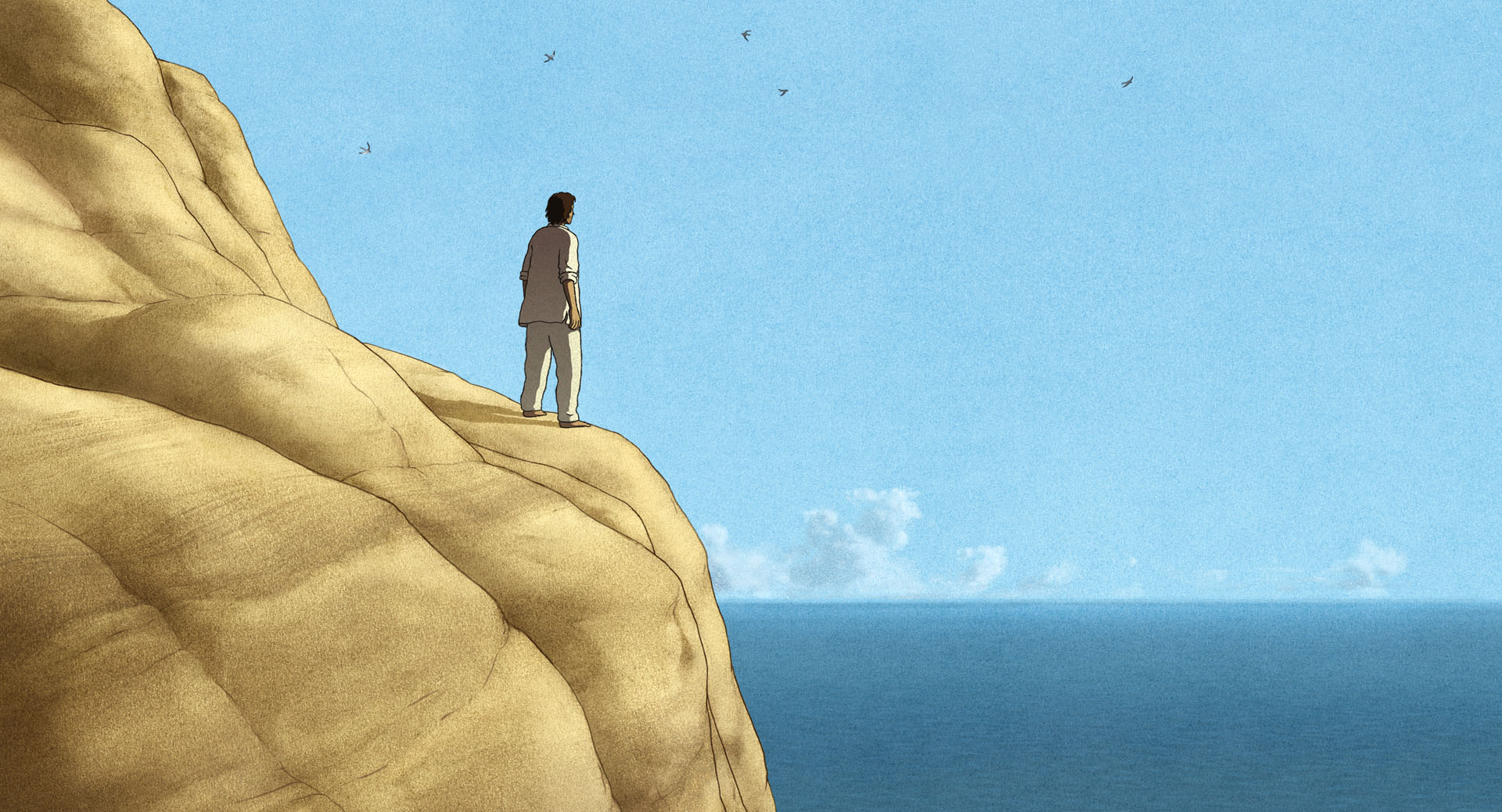
The Red Turtle opens with almost no explanation. A man is tossed through a violent sea, reaches an uninhabited island and begins the practical work of staying alive. He finds water, fruit, bamboo and shelter. Small crabs observe him. Birds pass overhead. No rescuer arrives, and there is no spoken narration to tell us who he was before the storm.
The first section is built around escape. The man repeatedly constructs bamboo rafts and pushes them into open water. Something powerful strikes from below and breaks them apart. When he finally sees the red turtle responsible, fear and frustration become rage. That confrontation turns the film away from a straightforward castaway adventure and toward a strange, emotionally charged myth.
The absence of dialogue is not a gimmick. Dudok de Wit makes posture, distance, weather and rhythm carry the story. A tiny human body against a pale beach can communicate loneliness; a change in the tide can signal danger; a gesture between two people can replace a page of explanation. The approach makes the film accessible across languages, but it also asks for patient attention. This is not a fast Ghibli comedy or an exposition-heavy fantasy.
Choose it when you want something meditative and visually clear rather than plot-dense. For another ecological fable with a much larger cast and more comedy, try Pom Poko. For a more confrontational struggle between people and nature, watch Princess Mononoke. For another adult reflection on memory and the life someone chooses, continue with Only Yesterday.
Storyline: what happens in The Red Turtle?
The rest of this section contains full story and ending spoilers.
A violent storm leaves the man alone in the ocean. He is battered by waves before waking on a tropical island with no visible settlement, boat or companion. His first days are practical. He explores the forest and shoreline, finds fresh water and fruit, and uses bamboo to make shelter. A group of small red crabs follows his activity like a silent audience. He searches the horizon and calls out, but the only answers come from the island.
Determined to leave, he cuts bamboo and ties it into a raft. The sea seems calm enough, yet an unseen force strikes the raft from below and destroys it. He swims back exhausted. He builds again, using more care and stronger materials. The same thing happens. On a later attempt he dives and finally sees an enormous red turtle beneath him.
When the turtle comes ashore, the man’s fear and accumulated frustration overwhelm him. He attacks it and rolls it onto its back, leaving it helpless under the sun. At first his act seems like revenge against the creature that trapped him. As time passes, anger drains away and guilt takes its place. He brings water and tries to protect the turtle, but it has stopped moving.
The shell splits, and the turtle transforms into a red-haired woman. The change is never explained as a system of magic. It arrives with the directness of myth. The man cares for her until she wakes. Their relationship grows through shared work, play and proximity rather than conversation. He destroys the last raft, accepting that his life is now connected to hers and to the island.
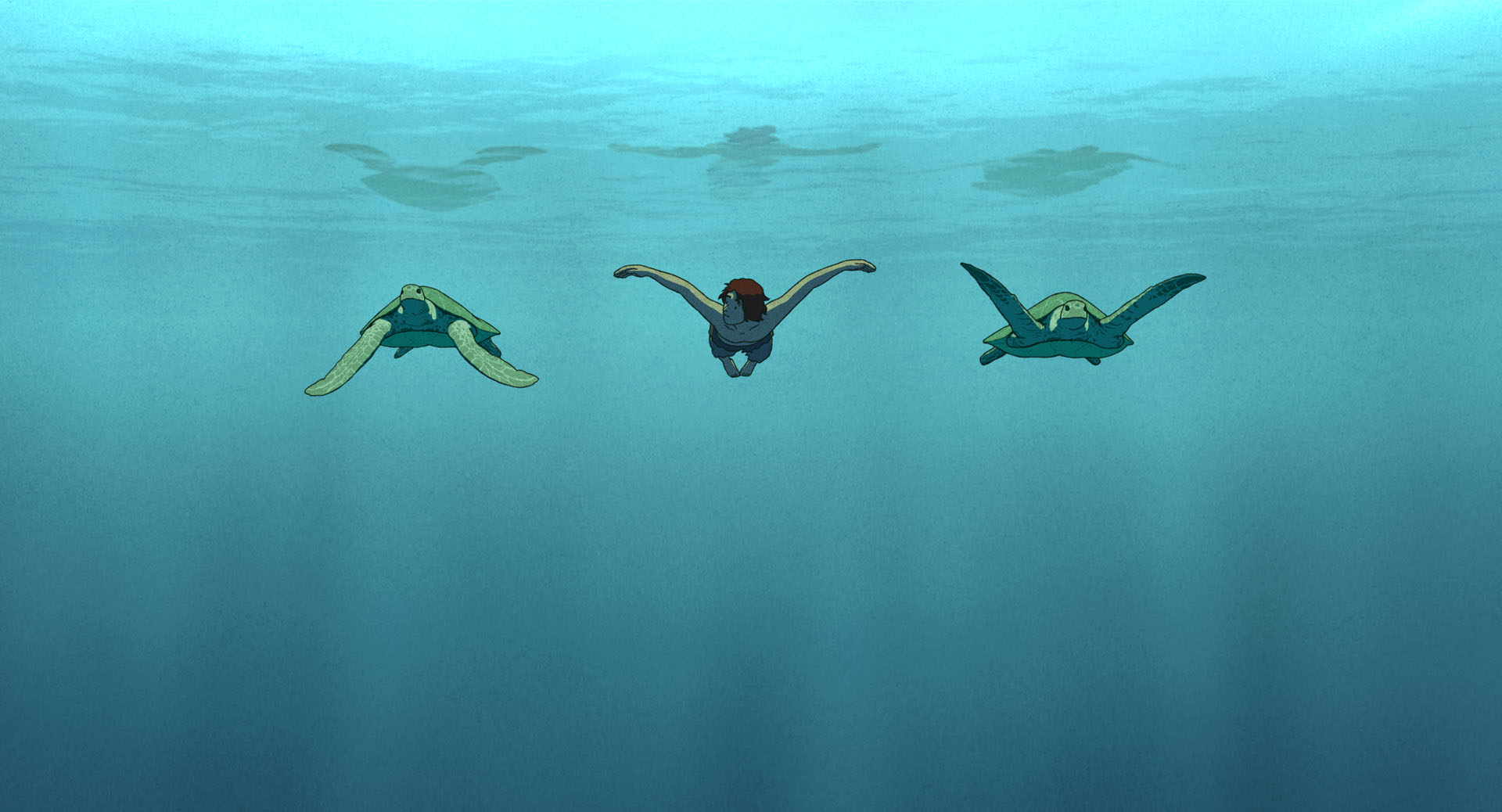
Time passes. The couple have a son, and the film settles into the rhythms of family life. The boy learns the island differently from his father. Where the man once treated every resource as part of an escape plan, the child explores with curiosity. He swims powerfully, befriends turtles and seems instinctively at home in the sea. His parents teach and protect him, but the island is also his teacher.
A tsunami strikes with devastating force. Water tears through the bamboo forest and scatters the family. The woman searches underwater while the son tries to reach his parents. The man is badly injured and lies among the wreckage. Together they find one another and survive, but their home and familiar landscape have changed. The sequence gives nature neither cruelty nor kindness. The same sea that sustains them can erase their work in minutes.
As the son grows into a young man, he becomes increasingly drawn beyond the island. He sees turtles gathering offshore and understands that his life cannot remain contained by his parents’ home. His departure echoes his father’s old desire to cross the sea, but it does not repeat the same desperation. The parents let him go, grieving and accepting the separation at once.
The couple grow old together. The man’s body slows, and eventually he dies peacefully beside the woman. She holds him, then returns to her original form as the red turtle and moves back into the ocean. The ending completes a cycle rather than solving a puzzle. The island held a whole life: arrival, harm, love, parenthood, disaster, departure, ageing and death.
Main characters
The man
The protagonist has no name and no spoken history. That simplicity makes him both specific and universal. He is resourceful, frightened, stubborn and capable of violence. His worst act grows from the belief that the turtle is merely an obstacle to his plan. His later life is not a reward that erases the harm; it is a long movement from control toward relationship and acceptance.
The red turtle and the woman
The turtle is first presented as a mysterious force preventing escape. After the man attacks her, she becomes a woman and shares his life. The film never supplies a literal explanation for the transformation. She can be read as a spirit of the island, nature made intimate, a figure of love, or an event that belongs to dream and myth rather than ordinary causality. Her final return to turtle form keeps that mystery intact.
The son
The child belongs to both worlds. He is raised by human parents but moves through water with an ease his father never has. His growth changes the story from companionship into generational time. His eventual departure is painful, yet it is also proof that care has prepared him for a life beyond his parents.
The island and its animals
The island is effectively another character. Bamboo provides tools and shelter; fruit and water support life; cliffs and caves create danger; the sea surrounds everything. The little crabs add humour without becoming talking mascots. Turtles and birds establish that the human family is one temporary pattern inside a much older ecosystem.
Themes, meaning and interpretation
Control gives way to acceptance
The man initially treats survival as a sequence of problems he can solve. That skill keeps him alive, but it cannot guarantee escape or command the sea. His attack on the turtle is the darkest expression of frustrated control. The rest of the film asks what becomes possible when he stops forcing the world into his original plan.
Nature is not a moral servant
The island feeds the family and gives them beauty, but the tsunami destroys their home. The turtle blocks escape and later becomes the man’s companion. These contradictions resist a simple message that nature is benevolent or hostile. Human beings live within systems that do not organise themselves around human fairness.
A whole life can be told through moments
The story leaves out ordinary explanations and selects essential transitions: arrival, attempted escape, an act of harm, love, birth, catastrophe, separation and death. This compression gives the film the quality of memory. Looking back, a life is not every meal and every morning; it is a chain of moments that changed what came after.
Family includes letting go
The son’s departure could feel like another loss to be resisted. Instead, the parents recognise that keeping him would contradict the freedom they helped him develop. Love does not prevent separation. It makes separation meaningful and survivable.
The transformation does not need one fixed answer
Some viewers interpret the woman as nature forgiving the man, some as a supernatural island spirit, and others as a symbolic expression of companionship arising when escape is surrendered. The film supports several readings because it never converts its images into a code. The emotional truth matters more than a mechanical explanation.
Age suitability and content guidance
The Red Turtle is visually gentle for long stretches, but its themes and a few sequences can be intense. The opening shipwreck includes powerful waves and a person struggling in the sea. The man attacks the turtle, flips her onto her shell and later believes she has died. The scene is not graphic, though the helplessness and remorse may upset sensitive children.
There is also a destructive tsunami, family separation, injury, peril underwater and a peaceful death at the end. The man and woman are shown as partners and become parents, without explicit sexual content. Their bodies are drawn simply and non-sexually. There is no dialogue-based bad language and no graphic gore.
The film has received a PG rating in some territories, but classifications vary, so check the current local release. As a practical guide, younger children who enjoy action-driven Ghibli films may find the slow, symbolic storytelling harder than the content itself. Older children and adults are more likely to engage with its ideas about mortality, guilt and letting go. Watching together helps because the transformation and ending naturally invite questions.
Production and release context
Studio Ghibli’s official works page credits Michaël Dudok de Wit with the original story, screenplay and direction, with Pascale Ferran also credited for the screenplay. Isao Takahata served as artistic producer, and Laurent Perez del Mar composed the music. The page lists an approximately 81-minute running time and a Japanese theatrical release on 17 September 2016 through Toho.
The copyright line identifies a wide international partnership including Studio Ghibli, Wild Bunch, Why Not Productions, Arte France Cinéma, CN4 Productions and Belvision, along with Japanese partners. That is why the film sits slightly differently from a standard internally directed Studio Ghibli feature. It belongs in the official works catalogue and carries Ghibli’s involvement, while remaining unmistakably the feature debut of Dutch animator Dudok de Wit.
Dudok de Wit was already known for economical, hand-drawn short films. His feature keeps that discipline. Human figures are simplified but expressive, backgrounds alternate between spare beach light and dense charcoal-like darkness, and digital tools support an image that still feels tactile. Takahata’s involvement makes sense: both filmmakers trust observation, silence and visual rhythm more than constant explanation.
The film premiered in the Un Certain Regard section at the 2016 Cannes Film Festival and later received an Academy Award nomination for animated feature. Those milestones helped a quiet, dialogue-free co-production reach viewers who might otherwise have overlooked it. Awards are useful context, but the film’s lasting distinction is formal: very few animated features communicate an entire lifespan with so little verbal guidance.
Where to watch legally
Streaming and rental rights for The Red Turtle vary by country and may differ from the main Studio Ghibli catalogue because it is an international co-production. Check the site’s Studio Ghibli streaming guide, then search the exact title on your local legal services. Also check reputable digital rental stores and current Blu-ray or DVD releases. Do not assume that a service carrying the Miyazaki films automatically carries this one.
Official image gallery
Related films and guides
Continue with Only Yesterday for another adult reflection on the shape of a life, Pom Poko for a more comic but equally bittersweet ecological fable, or Princess Mononoke for a larger conflict between human need and the non-human world. The Ghibli awards guide explains where this co-production fits in the studio’s Oscar history, while the film-count guide explains why some lists treat it as an edge case.
Frequently asked questions
Is The Red Turtle a Studio Ghibli movie?
It is an international co-production involving Studio Ghibli and appears in the studio’s official works catalogue. It was directed by Michaël Dudok de Wit rather than a regular Ghibli director, so some fan lists separate it from the core internally produced run.
Does The Red Turtle have dialogue?
No. It uses cries, breathing and other human sounds, but no spoken dialogue. Movement, framing, music and sound effects carry the narrative.
Why does the red turtle become a woman?
The film does not give a literal rule. The transformation can be understood as myth, nature becoming companion, forgiveness, or a symbolic turning point from forced escape toward relationship. No single explanation is confirmed.
What does the ending mean?
After the man dies, the woman returns to turtle form and enters the sea. The ending completes the film’s cycle of arrival, companionship, family, separation and death. It suggests that human life is temporary within a larger natural rhythm.
Is the island real or imagined?
The story treats the island as physically real, but its transformation and compressed passage of time give it a mythic quality. The film is more interested in emotional truth than proving a realistic geography.
Is The Red Turtle suitable for children?
Many children can watch it, but it includes shipwreck peril, an attack on an animal, a tsunami, injury, separation and death. Its slow pace and symbolic story may suit older children better than very young viewers.
How long is The Red Turtle?
Studio Ghibli’s official page lists a running time of approximately 81 minutes.
Who directed The Red Turtle?
Dutch animator Michaël Dudok de Wit directed it and shares screenplay credit with Pascale Ferran. Isao Takahata served as artistic producer.
Official film stills are credited to Studio Ghibli and used under its common-sense image-use notice.