Castle in the Sky is a thrilling adventure, but its real meaning sits inside Laputa itself: a beautiful flying civilisation that became dangerous when power outgrew wisdom. The film uses Sheeta’s crystal, Pazu’s loyalty, and Muska’s obsession to ask a simple question: what should people do with technology they are not mature enough to control?
The quick answer: what is Laputa?
Laputa is a lost city in the sky, protected by storms, advanced machines, and a history most people on the ground have forgotten. It is not only a location. It is the film’s symbol for human ambition at its most dazzling and most dangerous. The city contains gardens, robots, ancient architecture, and terrible weapons. That mix is the point.
Hayao Miyazaki does not present Laputa as pure evil. It is beautiful. The quiet robot tending birds and flowers is one of the gentlest images in the movie. But the same civilisation also built a weapon capable of destroying cities below. Laputa becomes a warning that beauty, intelligence, and technical brilliance do not automatically create moral wisdom.
Why Sheeta’s crystal matters
Sheeta’s crystal is the key that connects her to Laputa. On the surface, it is a magical object that saves her when she falls and lets the characters locate the hidden city. Underneath that adventure logic, it represents inheritance: Sheeta carries a legacy she did not ask for and does not fully understand at first.
That is why the crystal attracts so many different kinds of attention. Pazu sees wonder and possibility. Dola’s pirates see treasure. The army sees strategic value. Muska sees control. Sheeta gradually understands that the crystal is not a prize. It is a responsibility.
The film’s emotional tension comes from the difference between possessing power and deserving it. Sheeta is the rightful heir in a bloodline sense, but her real worth comes from refusing to use Laputa as a weapon. Muska can read the same legacy as entitlement. She reads it as a burden that must be handled carefully.
Muska’s mistake: power without belonging
Muska is frightening because he is not confused about Laputa’s capabilities. He understands enough to operate its systems, quote its lineage, and activate its weapons. What he lacks is humility. He treats Laputa as proof that he should rule rather than proof that past rulers may have gone terribly wrong.
His mistake is also emotional. Pazu and Sheeta reach Laputa through trust, sacrifice, and care. Muska reaches it through pursuit, coercion, and entitlement. He wants the city but has no relationship with its living heart. He can access the throne room, but he cannot understand the garden.
That contrast is one of the cleanest moral lines in the film. The person who wants to dominate the world is blind to the parts of Laputa that make it worth saving.
Why the robots are so important
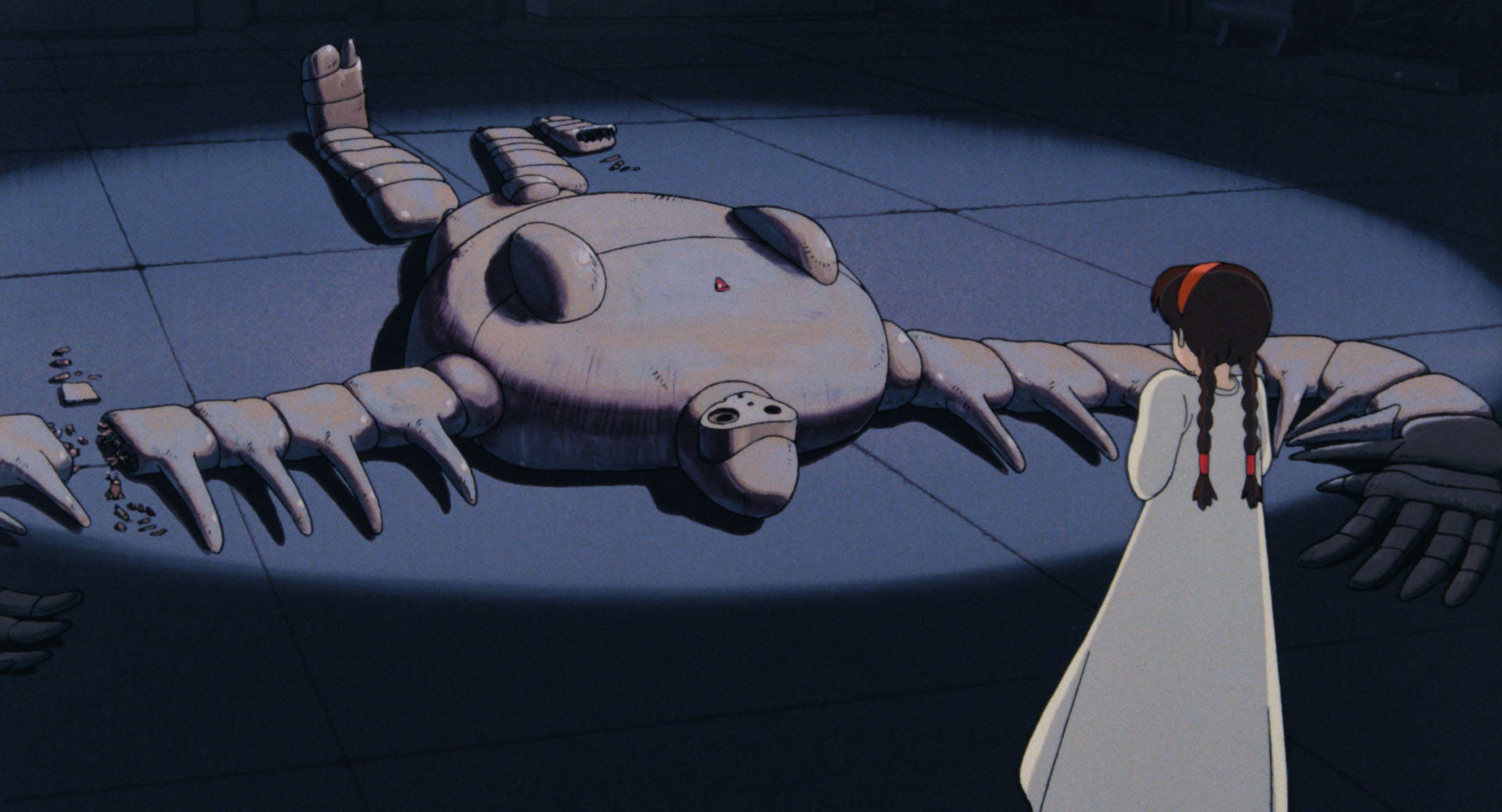
The robots make Laputa feel tragic rather than simply scary. The first robot the characters encounter is destructive because humans weaponise and provoke it. Later, the robot in the sky garden is tender, patient, and almost sacred. It cares for birds, tends the overgrown city, and places flowers on a grave.
Those scenes complicate the film’s technology theme. Miyazaki is not saying machines are bad. He is saying machines reflect the values of the people who build and command them. A robot can be a soldier, guardian, gardener, or mourner. The danger is not metal. The danger is the human appetite for domination.
The destruction spell and the film’s big warning
When Sheeta and Pazu use the destruction spell, they are not rejecting wonder. They are rejecting weaponised power. The spell breaks the military core of Laputa and sends the living tree upward, away from the machinery of control. That image matters: the destructive systems fall, while the natural, rooted, living part survives.
The ending does not say civilisation should avoid invention. It says invention must be separated from conquest. Laputa’s final form, a great tree floating into the sky, is one of Studio Ghibli’s clearest images of nature outlasting empire.
This is why Castle in the Sky sits so comfortably beside later Ghibli films with environmental and anti-war themes. If you like this side of the film, Princess Mononoke is a natural next step, while Spirited Away explores a more dreamlike kind of moral world.
Why Pazu is the right partner for Sheeta
Pazu does not help Sheeta because she is royal, valuable, or useful. He helps her because she is a person in danger. That makes him the opposite of almost every adult institution chasing the crystal. His dream of finding Laputa is personal and hopeful, tied to his father’s memory, but he gives up possession when possession becomes harmful.
Their partnership is built on mutual courage. Sheeta brings history, instinct, and moral clarity. Pazu brings loyalty, practical bravery, and faith that the impossible can be reached. Together they turn a treasure hunt into a choice about what should be preserved and what must be let go.
Where Castle in the Sky fits in a Ghibli watch order
Castle in the Sky is one of the best early watches for viewers who want classic adventure. It has chases, pirates, flying machines, ancient ruins, comedy, danger, and a huge emotional payoff. It is also a good bridge between gentler first watches and heavier films because it introduces big Ghibli themes in an accessible shape.
For the spoiler-light story, main characters, age guidance, production context, ending, and official still gallery in one place, start with the complete Castle in the Sky movie guide.
For a beginner route, it pairs well after My Neighbor Totoro or Kiki’s Delivery Service, then before more intense films. Our Studio Ghibli movies in order guide can help you place it in a first-time marathon, and our watch guides cover practical viewing routes by mood and audience.
FAQ
Is Laputa good or evil?
Laputa is neither purely good nor purely evil. It is a civilisation with both beauty and destructive power. The film asks whether people can protect the beautiful parts without reviving the systems of domination.
What does Sheeta’s crystal do?
The crystal protects Sheeta, points the way to Laputa, and activates parts of the city’s ancient technology. Symbolically, it represents inherited power and the responsibility to decide how that power should be used.
Why do Sheeta and Pazu destroy Laputa?
They destroy the military and control systems because Muska is about to use them as a weapon. The living tree survives, which shows that they are not rejecting nature, memory, or wonder.
Is Castle in the Sky connected to other Studio Ghibli movies?
It is not a direct sequel or prequel to another Ghibli film, but it shares major themes with many of them: flight, environmental respect, anti-war politics, childhood courage, and suspicion of greedy power.
Image note: official Studio Ghibli still used from ghibli.jp, where the studio provides images with a common-sense usage notice.