The Wind Rises quick facts
- Japanese title: Kaze Tachinu
- Japanese release: 20 July 2013
- Director and screenplay: Hayao Miyazaki
- Producer: Toshio Suzuki
- Music: Joe Hisaishi
- Running time: about 126 minutes
- Setting: Japan from the 1910s into the 1930s, with dream sequences beyond ordinary time
- Inspired by: aircraft designer Jiro Horikoshi’s life, blended with fictional characters and ideas associated with Tatsuo Hori’s novel The Wind Has Risen
- Best for: teens and adults interested in aviation, creative ambition, history, romance and difficult questions about responsibility
Spoiler-free answer: The Wind Rises is Hayao Miyazaki’s fictionalised portrait of Jiro Horikoshi, a boy who cannot become a pilot but devotes his life to designing aircraft. His dream of beautiful flight carries him through earthquake, economic hardship, engineering failure, love and a country moving toward war. The film admires craft without pretending that a designer controls how the world will use it.
Spoiler-free overview
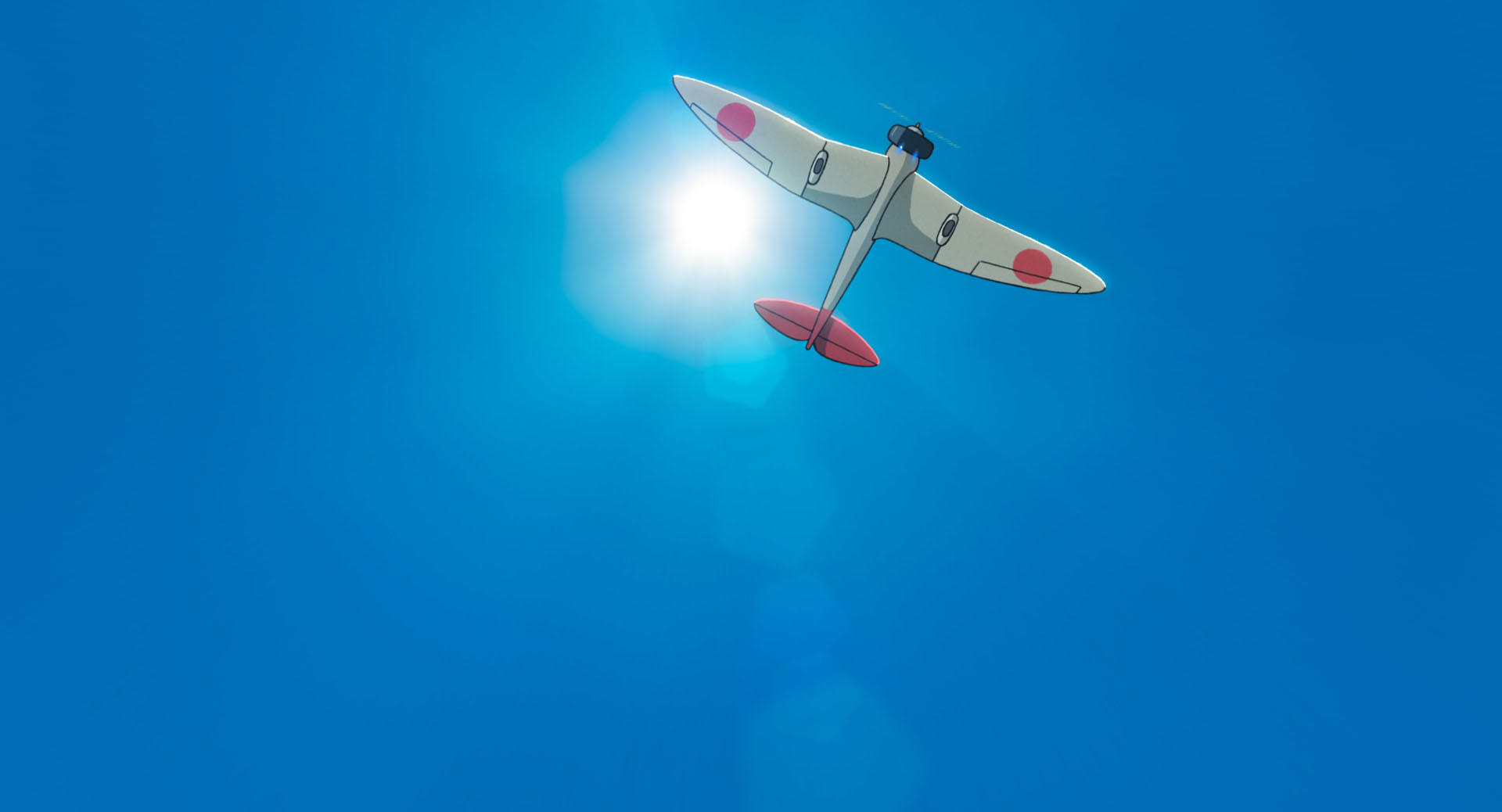
This is one of Studio Ghibli’s most adult and historically grounded features. Its fantasy appears mainly in dreams, where Jiro meets the Italian aviation pioneer Giovanni Battista Caproni and walks across impossible wings. Everyday scenes are built from drafting tables, slide rules, train journeys, cigarettes, hotel terraces and the sound of wind moving through grass. The result is less an adventure than a life observed through work and memory.
Jiro is fascinated by aircraft from childhood, but his poor eyesight rules out becoming a pilot. Design becomes his route into the sky. The film follows the discipline behind that choice: study, repeated failure, attention to tiny improvements and collaboration with engineers who must make ambitious ideas survive real materials and limited resources.
A second thread follows Jiro’s relationship with Nahoko Satomi. Their connection begins amid disaster and returns years later at a mountain hotel. Nahoko’s serious illness gives their love a limited horizon. The romance is tender, but the film never uses it to cancel the harder questions around Jiro’s work or the history gathering outside their private happiness.
Choose this after Porco Rosso if you want another Miyazaki film about aviation and compromised idealists, or after From Up on Poppy Hill for another grounded story shaped by twentieth-century Japan. It is heavier and more morally unsettled than either.
Storyline: what happens in The Wind Rises?
The rest of this section contains major plot spoilers.
As a child, Jiro dreams of climbing onto the roof of his family home and flying a small aircraft. The dream turns threatening when a vast war machine appears. He then meets Caproni in a shared imaginative space. Caproni tells him that eyesight need not end his relationship with flight: he can build planes rather than pilot them. The encounter gives Jiro a vocation and gives the film a recurring place where beauty can be discussed apart from ordinary chronology.
Years later, Jiro travels by train to study aeronautical engineering. The Great Kanto Earthquake strikes in 1923. The ground rolls, the train stops and fires spread through the city. Jiro helps a young woman, Nahoko, and her injured maid reach safety, giving away his slide rule as a splint. He leaves before names can be properly exchanged. Their first meeting links care and catastrophe before romance has even begun.
Jiro studies with his friend Honjo and eventually joins an aircraft manufacturer. Japan’s aviation industry is trying to catch up with European designs while working under material and economic limits. Jiro is inventive, observant and absorbed by technical problems. A major design fails during testing, reminding him that elegance on paper is not enough. Aircraft have weight, stress and pilots whose lives depend on decisions made at a desk.
Jiro and Honjo travel to Germany to study aviation technology. The journey shows technical achievement beside political intimidation and social unease. Jiro’s dream meetings with Caproni continue, but they become less innocent. Caproni speaks of a creator’s productive years as finite and asks whether Jiro will choose a world with pyramids or a world without them: a deliberately uncomfortable image for magnificent creations built at terrible human cost.
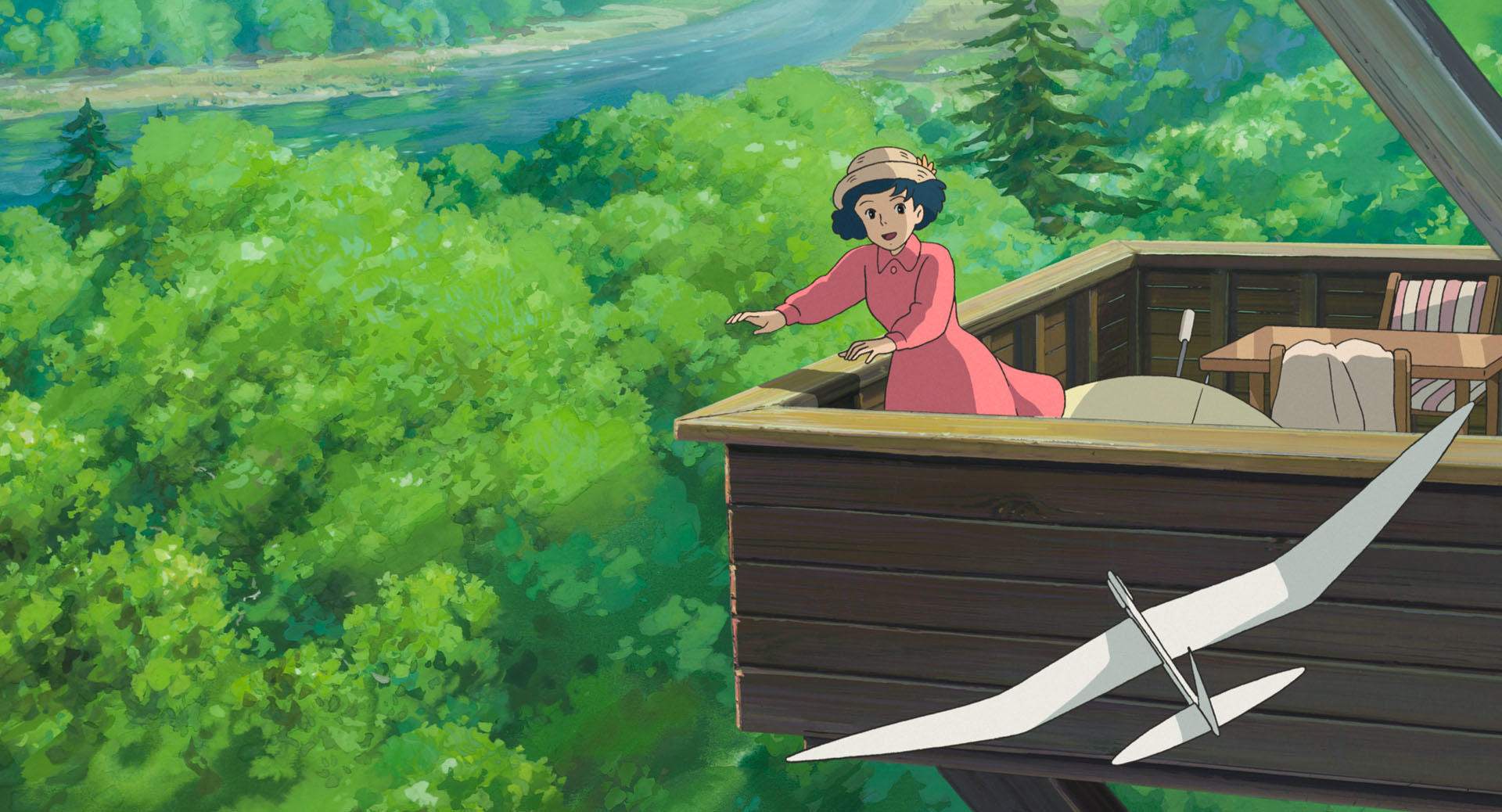
After professional disappointment, Jiro rests at a mountain hotel. He meets Nahoko again, now painting outdoors with her father nearby. A paper airplane helps reopen their connection. Their courtship takes place against beautiful weather and an awareness that Nahoko has tuberculosis. A mysterious German visitor, Castorp, also warns Jiro about the political direction of the country, adding an outsider’s unease to the resort’s temporary calm.
Jiro proposes, but Nahoko insists that they should wait until she is well enough to marry. Her illness worsens and she enters a mountain sanatorium. At work, Jiro develops a more promising aircraft design while pressure around him increases. He is watched by authorities and temporarily sheltered by his manager, Kurokawa. The professional system needs his skill even as the political system becomes more dangerous.
Nahoko leaves the sanatorium to be with Jiro. Kurokawa and his wife help the couple marry privately. Their shared home is modest, and Jiro often continues drawing beside Nahoko. These scenes are loving and painful because both understand that time is short. The film does not present devotion as a cure. Nahoko supports Jiro’s work, but her illness continues regardless of how sincerely they love each other.
Jiro’s new prototype succeeds in flight testing. While he is away, Nahoko quietly decides to return to the sanatorium. She does not want Jiro’s last memory to be only her final decline, though her choice also means facing death away from him. Jiro senses her departure during the successful test. Triumph and loss occur together, making it impossible to read the achievement as uncomplicated victory.
In the final dream landscape, the sky has become a field of wreckage. Jiro tells Caproni that none of the aircraft returned. The image looks beyond one successful prototype toward war and destruction. Nahoko appears as a loving memory and urges Jiro to live. The ending offers neither acquittal nor total condemnation. Jiro must continue after love, work and history have all revealed their cost.
Main characters
Jiro Horikoshi
Jiro is quiet, technically gifted and capable of intense concentration. He notices airflow, fasteners, curves and structural weight, but can become less attentive to the human world immediately around him. The film’s central tension lives inside that focus: disciplined craft can produce beauty while narrowing the creator’s view of consequences.
Nahoko Satomi
Nahoko is the film’s fictional romantic centre. She first meets Jiro during the earthquake, later reconnects with him at the mountain hotel and chooses a brief married life despite tuberculosis. She is not simply a tragic reward for the hero. Her choices shape the time they have, including the painful decision to leave on her own terms.
Giovanni Battista Caproni
Caproni is based on the Italian aircraft designer but functions mainly as Jiro’s dream mentor. He gives language to the pleasure of invention and to the uncomfortable bargain surrounding it. Because he appears in dreams, he can encourage, question and challenge Jiro without becoming a literal judge.
Honjo
Honjo is Jiro’s friend and fellow engineer. He is practical, sharp and more openly frustrated by industrial limitations. Their conversations show engineering as collective labour rather than one solitary genius producing a finished aircraft from inspiration alone.
Kurokawa and Mrs Kurokawa
Kurokawa is Jiro’s demanding supervisor, later also his protector and witness at the marriage. His apparent severity sits beside real loyalty. Mrs Kurokawa helps Nahoko prepare for the ceremony and gives the couple humane support inside a story crowded by institutions and historical pressure.
Castorp
The German visitor at the mountain hotel speaks with unusual bluntness about militarism and danger. He is less a conventional subplot character than a warning from beyond Jiro’s professional bubble, connecting the peaceful resort to events developing across Europe and Japan.
Themes, meaning and interpretation
Can beauty be separated from use?
Jiro experiences aircraft as elegant solutions to problems of air and structure. History experiences military aircraft as weapons. The film refuses the easy answer that beauty makes the work innocent, but it also refuses to depict the act of designing as emotionally empty. Its discomfort comes from holding admiration and consequence in the same frame.
The creator’s limited field of vision
Jiro’s eyesight prevents him from flying, but the deeper limitation is selective attention. He can see minute technical possibilities while political and personal realities sit at the edge of the drawing board. This does not make him a cartoon villain. It makes him a troubling study of how talent, institutions and obsession can narrow moral awareness.
The wind as change
Wind connects paper planes, aircraft, illness, earthquake fires, chance meetings and dream landscapes. It cannot be held still. The title’s invitation to live suggests action despite instability, not confidence that life will become safe. Jiro and Nahoko build meaning inside conditions neither can control.
Love does not defeat mortality
Nahoko and Jiro’s marriage matters because it is temporary, not because the film grants a miracle. Their happiness is real and their choices can still be questioned. The story treats love as attention, shelter and time shared under pressure rather than a magical cure for tuberculosis or history.
Dreams inside compromised systems
Jiro does not design in isolation. Companies, military requirements, government pressure and national ambition shape the available work. The film asks what responsibility remains when a gifted person serves a system larger than himself. It offers no neat formula, but it does not let technical fascination erase the question.
Age suitability and content guidance
The Wind Rises is not especially graphic, but it is mature in pace, history and emotional weight. The earthquake sequence is intense: the ground moves violently, buildings collapse, crowds panic and a city burns. Aircraft fail in tests. War is discussed and its eventual devastation hangs over the ending, though sustained battlefield combat is not the film’s focus.
Families should also expect terminal illness, tuberculosis, grief, a young woman leaving to die, political intimidation and frequent period-accurate smoking. The romance is gentle, with no explicit sexual content. Younger children may be bored by engineering meetings and confused by the blend of biography, fiction and dreams. Many teens can handle the content, especially with context about history and the ethical questions. Check the current classification in your territory because ratings vary.
Production, history and release context
Studio Ghibli’s official works page lists a Japanese release date of 20 July 2013 and a running time of approximately 126 minutes. Hayao Miyazaki wrote and directed the film, Toshio Suzuki produced it, and Joe Hisaishi composed the music. The Japanese title is Kaze Tachinu.
The film is not a documentary biography. It uses Jiro Horikoshi, the real aircraft engineer associated with major Mitsubishi fighter designs, as the foundation for a fictionalised character. It combines that life with a romance and literary echoes connected to Tatsuo Hori. Viewers should not treat every conversation, relationship or timeline detail as a verified historical event.
That blend is deliberate. It lets Miyazaki address a personal fascination with flight while confronting the military history attached to aircraft design. The dream sequences make technical imagination visible; the earthquake, surveillance, illness and final wreckage prevent imagination from floating free of consequence.
Where to watch legally
Streaming, rental and disc rights vary by country and change over time. Use the site’s Studio Ghibli streaming guide as a starting point, then confirm The Wind Rises in your local authorised catalogue. This page does not claim one worldwide service because regional availability can differ.
Official image gallery
Related films and guides
Continue with Porco Rosso for aviation, regret and anti-fascist melancholy; Castle in the Sky for a more adventurous argument about technology and power; or From Up on Poppy Hill for another grounded historical drama. The dedicated ending explanation explores the final dream sequence in more detail.
Frequently asked questions
Is The Wind Rises based on a true story?
It is a fictionalised film inspired by real aircraft designer Jiro Horikoshi. It combines historical settings and engineering work with invented dialogue, dream sequences and a fictional romantic story. It should not be used as a documentary record.
What aircraft does Jiro design?
The film follows designs leading toward the Mitsubishi A5M and places Jiro’s work in the historical shadow of the A6M Zero. Its main concern is not a technical catalogue but the relationship between beautiful engineering and military use.
Is Nahoko a real person?
Nahoko is a fictional character rather than a straightforward portrait of Horikoshi’s real-life partner. Her story helps the film connect love, illness and limited time with Jiro’s consuming professional dream.
What does Caproni represent?
Caproni represents inspiration, mentorship and the creator’s uneasy bargain with history. In the dream world, he can celebrate flight while asking questions about what magnificent machines cost and what they become after leaving the designer’s hands.
Why does Nahoko leave?
She returns to the sanatorium as her tuberculosis worsens. The film presents the choice as an attempt to protect the memory of their shared happiness and to face her final decline on her own terms.
Is The Wind Rises anti-war?
The film clearly presents war as destructive and ends with the loss attached to military aviation. Its method is deliberately uncomfortable because it also shows genuine admiration for aircraft design. That tension is the subject, not evidence that consequences have been forgotten.
Is it suitable for children?
Older children and teens may appreciate it with historical context. Very young viewers may find the adult pace, illness, earthquake, smoking and engineering dialogue difficult or upsetting.
How long is The Wind Rises?
Studio Ghibli’s official page lists a running time of approximately 126 minutes.
Official film stills are credited to Studio Ghibli and used under its common-sense image-use notice.