Quick answer: Nausicaä is the princess of the Valley of the Wind, but her real power is not royal status. She is memorable because she listens before she fights, treats insects and enemies as living beings, and keeps choosing compassion even when fear would be easier. Her character turns Nausicaä of the Valley of the Wind into one of Studio Ghibli’s clearest stories about courage, ecology and moral imagination.
Who is Nausicaä?
Nausicaä is the young leader of a small wind-protected valley in a world damaged by war, poison and ecological collapse. Around her, kingdoms fight over old weapons and fear the spreading Toxic Jungle. She grows up inside that danger, but she does not respond to it with simple hatred. She studies spores, insects, air currents and the behaviour of the giant Ohmu because she wants to understand the world before judging it.
That curiosity is the foundation of her heroism. Nausicaä is brave in battle, but the film makes clear that her deepest strength is attention. She notices what other people dismiss as monstrous. She asks why creatures attack, what the jungle is doing, and whether humans have misunderstood the very system that might save them.
Why Nausicaä is different from a typical warrior princess
Nausicaä can fly, fight and lead, so it would be easy to describe her as an action heroine. That is true, but incomplete. She is different because violence is never her preferred proof of strength. She fights when people are threatened, yet the film keeps returning to her refusal to reduce enemies to targets.
Her courage is most visible when she steps between opposing forces. She stands between humans and insects, between panic and understanding, between revenge and restraint. In many fantasy stories, the hero wins by destroying the threatening creature. Nausicaä wins trust by recognising that the creature has its own pain, logic and place in the world.
Nausicaä and the Ohmu
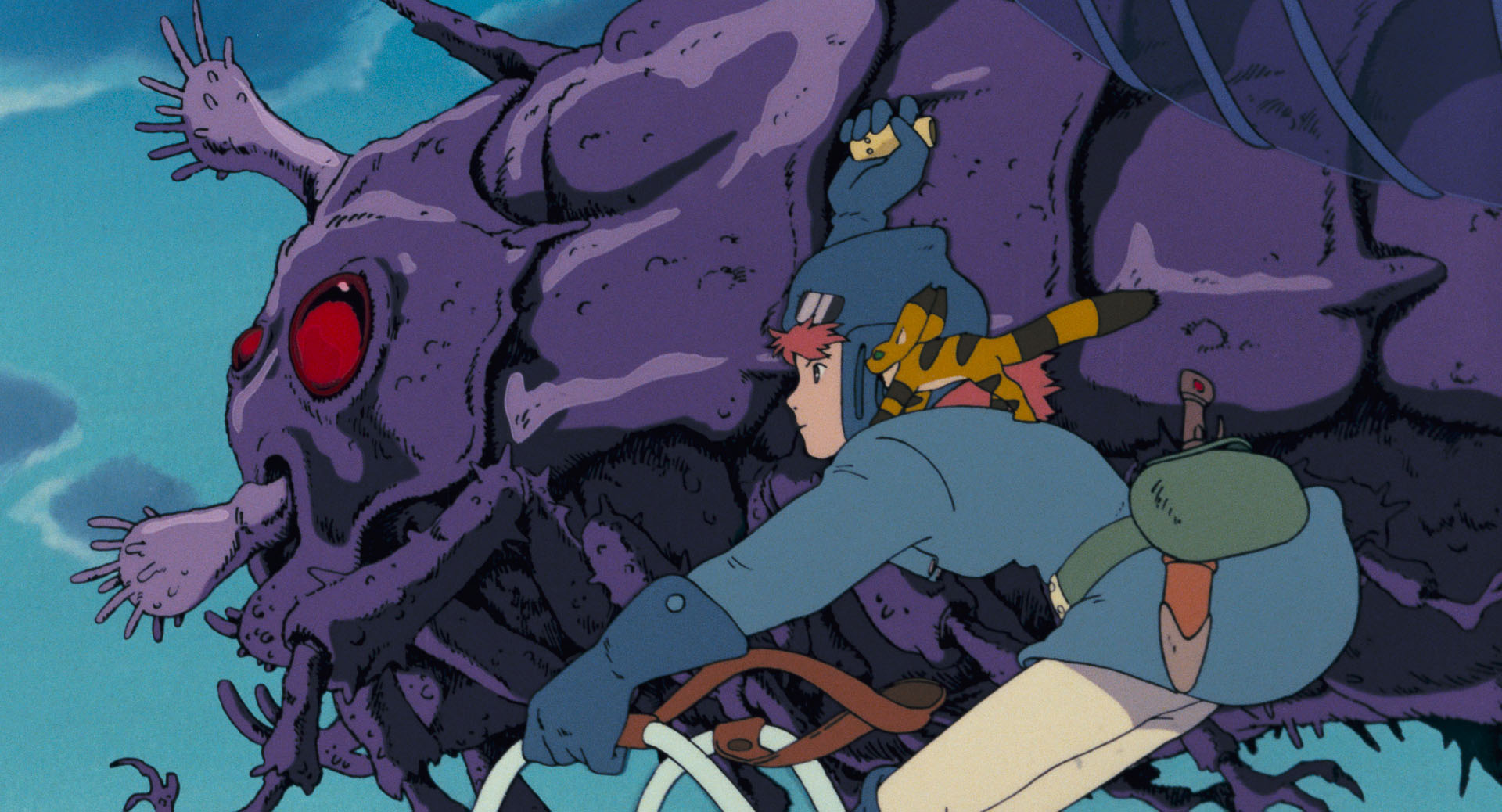
The Ohmu are terrifying at first glance: huge armoured insects with glowing eyes and enough power to crush armies. Most people in the film treat them as a disaster waiting to happen. Nausicaä sees something else. She recognises intelligence, memory and emotion in them. She understands that their rage is often a response to human cruelty or fear.
This relationship is central to the film’s meaning. Nausicaä does not “tame” the Ohmu in a cute animal-companion way. She respects them. She risks herself because she believes communication is possible across a boundary that everyone else treats as absolute. That makes her one of the best examples of Ghibli’s recurring belief that nature is not a backdrop. It is alive, wounded and morally serious.
Compassion as active courage
Nausicaä’s compassion is sometimes mistaken for gentleness alone. The film is sharper than that. Her compassion is active, costly and often dangerous. She keeps caring when grief and anger push her toward revenge. She keeps asking questions when the adults around her want easy answers. She keeps protecting life even when that choice makes her vulnerable.
That is why her character still feels powerful decades later. The story does not suggest that kindness is naive. It suggests that kindness without courage is too weak, and courage without kindness becomes destructive. Nausicaä holds both together better than almost anyone around her.
Her anger matters too
Nausicaä is not a flawless saint. One of the most important parts of her character is that she can be overwhelmed by rage. When violence reaches her own home, she briefly becomes exactly what she fears: someone ready to strike back without seeing clearly. The film does not erase that moment. It uses it to make her compassion more believable.
Real mercy matters only when hatred is possible. Nausicaä’s goodness is not innocence untouched by pain. It is a decision she has to recover after pain nearly breaks her. That makes her a stronger character than a simple symbol of purity.
Nausicaä and environmental storytelling
If you are reading the film through the lens of Studio Ghibli’s nature and environmental themes, Nausicaä is essential. She is the character who understands that the poisonous jungle may not be evil in the way humans assume. The world is damaged, but it is also trying to process that damage through systems people do not yet understand.
This gives the film a more complex ecological message than “nature good, humans bad.” Humans have caused enormous harm, but they are still part of the world and still capable of repair. Nausicaä’s gift is that she refuses both despair and domination. She looks for relationship instead.
How Nausicaä compares with later Ghibli heroines
Nausicaä stands at the beginning of many character patterns that later Ghibli films develop in different ways. Like Chihiro, she grows through responsibility. Like San in Princess Mononoke, she lives close to a wounded natural world. Like Kiki, she has a gift that depends on confidence, discipline and purpose. But Nausicaä is more openly political and mythic than many later leads.
She is not only figuring out who she is. She is trying to prevent societies from destroying each other because they cannot imagine a shared future. That larger scale is part of why the film still feels urgent. Nausicaä’s personal virtues become public leadership.
Why Nausicaä is still a fan favourite
Nausicaä remains beloved because she combines softness and steel. She can be tender with a frightened creature, technically skilled in the air, furious in grief, calm under pressure and stubborn in the face of authority. None of those qualities cancels out the others. Together, they make her feel unusually complete.
She also offers a kind of heroism that feels rare in fantasy. She is not trying to be chosen, crowned or proven superior. She is trying to understand enough to stop needless suffering. That makes her a useful first stop for viewers exploring the Nausicaä movie guide or planning a wider Studio Ghibli watch order.
What Nausicaä represents
Nausicaä represents moral courage in a frightened world. She shows that understanding is not passivity, that empathy can be strategic, and that protecting life sometimes requires standing in the path of everyone else’s fear. Her character asks a hard question: what would leadership look like if it began with listening?
That question is why she still matters. The film’s creatures, aircraft and ruined landscapes are unforgettable, but Nausicaä gives them emotional direction. She is the person who sees a broken world and refuses to treat brokenness as permission to stop caring.
FAQ about Nausicaä
Is Nausicaä a Studio Ghibli character?
Yes, she is central to Nausicaä of the Valley of the Wind. The film was released before Studio Ghibli was formally founded, but it is normally included in Ghibli collections and history because of its creators, style and importance.
What makes Nausicaä powerful?
Her power comes from courage, observation, empathy and leadership. She can fight and fly, but her defining strength is understanding living systems that others fear.
Is Nausicaä similar to Princess Mononoke?
There are strong thematic links, especially around nature, violence and human responsibility. Nausicaä is more mediator-scientist, while San is more wounded outsider and defender of the forest.
What should I read next?
Try the guide to Studio Ghibli creatures and spirits, the nature-themed movie guide, or the full Nausicaä of the Valley of the Wind guide.
Image credit: Official stills from Studio Ghibli’s Nausicaä of the Valley of the Wind works page, used under the studio’s common-sense image-use notice. This article is an independent fan guide and is not affiliated with Studio Ghibli.