The Secret World of Arrietty quick facts
- Japanese title: Karigurashi no Arrietty (often translated as Arrietty the Borrower)
- Japanese release: 17 July 2010
- Director: Hiromasa Yonebayashi
- Planning and screenplay: Hayao Miyazaki
- Screenplay: Keiko Niwa
- Based on: Mary Norton’s The Borrowers
- Producer: Toshio Suzuki
- Music and theme song: Cécile Corbel
- Running time: about 94 minutes
- Best for: families and viewers who want a gentle miniature-world adventure with suspense, friendship and a bittersweet ending
Spoiler-free answer: The Secret World of Arrietty follows a tiny Borrower girl who lives with her parents beneath a country house. Her first borrowing expedition becomes dangerous when Shō, a human boy resting before medical treatment, sees her. Their careful friendship gives both children hope, but human attention threatens the family’s hidden home and forces Arrietty to decide what courage looks like when staying is no longer safe.

Spoiler-free overview
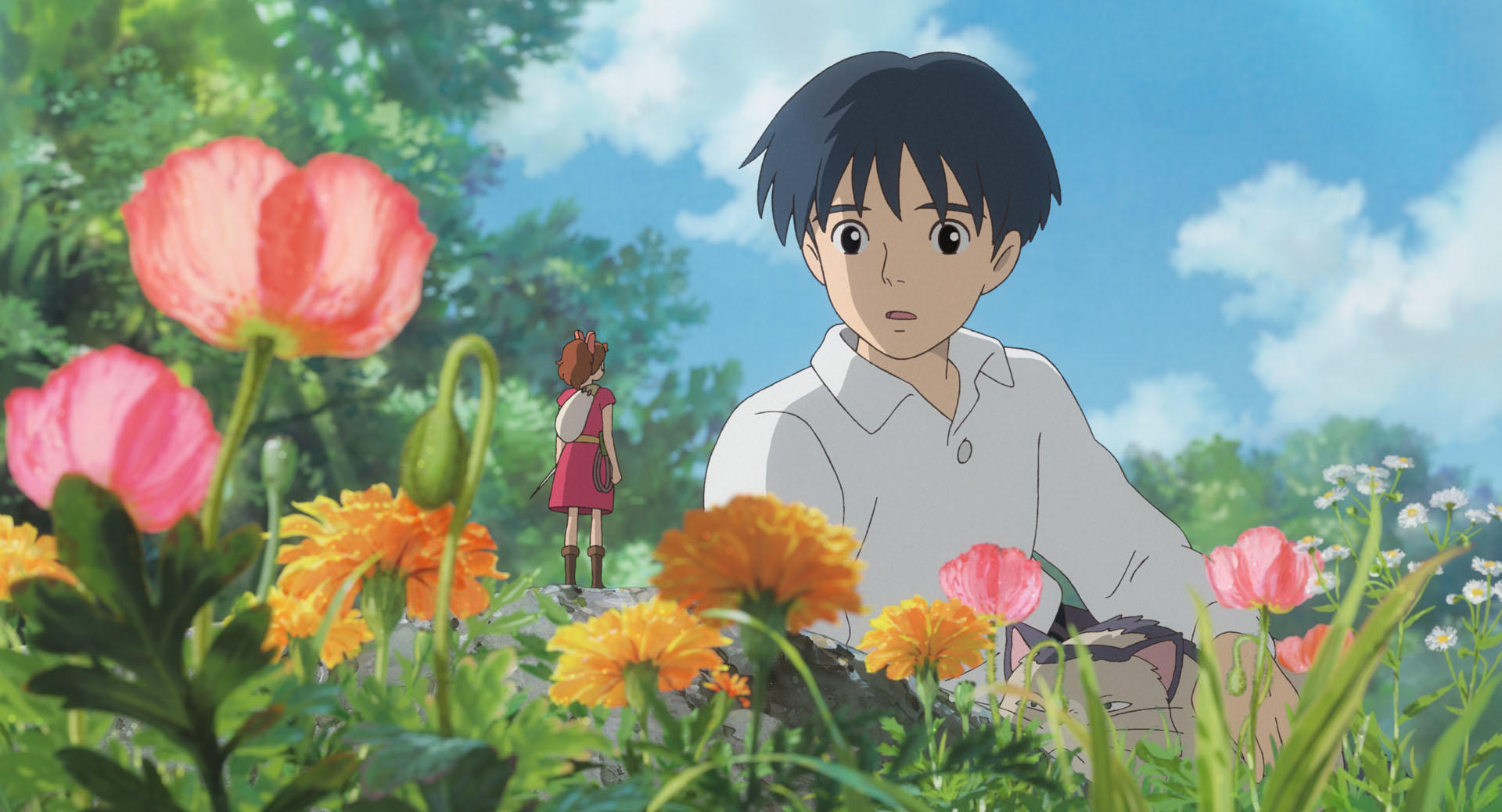
Arrietty is a quiet fantasy built from scale rather than spectacle. A pin becomes a sword, a sugar cube becomes a major prize and a journey across one room requires ropes, hooks and careful planning. The film asks viewers to look again at domestic spaces that usually disappear into the background. Floorboards become roads, walls contain hidden chambers and a garden is as immense as a forest.
The emotional scale is equally intimate. Arrietty wants the freedom to take part in her family’s work. Shō is isolated by illness and by adults making decisions around him. Their friendship begins across a boundary both understand could be dangerous. Neither child can simply solve the other’s life, but each gives the other evidence that loneliness is not the whole world.
This is not a film with a conventional monster or battle. Its tension comes from discovery, pursuit and the risk that one careless human action can destroy a tiny household. Haru, the housekeeper, becomes threatening because curiosity turns into control. Even sympathetic human help can be harmful when it ignores what the Borrowers say they need.
Choose Arrietty if you like the domestic warmth of My Neighbor Totoro, the growing independence of Kiki’s Delivery Service or the quieter emotional mystery of When Marnie Was There. It is more suspenseful than its gentle colours suggest, but far less intense than Princess Mononoke.
Storyline: what happens in The Secret World of Arrietty?
Shō arrives at the old house where his mother grew up. He is due to undergo an operation and has been sent to rest in the countryside with his great-aunt Sadako and the housekeeper Haru. Soon after arriving, he notices a tiny girl in the garden. She is Arrietty, a fourteen-year-old Borrower who lives secretly below the house with her parents, Pod and Homily.
The Borrowers survive by taking very small quantities of things humans are unlikely to miss. A cube of sugar, one tissue or a little food can support them for a long time. Their way of life depends on concealment. Pod is calm and methodical because every borrowing trip crosses a world built at the wrong scale. Homily’s anxiety can seem comic, but she understands that discovery may mean abandoning everything they have made.
Arrietty is thrilled when Pod decides she is ready for her first borrowing. They travel through the walls and into the human rooms using nails, ladders, string and improvised tools. Pod teaches her to observe before moving and to leave no sign behind. The expedition shows how competent the family is, but it also reveals Arrietty’s inexperience. In Shō’s room, she drops the sugar cube when she realises he is awake and watching her.
Shō tries to return the sugar. To him, the gesture is gentle. To the Borrowers, the carefully placed cube proves that their home has been found. Pod explains that being seen changes everything. Arrietty is frustrated because Shō does not appear cruel, yet the family’s rule comes from survival rather than prejudice. A kind human can attract a less kind one.
Arrietty meets Shō outside and tells him to leave her family alone. Their conversation is tense, then honest. Shō speaks bleakly about the Borrowers’ chances of survival and about his own uncertain future. Arrietty rejects the idea that being few or vulnerable makes a life meaningless. Her determination affects him, while his loneliness helps her see that human size does not guarantee security.
Shō discovers the family’s miniature kitchen and removes part of the floor so that he can replace it with a beautiful dollhouse kitchen made long ago for Borrowers. The gift is generous in intention but terrifying in effect. It opens the family’s private world without permission. Pod decides they must move. The film makes an important distinction here: affection does not cancel the consequences of intrusion.
Before they can leave, Pod returns from scouting with Spiller, a young Borrower who lives more independently outdoors. His presence proves that Arrietty’s family may not be the last of their kind. It also offers a practical route away from the house. The possibility is hopeful, but moving still means losing the home they built and the ordinary routines that made it theirs.
Haru has long suspected tiny people live in the house. She locks Shō in his room, removes the floor and captures Homily in a jar. She calls a pest-control company, treating the Borrowers as specimens or vermin rather than people. Arrietty goes to Shō because rescuing her mother now requires human-scale help.
Shō escapes and restores the house after Arrietty finds Homily. Haru’s proof disappears before the pest-control workers can confirm it. The rescue succeeds, but secrecy cannot be restored. The family leaves at night, travelling through the garden toward a waterway where Spiller has a small vessel.
Arrietty and Shō say goodbye. He gives her the sugar cube, now not as a lure but as a farewell she is free to accept. Arrietty gives him her hair clip. They cannot make their worlds safely overlap, yet the friendship changes how each faces uncertainty. Arrietty moves toward an unknown home with her family. Shō goes toward his operation carrying a stronger desire to live.
Main characters
Arrietty
Arrietty is curious, brave and impatient to be trusted. She loves her parents but does not want fear to define the size of her life. Her courage matures over the story. At first it means proving she can borrow; later it means protecting Homily, accepting the loss of home and carrying hope into a future she cannot see.
Shō
Shō is a quiet human boy preparing for heart surgery. Some English-language versions call him Shawn. His physical vulnerability allows him to recognise Arrietty’s fragility, but his help is not always harmless. The dollhouse kitchen shows how easily kindness becomes intrusion when the stronger person controls the terms.
Pod
Pod is Arrietty’s father and teacher. His restraint is not emotional distance. It is the discipline required to keep a tiny family alive in a human environment. He trusts Arrietty enough to train her, then makes the painful decision to move when concealment is lost.
Homily
Homily is expressive, anxious and deeply attached to home. Her fears are often played for warmth, but the plot repeatedly proves they have a rational basis. She represents the comfort of domestic life and the emotional cost of leaving it.
Haru
Haru is the housekeeper whose suspicion becomes a hunt. She is not a magical villain. Her danger comes from refusing to treat the Borrowers as people with rights to privacy and safety. Curiosity, entitlement and control are enough to make her frightening.
Spiller, Sadako and Niya
Spiller is a resourceful young Borrower who expands Arrietty’s sense of what survives beyond the house. Sadako is Shō’s great-aunt and is open to the family stories about little people. Niya, the cat, initially treats Arrietty as prey but later helps direct Shō toward her departure.
Themes, meaning and interpretation
Scale changes power, not personhood
The film’s miniature design is delightful, but scale is also political. Humans can expose a roof, move furniture or imprison Homily with one hand. The Borrowers’ tools, customs and family relationships show that physical smallness does not reduce the value of their lives.
Kind intentions can still cross boundaries
Shō wants to help, and the dollhouse kitchen is beautiful. Yet he opens a private home and chooses a solution before asking. The film does not punish him as cruel; it lets him learn that care requires listening. This makes the friendship more thoughtful than a simple story about a large hero saving tiny people.
Home is both shelter and something we carry
Homily’s kitchen and Arrietty’s room are assembled from borrowed fragments, but they are no less real as a home. Leaving is a genuine loss. At the same time, the family’s knowledge, habits and love travel with them. The ending balances grief for a particular place with hope that home can be rebuilt.
Vulnerability does not erase agency
Shō is ill and Arrietty’s community may be disappearing. Both could be described only by risk. Instead, their conversations challenge fatalism. Arrietty refuses to accept that small numbers make survival pointless. Shō discovers that uncertainty about his body does not mean he has stopped participating in life.
Growing up means entering risk
Arrietty’s first borrowing is a family milestone. Pod cannot make her capable by keeping her permanently safe. He teaches attention, restraint and responsibility, then allows experience to do the rest. Her coming of age includes not only adventure, but the ability to act when the old home and old rules are no longer enough.
Age suitability and content guidance
The Secret World of Arrietty is one of Studio Ghibli’s gentler family films, but it includes sustained suspense. A cat chases Arrietty, borrowing trips involve high drops and sharp objects, a crow crashes into a window, and Homily is captured inside a jar. Haru removes the family’s roof and calls pest control. The climax includes pursuit and the fear of permanent separation from home.
There is no graphic violence or gore. The more sensitive material is emotional: Shō discusses his heart condition and the possibility that he may not survive his operation, while the Borrowers fear extinction and are forced to leave their home. Younger children may need reassurance about illness, capture or whether the family finds safety. Ratings vary by country and release, so check the current local classification rather than relying on one territory’s label.
Production, adaptation and release context
Studio Ghibli’s official works page lists a Japanese release date of 17 July 2010 and a running time of approximately 94 minutes. Hiromasa Yonebayashi directed the film, with Hayao Miyazaki credited for planning and screenplay and Keiko Niwa also credited for the screenplay. Toshio Suzuki produced it, and Cécile Corbel composed the music and performed the theme song.
The story adapts Mary Norton’s 1952 novel The Borrowers, but relocates the hidden family into a Japanese country house and lets Ghibli’s attention to food, plants, tools and domestic labour shape the world. The adaptation keeps the central tension between a tiny household and curious humans while building its emotional centre around Arrietty and Shō.
This was Yonebayashi’s feature-directing debut. His staging repeatedly moves between human and Borrower viewpoints. Sound, distance and texture change with scale: footsteps become impacts, a room becomes a landscape and drops of water feel physically large. The technique makes the miniature world convincing without requiring lengthy explanations of how every object was constructed.
Where to watch legally
Streaming, rental and disc rights vary by country and change over time. Use the site’s Studio Ghibli streaming guide as a starting point, then search for the title in your local service or authorised retailer. Some regions list it as Arrietty, Arrietty the Borrower or The Secret World of Arrietty, so check alternate titles before assuming it is unavailable.
Official image gallery
Related films and guides
Continue with My Neighbor Totoro for another countryside story built around childhood uncertainty, Kiki’s Delivery Service for independence and confidence, or Whisper of the Heart for a grounded coming-of-age film about taking your first imperfect steps. Read the Arrietty characters guide or the dedicated ending explanation when you want deeper, spoiler-aware detail.
Frequently asked questions
Is The Secret World of Arrietty based on a book?
Yes. It adapts Mary Norton’s The Borrowers, the first novel in her series about tiny people who live secretly alongside humans and take small items to survive.
Are Arrietty and Shō in love?
The film presents an intense, tender connection, but it does not need to be reduced to a conventional romance. Their friendship is shaped by loneliness, limited time and the fact that their worlds cannot safely merge.
Why must the Borrowers leave?
Their home has been exposed. Even though Shō helps them, Haru captures Homily and calls pest control. Staying would mean accepting that humans now know exactly where and how they live.
Does Shō survive his operation?
The film does not show the operation or provide a later medical outcome. Its ending focuses on the hope Arrietty gives him and his renewed determination to live, not a guaranteed result.
Why does Shō give Arrietty the sugar cube?
Earlier, returning the sugar proves he has discovered her. At the farewell, Arrietty accepts it freely. The same object changes from an unwanted intervention into a mutual gift.
What is Arrietty’s age?
The film presents Arrietty as fourteen. She is old enough for her first borrowing expedition but still learning the discipline and consequences of her family’s hidden life.
Who directed The Secret World of Arrietty?
Hiromasa Yonebayashi directed it. The official Studio Ghibli page credits Hayao Miyazaki with planning and screenplay and Keiko Niwa with screenplay.
How long is The Secret World of Arrietty?
Studio Ghibli’s official works page lists the running time as approximately 94 minutes.
Official film stills are credited to Studio Ghibli and used under its common-sense image-use notice.